Elections in the United States

America on the ballot chooses the future. Barbed wire around the White House

Last rallies, at the polls a country deeply divided between Kamala Harris and Donald Trump. Few will decide who will be president. Riots are feared

from New York Marco Valsania and Luca Veronese

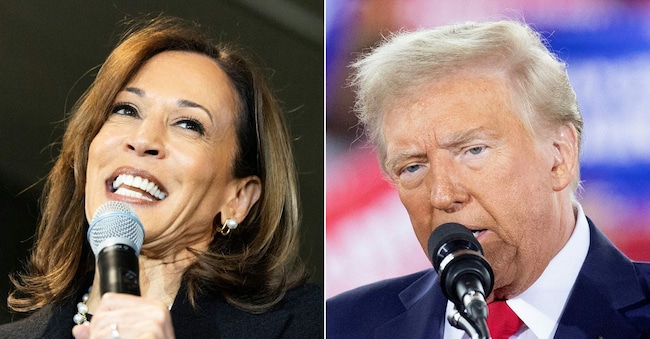
I due candidati. La democratica Kamala Harris e il repubblicano Donald Trump

4' min read

4' min read

What to watch out for on election night in the United States? On the map - also on the map that will be updated, as we go along, with exit polls and projections - mark Montgomery County, Pennsylvania: 800,000 inhabitants in all, north of Philadelphia

It will most likely be areas like this, unknown to most, that will decide who will be the next President of the United States. A few thousand votes in the swing states will make the difference, and those votes will come from the uncertain counties in the swing states.

Loading...

Head-to-head in the polls

.

An America deeply divided between Kamala Harris and Donald Trump goes to the polls in a climate of high tension, with extraordinary security measures (including new six-foot fences and barbed-wire barricades around the White House and the Capitol) and polls that never in the history of the country have shown such an open battle: all prisoners - after a campaign that was at times violent and vulgar - of tiny margins, fractions of a percentage point, included in the statistical error, and therefore useless to understand on the eve of the polls who will prevail.

According to the most accredited analyses: Harris starts with a historic endowment of 226 large voters, Trump already has 210 in his pocket. To win, under the American electoral system, one needs at least 270 out of 538. At stake, amidst last-minute surprises, are 93 large voters still to be assigned.

Loading...

The Contested States

.

The seven contested states - from the Midwest to the Southeast and Pennsylvania - are a microcosm of the country, and from their counties they can anticipate the final results: they have voters who are often still overwhelmingly white, without college degrees. Their landscape is made up of vast rural areas, but with an increasing presence of minorities and growth of urban suburbs. There's Montgomery, which won the Democrats in 2020 with a net gain of 40,000 votes over 2016, more than half the number it took Joe Biden to win the whole of Pennsylvania. Or Lackawanna, with the old industrial centre of Scranton, where Harris began his final day of campaigning yesterday before the final rally-concert in Philadelphia, where stars such as Lady Gaga and Oprah Winfrey arrived.

But here, in Michigan, there is also Wayne County, with Detroit and Dearborn, 38% black and home to the largest Arab community in the USA: 100,000 residents shaken by the war in Gaza. And even more so Kent, with Grand Rapids where Trump, following tradition, wanted to organise the closure of his campaign: an old conservative stronghold, it was among the three counties in the state to change political colour four years ago, passing from Trump to Biden. And then, in neighbouring Wisconsin, Dane County, with the university town of Madison courted by Harris. And Milwaukee with its three neighbouring counties, the Wow counties, on which Trump is counting.

"The two candidates have bombarded Pennsylvanians with posters in the streets, e-mails, videos on social media, TV spots. People here seem to be divided into groups that don't talk to each other,' says Kyle Rorhbaugh, a college student who lives near Norristown, Montgomery County, and is about to vote for the first time. "I go to university in Pittsburgh, a liberal city, but," Rorhbaugh adds, "once you get out of the inner city there are Trump posters everywhere you look, everyone here knows that the electoral challenge is very close.

Two Americas, the clash in the latest rallies

The two campaigns' messages, in the final sprint, became increasingly polarised. "I wouldn't mind if someone shot journalists," Trump said, reiterating his hatred for the media "who only spread fake news". The populist right-wing leader also said he should never have "left the White House" after his 2020 defeat. The Republican people are shouting Make America Great Again, and Trump is warming up his supporters by appealing to the fear of crime and immigrants, the social malaise exacerbated by years of inflation, and the unpopularity of outgoing Democratic President Biden. Yesterday Trump proposed new anti-immigrant tariffs: 25% against Mexico.

Harris responded by intensifying his criticism of Trump. 'He is a danger to democracy, he is not qualified to lead the country,' she insists. And she promises, if elected, to be 'the president of all Americans', to 'turn over a new leaf in order to overcome the rifts': appeals that have also convinced some moderate Republicans and conservative figures.

But America and its voters are divided: by income and education level, by gender and community of origin. Harris has tried to keep among minorities and especially to mobilise women - the majority of those who will vote - concerned about the drastic restrictions on abortion sought by the Republicans. Trump has targeted male voters, white and from the working classes and rural areas. However, he has also gone to great lengths (and the polls say with some success) to gain space among young people, Hispanics and African-Americans sensitive to his charisma. Nor are these rifts only reflected in the vote for the White House. Americans will also decide today the majority in Congress, hence what ability the new president will have to pass laws and set priorities for the country. The Republicans are the favourites: their reconquest of the Senate emerges in 91 scenarios out of the 100 simulated by the specialised website 538. Less clear is the situation in the House, where the Democrats win in 51 out of 100 cases.

The risks for the aftermath of the vote

.

In the nervous atmosphere of anticipation, fears of riots and violence are spreading, during and after the vote. Many states have alerted the National Guard and planned special police security measures at polling stations and election centres. In some cities there will be drones and snipers on rooftops. White supremacist groups and pro-Trump militias such as the Proud Boys are being monitored. Trump - according to the Democrats - would be ready to declare himself the winner with the polls still running: in case of doubtful data, or defeat, he could play the chaos card and then block the democratic process with hundreds of legal appeals. 'We are ready, we will know what to do,' Harris replied. The first results are expected a few hours after the polls close. But even here there is great uncertainty. No one can say how America will wake up after the vote.

Copyright reserved ©
Loading...

Brand connect

Loading...

Newsletter

Notizie e approfondimenti sugli avvenimenti politici, economici e finanziari.

Iscriviti