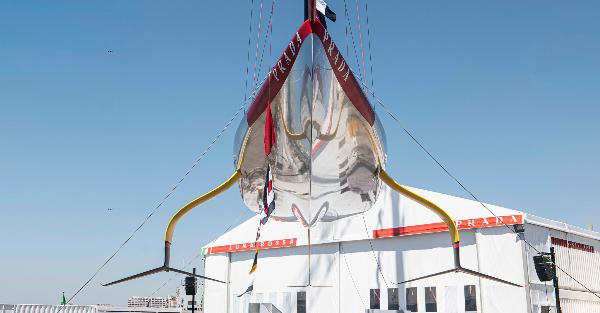
America's Cup: Luna Rossa is ready to cross the starting line
On 29 August, the dance of the flying hulls begins in Barcelona. All the pluses of a boat that is a concentrate of Made in Italy. Capable of exceeding 100 kilometres per hour.

6' min read
6' min read
"I want to win the America's Cup to give Italy a reason to be proud, and I want to win it with our ethical and sporting criteria, continuing the path started more than 20 years ago, which has created a generation of top international sailors capable of passing on their know-how to younger sailors, and ensure that the skills they have acquired can be passed on." When Luna Rossa crosses the starting line in the first race of the 37th America's Cup (in Barcelona, from 29 August to 21 October), Patrizio Bertelli's words will have to be borne in mind to understand the magnitude of a challenge that goes far beyond sporting competition. For 25 years, Luna Rossa has represented the national team of Italian sailing, the only boat capable of training millions of expert sailors at night, ready to discuss foils, cavitation, pitches, and ballasting at the bar. But behind this amazing hull (now flying) there is more, there is an entire Italian system and the long-term vision of its owner, who has always refused shortcuts and is in no hurry to reach the finish line. As long as he cuts it on his own terms.
The meeting between the America's Cup and Bertelli was inevitable: passionate about sailing and the history of navigation, as well as a collector of vintage and classic boats (which he personally restores and helms in dedicated regattas), the Prada Group chairman and executive director could not resist the allure of the oldest trophy in the history of the sport (42 years older than the modern Olympics). So, when in 1997 he decided to embark on the American Cup adventure (running the 2000 edition in Auckland), nobody was surprised. Rather, the novelty lay in the old-style approach of the then Prada Challenge, which was carried out personally, without the string of sponsors that had accompanied the first Italian campaign (Azzurra, 1983). A solitary enterprise, costing 100 million lire, in the footsteps of the memorable challenges of Sir Thomas Lipton, who between 1899 and 1930 tried five times to engrave his name on the silver 'jug' (without ever succeeding).
The 2000 debut was an incredible success and not only in sporting terms (the Italian boat reached the final against the New Zealanders): while the "Silver Bullet" nailed millions of Italians in front of the TV in the unlikely night-time hours of the New Zealand regattas, the thin red line that characterised the boat and the crew uniforms (with a minimal look, but made with avant-garde materials and methods such as nylon and heat-sealing) became one of the most recognisable logos in fashion, making Luna Rossa the new sailing icon. The Auckland edition marked the beginning of a long affair between Luna Rossa and the America's Cup, which lasts uninterrupted to this day (only in 2017 did Bertelli decide not to participate, in contrast to the then Defender Oracle).
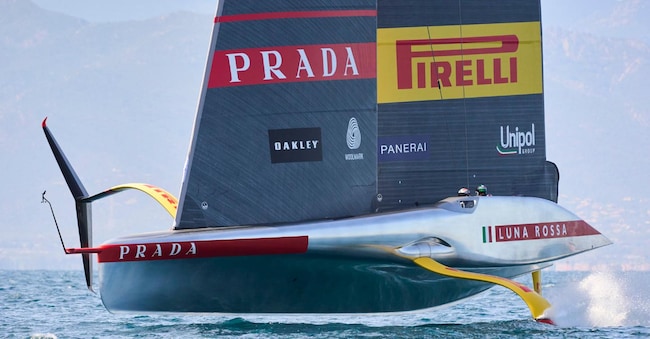
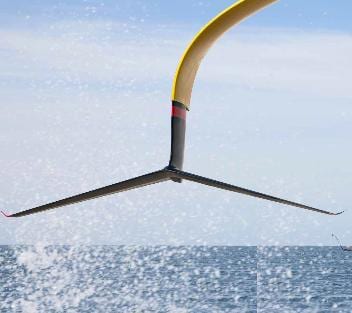
In the meantime, the America's Cup has evolved and, in a sudden change of gear, has gone from the slow displacement boats of the 2007 Valencian edition to the AC75 foiling monohulls of 2021: a Copernican revolution that has taken place in just 14 years. Capable of rising on foils and exceeding the speed of a hydrofoil (over 100 kilometres per hour), today's boats (20.7 metres long) are made of carbon, titanium and steel, and are no longer born on the drawing board but on the computer, the result of brainstorming involving designers, engineers, fluid and hydrodynamics experts, mechatronics and sailmakers. The team grows to make room for those who know how to manage and programme simulators, Artificial Intelligence, analytical software, telemetry, and costs rise accordingly. In a short time, Luna Rossa has turned into a sports company of 140 people that has to be run like a business.
After the 2007 experiment (when, for the first time, the Alice and Tim brands appeared on the sails of the Luna Rossa), for the 2021 challenge Prada decided to open up to selected partners, internationally recognised as ambassadors of Italian-made products in the world, capable not only of supporting the challenge financially, but also of concretely sharing its values, message and ethics. A number of famous companies, mainly Italian, accepted the invitation, attracted by a name that, beyond the sporting outcome (Luna Rossa came very close to lifting the Cup, closer than any other Italian team, but has not yet succeeded), was nevertheless a winner because it had achieved an objective that none of the previous Italian teams had ever set itself: to create a legacy, developing over the years a team of young talent, able not only to bring immediate benefits to the team, but also to reshape the national landscape of the sport, helping to shape future generations.