
Amid the climate crisis and the push for reuse, the World Congress of Architects is rethinking the future
A discussion in Barcelona on the challenges facing contemporary architecture: the transformation of existing buildings, sustainability, living, materials and the role of the architect. The focus is on Les Tres Xemeneies, a former industrial power station that is a symbol of the city

Key points
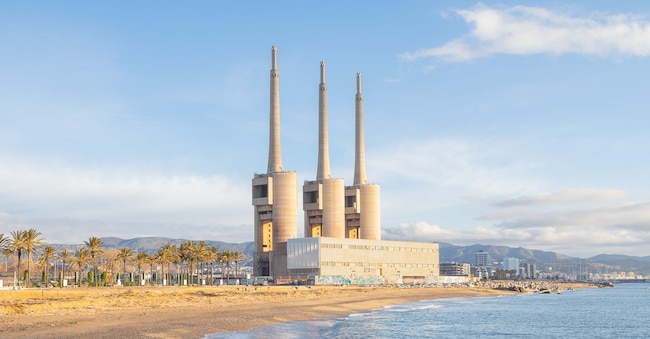
The three chimneys of Sant’Adrià de Besòs are not merely the backdrop for the opening of the 2026 UIA World Congress of Architects. They are a visual embodiment of the themes that Barcelona is bringing to the international stage in the year it is World Capital of Architecture. A former power station on the city’s seafront, not far from the area that hosted the Forum of Cultures in 2004, this large disused industrial site is now a temporary venue for exhibitions, forums and experimental projects. It will soon be home to Catalunya Media City, a technological, audiovisual and digital hub. It is a place that immediately illustrates what the discipline is now called upon to address: transforming the existing, working with material legacies, finding new uses for spaces in limbo, and imagining possibilities before they become concrete plans. In this transitional phase, prior to its transformation into a centre for digital and audiovisual culture, Les Tres Xemeneies becomes a threshold. Not only between the industrial past and the new urban economy, but between two ways of understanding design: on the one hand, architecture as the production of objects; on the other, as the capacity to open up new scenarios, to reconcile conflicts, long-term perspectives and urgent needs.
The World Congress of Architects returns to Barcelona
It is here that Barcelona has launched the 29th World Congress of Architects of the International Union of Architects, scheduled to take place from 28 June to 2 July 2026. The city is once again hosting the event after thirty years, and is doing so in the year in which it is, in fact, the UNESCO-UIA World Capital of Architecture. The figures give an idea of the scale of the event: around 10,000 professionals, students and institutional representatives are expected from over 130 countries, with more than 250 international speakers and over 40 sessions, including plenary sessions, debates, workshops, forums, awards ceremonies and public events. The main venues are the CCIB, Les Tres Xemeneies and the Disseny Hub Barcelona, with some events also taking place at the renovated Sagrada Família. The main exhibition occupies 4,000 square metres in the turbine hall of the former power station and will remain open to the public until 19 July.
Becoming: designing within the transition
The chosen title, *Becoming. Architectures for a planet in transition*, does not point to a single direction. Rather, it proposes a condition: design within transition. Not an architecture that arrives after the problem has arisen to solve it, but a discipline that recognises it is part of the processes that have led to environmental crisis, housing pressure, regional inequalities, resource consumption and urban fragility.
On the opening night, Regina Gonthier, president of the UIA, pointed out that today’s challenges cannot be tackled using “the approaches of the past”. Marta Vall-llossera, president of the CSCAE and of the Congress, spoke of Barcelona as a “global meeting point” for sharing knowledge and devising joint responses. Mayor Jaume Collboni described the city as a “living laboratory for the cities of tomorrow. Architecture gives shape not only to buildings, but to people’s opportunities’, whilst Iñaqui Carnicero, Secretary-General of the Spanish Government’s Urban Agenda, Housing and Architecture Department, highlighted the discipline’s capacity to ‘transform uncertainty into possibility’. More specifically, he spoke of “an invitation to understand architecture as a living promise: that in a changing world we can still create the conditions for care, justice, beauty and a sense of belonging. Architecture is not just what we leave behind, but also what we make possible for others”.
Beyond anthropocentrism: a new vision of the city
The conference begins by challenging anthropocentrism. The city is no longer viewed as a machine built for human beings and at the expense of the environment, but as part of ecological systems in which soil, water, the atmosphere, animals, plants, microorganisms, infrastructure and materials interact. The result is a re-examination of the discipline’s vocabulary: the Vitruvian triad of firmitas, utilitas and venustas is complemented by a new agenda based on stability, ecology and care. Stability not as immobile permanence, but as the ability to work with unstable soils, changing climates and uncertain conditions; ecology not as greenery added to the design, but as the recognition of the building’s place within biological, geological, hydrological and atmospheric systems; care not as rhetoric, but as maintenance, restoration and repair.

Brand connect


Newsletter RealEstate+
La newsletter premium dedicata al mondo del mercato immobiliare con inchieste esclusive, notizie, analisi ed approfondimenti
Abbonati