New collecting

Amid billions of selfies, getting a portrait painted is back in fashion

One's own face on the walls of one's home. The digital native generation rediscovers the power of the physical portrait, commissioned by great contemporary painters.

by Marina Mojana

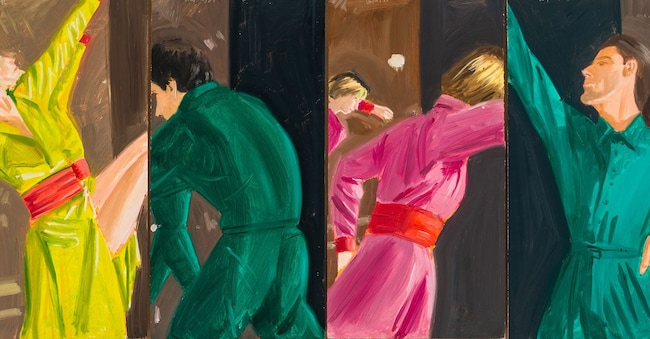
“Last Look” (1986), di Alex Katz.

8' min read

8' min read

Among eight billion faces on the planet, it is not possible to find two that are truly identical, and the idea that each of us has at least one living double seems to be a groundless legend. We are unique and unrepeatable beings and we communicate this to the world primarily through our face. We all have a face and every day we have to deal with those of others: our very identity has always been linked to our physiognomic features. Every morning we look in the mirror and make a decision: we comb our hair, put on make-up or simply check that everything is in order. "At that moment we ask ourselves what to do with our face: it is not an elbow or a shoulder blade, it is a significant object," explains graphic designer Riccardo Falcinelli, who has dedicated a book to the subject, Visus. Storia del volto dall'antichità al selfie (Einaudi). "And even if we are not Rembrandt, for each of us the face is something to think about".

Obsessed with our image - with 93 million selfies taken every day in the world, a figure for 2020 - we try to fix it in the moment in an era, the 21st century, in which everything seems to be fluid and relative. Perhaps because we confusingly feel the desire to leave a lasting trace of ourselves, to experience something that is not an adventure or that is not consumed in a twenty-four-hour story on Instagram.

Loading...

But how to try to stop time? The answer - less banal than it seems - is to have a portrait painting done. The genre, which has never really waned, is experiencing a surprising revival and this is not only because many are choosing to have their portraits taken by prominent contemporary painters. For example by Kehinde Wiley, born in 1977, a black artist from Los Angeles, known for having immortalised Barack Obama and for his highly realistic paintings of African Americans in heroic poses.

Painting wins out over photographic portraits that fade over time and also over videos, which will become unreadable as soon as the technology behind them is outdated. It may seem a paradox, but Generation Z, the first of the true digital natives, preferentially collects physically tangible and solid works, primarily paintings. The painting transmits our image to those who will come after us, and having one's own face hung on the walls of one's home (alone or with that of one's loved ones) is becoming a trend in contemporary collecting, confirmed by exhibitions, books, television programmes and scientific essays.

The starting point for a figurative investigation of the subject remains the exhibition The Soul and the Face. Ritratto e fisiognomica da Leonardo a Bacon which was proposed almost thirty years ago by Flavio Caroli at the Palazzo Reale in Milan. Between Leonardo da Vinci's Vitruvian man and Francis Bacon's lump of flesh is the modern Western man's representation of himself, his greatness, his transience and perhaps his destiny. Until 29 June, instead, an anthological exhibition of around 300 self-portraits by the most famous painters in the history of art, from the 15th to the 20th century, The Portrait of the Artist. In the Mirror of Narcissus. The face, the mask, the selfie. But what does it feel like when we look at a portrait and what does the painter convey to us? "We were created to look at each other", wrote Edgar Degas, who took the omnibus to Paris every day to immerse himself in a crowd of faces, to penetrate into their souls, to grasp the expressiveness of their gaze. The first ones he portrayed were those of his Italian relatives. Not yet 20 years old, in 1854, he had stopped in Florence, the guest of his aunt Laura Degas - wife of Baron Gennaro Bellelli, a Neapolitan patriot in exile - and his cousins Giulia and Giovanna. The gestation of the Portrait of the Bellelli family, now at the Musée d'Orsay in Paris, was very long (1858 - 1869), but in the end the artist succeeded in expressing not only what appears, but also the interiority of each character posed life-size.

Leonardo's intuition, taken up by Degas, echoes throughout the history of modern portraiture from Lotto to Velasquez, from Van Dyck to Rembrandt, Ingres, Hayez, up to Modigliani, Klimt, Schiele and then to the Surrealists who, thanks to psychoanalysis, discovered hitherto unfathomed depths in the unconscious. Art, in fact, is a form of knowledge and every era has its own face. Not for nothing is it said that the portrait is the mirror of a society and translates the spirit of the time.

So if a portrait is entrusted with our values and principles, what do contemporary portraits tell us? First of all, that we are in the midst of a renaissance of black culture; the most successful portrait painters, in fact, are African American and paint mainly black people. Besides Wiley, there is also Georgia-born Amy Sherald, born in 1973, famous for portraying Michelle Obama in 2018. Her subjects are the focus of simple, linear compositions that lack depth. The only elements to have texture and volume are the eyes, because they express a humanity that is no longer intimidated. At Hauser & Wirth, his portraits are priced from 200,000 to almost EUR 3 million.

A rising star is Ghanaian Amoako Boafo, born in 1984: fifteen years ago he was selling his paintings in Accra for USD 100 per canvas, today he is in the elite of contemporary African artists and his portraits go for millions of dollars at auctions and galleries. He paints with his hands in the manner of Egon Schiele, discovered during a stay in Vienna in 2014, and for him the exchange of energy with the person portrayed is an essential aspect to the success of the painting. After all, portraying a face is like giving an interpretation of reality: one paints in a certain way to convey a version of facts or a way of feeling life.

As does Elizabeth Peyton from Connecticut, where she was born in 1965. Today she lives and works between Long Island, New York and Berlin. She portrays family friends, fashionable rock stars, royalty and boyfriends, but to some extent they all look a bit like her: they are thin, posed, always neat and perfect. Inspired by Goya, Frida Kahlo and many others, she creates paintings that make you dream, recounting a moment that will never return. A portrait of her by Thaddaeus Ropac costs between 200,000 and 2 million euros.

All the great artists of the present day have grappled with the art of the portrait, from Alex Katz (1927) and David Hockney (1939) to the South African Marlene Dumas (1953) to Julian Schnabel's portraits (1951) made in the 1980s with broken crockery, cups and plates, yet incredibly similar. Portraits and self-portraits seem more than ever to be tools for deepening self-knowledge, in which the artist poses as both object and subject of his own research.

Francesco Clemente, for example - a nomadic artist par excellence, born in Naples in 1952 - has found inspiration in Eastern philosophical, spiritual and aesthetic traditions, and in his works depicts a fragmentary self and constantly shifting figures - between the material and spiritual worlds, between male and female - who yearn for forms of reconciliation. An exponent of the Transavantgarde movement, he lives between India and New York. In Italy, his works are handled by the Roman gallery Lorcan O'Neill and the price of a portrait ranges from 100,000 to 500,000 euros, depending on the size and technique used (watercolour, pastel, drawing, oil, encaustic).

Fra miliardi di selfie, il ritorno del ritratto dipinto

Photogallery13 foto

Mindful of the Renaissance tradition, some up-and-coming Italian painters choose the portrait as the medium for an investigation into identity, physicality and social relations, and each one does so with a different accent. The Veronese painter Nicola Verlato (1965) has been living in the United States since 2004 and combines the iconographies and canons of classical art with a universe of contemporary visual suggestions, giving rise to surprising portraits, where contaminations with the world of science fiction, comic strips, videogames and 3D modelling technologies flash by. The Milanese gallery Giovanni Bonelli treats him, with prices ranging from EUR 10,000 to EUR 100,000. The Romagna-born Nicola Samorì (1977), on the other hand, starts by copying famous 16th and 17th century works, in which the clash between light and shadow dominates, to create enigmatic, wounded, stitched-up portraits, in which the individual emerges as a battlefield between good and evil. At auction and in the gallery, the works fetch between EUR 6,000 and EUR 70,000. The Milanese Barbara Nahmad (1967) has devoted a large part of her pictorial research to portraits. Characterised by a pop style, with large enamel backgrounds and primary colours, the faces in the series Yesterday Now, A Rebours, Can to General and All'ultimo respiro, occupy the entire surface of the canvas and narrate the human adventure through its protagonists, from Pope Pacelli to Che Guevara, from Mr. Tamburine to his companion at the bank.

Those who wish to browse a little on the website eccellentipittori.it, curated by Camillo Langone, will discover other interesting portrait painters, such as Greta Bisandola (1976) who rereads the New Objectivity in the light of the early Lucian Freud. At the Galleria la Dama in Capestrano (L'Aquila), her portraits, made using different techniques, are priced from EUR 2,000. Or like Giovanni Gasparro (1983), who is liked by the director Ferzan Ozpetek and who expresses the values of his client, eternalising him on canvas together with what he loves (at Galleria Russo in Rome, portrait prices around 10 thousand euro).

The human face is the first form that we distinguish as soon as we open our eyes to life; the first that we learn to represent and the first that makes us discover the Other from ourselves. This dialogue, with all its tensions, remains central to the creative process of contemporaries. And commissioning a portrait that represents us can be an excellent alternative to the fleetingness of selfies.

MIRROR MIRROR ARTISTS Greta Bisandola, €2,000, the Lady of Capestrano, ladamadicapestrano.it. Amoako Boafo, Gagosian and Mariane Ibrahim Gallery, gagosian.com, marianeibrahim.com. Francesco Clemente, €100,000 to €500,000, Lorcan O'Neill Gallery, lorcanoneill.com. Marlene Dumas, David Zwirner, davidzwirner.com. Giovanni Gasparro, approximately 10,000 euros, Galleria Russo, galleriarusso.com. David Hockney, Gagosian, gagosian.com. Alex Katz, Timothy Taylor, timothytaylor.com. Barbara Nahmad, from 5 thousand to 25 thousand euros, Federico Rui Arte contemporanea, federicorui.com. Elizabeth Peyton, from 200 thousand to 2 million euros, Thaddaeus Ropac, ropac.net. Nicola Samorì, from 6 thousand to 70 thousand euros, Monitor (Rome), Building (Milan), monitoronline.org, building-gallery.com. Amy Sherald, from 200 thousand to approximately 3 million euros, Hauser & Wirth, hauserwirth.com. Julian Schnabel, Pace Gallery, pacegallery.com. Nicola Verlato, from 10,000 to 100,000 euros, Galleria Giovanni Bonelli, galleriagiovannibonelli.com. Kehinde Wiley, from 100 thousand to 200 thousand euros, Roberts Projects, robertsprojectsla.com. Read 'Visus. Storia del volto dall'antichità al selfie" by Riccardo Falcinelli, 25 euro, Einaudi. "Self-portrait. Storia e tecnologie dell'immagine di sé dall'antichità al selfie" by Gabriella Giannachi, 23 euro, Treccani. Excellent painters, eccellentipittori.it. SEE "Amy Sherald: American Sublime", until 10/8 at the Whitney Museum of American Art in New York, whitney.org. "David Hockney 25", until 31/8 at Fondation Louis Vuitton in Paris, fondationlouisvuitton.fr. "The Portrait of the Artist. In the mirror of Narcissus. Il volto, la maschera, il selfie", until 29/6 at the Museo Civico San Domenico Forlì, mostremuseisandomenico.it. "Marlene Dumas: Cycladic Blues", from 5/6 at the Museum of Cycladic Art in Athens, cycladic.gr.

Copyright reserved ©
Loading...
Loading...

Newsletter

Notizie e approfondimenti sugli avvenimenti politici, economici e finanziari.

Iscriviti