Guided tour

Among the keepers of the oldest memory of the human species

There are seven 'living museums' in Namibia, located in remote areas and run by San hunters and gatherers and other local people. They offer visitors the opportunity to learn about their culture: from hunting and gathering to their dances and legends

7' min read

7' min read

Crouched in the red sand of the camp, he had just finished lighting a fire with two sticks. 'The male', 'the female', he said, showing them off, curious perhaps to see if the allusion was intended, but not malicious. They were light sticks of marula, baobab, or Senegalese maytenus. He rubbed them one into the hollow of the other, with a few tiny pebbles deposited in between, in the 'female' cavity, swiftly rotating the male in his tapered hands. A few cries of incitement, and a wisp of smoke rose into the air. He drew a fine straw closer and when the smoke began to spread, he gently gathered it in his palms and blew until the flame emerged. Then he laid it in a nest of twigs that immediately ignited.

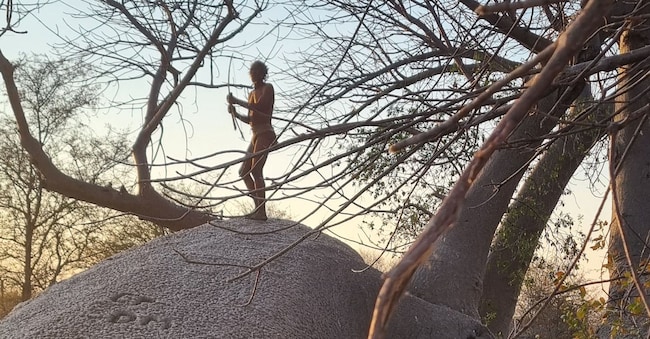
Now, however, it is the bow that is showing, the arrows. They are disassembled: the tip is tied tightly with an antelope tee to a short, hard stick, which is threaded through a long, thin cannula. When the animal is shot, only the cannula pulls out, leaving a bloody clue for the hunter, while the tip remains embedded in the flesh, more difficult to detach for those without hands, and thus releases all its lethal venom. The points,' he explains, 'were made from the giraffes' leg bones. They were left to soak for four days. Once they became more malleable, they sharpened them.

Loading...

Then he looks at me. His gaze is clear, penetrating, ironic perhaps. He seems to really see me. I feel seen. I wonder what he sees. I remember that I have come all this way to ask them who we are, who I am. They, the San, here the Ju/'Hoansi San, who hold the oldest memory of the human species. Who still live as we all lived, before the adoption of agriculture and farming took us so far from what our genes evolved to do, from our genetic self. Too fast the cultural evolution: biologically we are still the same nomadic humans who lived by hunting and gathering.

"When the Europeans arrived and started to fence everything in,' he says without emphasis, peering at me from the corner of his sharp, laughing eyes, 'that's when we started to peel off the metal of the fences to make triangular arrowheads that stayed firmly fixed in the flesh and therefore were not lost and could be reused. His tone is pragmatic, not vindictive. I look at him, wanting to understand if he is telling me something else, but he does not reveal himself. He shows me those efficient points 'stolen' from the fences that kept them out of their lands, that still confine them to the margins of a territory, that of southern Africa, of which they are the oldest inhabitants. They were the first, they have become the last. Their presence, witnessed also by splendid rock depictions in what are now Namibia and Botswana - which even asks them to buy a periodical permit to allow them to hunt - is tens of thousands, if not hundreds of thousands of years before the invasions of populations of Bantu shepherds, whom they call 'the blacks', because they instead have amber skin, and the more recent and more terrible usurpations of the whites. Traces of both remain in the stories handed down by the elders: when one evening around the fire I ask them if they have any memory of them, the tale of the violence and kidnappings for the slave trade is still vivid and full of strong emotions.

The tips are thin metal blades, they look almost harmless. To give them their shape, they beat them on the fire, he explains, showing a prodigious tool made from a very hard twisted root, which, depending on how a blade is inserted into it, turns into an axe or a scraping tool, or beating. It is not the weight of the arrows, the propulsive force of the bow, that allows it to kill even very large animals, such as kudu, giraffe, buffalo, once elephants, but the poison. A very powerful poison, which they only give to a boy when his behaviour allows him to be considered an adult. Not everyone can use it, it is too dangerous. But it is not exclusive to men, women also hunt if they want to: they are egalitarian cultures those of the San, and almost devoid of ceremonies and cults.

They keep only two or three poisoned arrows, as well as two sticks for lighting fires, in their quiver. Their only baggage, along with ostrich eggs used as flasks, is made from the root of the Vachellia reficiens, also known as the red-barked acacia, roasted for five hours over embers and then beaten to bring out the pith. The soft strap is made of the skin of dik-dik, cephalofo or other small antelopes, like their clothes. The skins of the larger ones, the oryx or eland, serve as beds and blankets.

As we make our way through the bush, they stop and eagerly display an anonymous shrub: it looks like bare branches. It is an elderly hunter who guides us, and he does not know English. He speaks his beautiful snappy language - there is one that contemplates over 80 clicks - adorning it with many eloquent gestures, so much so that at times there is almost no need for the translation made by the young San who had lit the fire and shown the arrows, and who is now saying "poison, poison!". "It does not yet have leaves," he explains, "because it is winter, but when they sprout they are filled with worms. They devour them all and then bury themselves. After a while, we dig under the plant, collect the cocoons of the nymphs into which the worms have turned: that's where the poison is'.

"Have you seen that my heart is cheerful and open? - says Elder San, taking leave of me -. When you go home, tell your friends, tell them that we are happy!".

The day ended in the Ju/'Hoansi-San Living Museum in Grashoek, 7 km north of the long dirt road C44, between Grootfontein and Tsumkwe, in north-east Namibia. It is one of seven 'living museums' created by the Living culture foundation Namibia, a German-Namibian foundation, and now entirely in the care of the San, Damara, Ovahimba and other local peoples. Since they have been there, cars full of tourists speeding along the white road dusting off the San and leaving them with the curiosity to get to know these unusual individuals, as Kxao Khan//an, a San guide, tells us, occasionally stop, enter the village, and patrons exchange money for culture: they enrol in courses lasting a few hours to learn, or at least see, how to build bows, light fires, track animals, hunt, dance, make jewellery from fragments of ostrich eggs and seeds, or listen to elders tell ancient stories . Near the village you can pitch your tent. Although they want to live like their ancestors, the San need money, especially since Namibia's independence, when the government forced them to become sedentary, to send their children to school. School is good, says Khan//an, but it is not easy to continue with studies: many drop out because they are mocked for their appearance, skin colour, strange language and poverty.

'They are happier,' says Nisa, who is 13 years old and lived in France, confidently, on her way back. The anthropologist James Suzman also says this, after a quarter of a century with the San, in Affluence without abundance. What we can learn from the world's most successful civilisation (Bloomsbury, pp. 300, £10.99). Affluence without abundance: a maximum of 15 hours a week the San need to procure food, and less than another 15 they spend on domestic activities that could only barely be called 'work'. They have no daily commitments, they only have to get busy when the food is finished. They can sleep, rest, have fun the rest of the time. They are not hostages to unattainable aspirations: they possess only what they can carry, and none have more than others. It was the advent of agriculture, ten thousand years ago, that produced the imbalance that forced women into domestic and subordinate roles and generated the accumulation of capital at the origin of today's inequalities, Suzman hypothesises.

A few days later, across the border, 500 km further south, the Kalahari desert blossomed. Tiny yellow and white flowers dot the sparse shrubs. The canary-coloured pompoms of the water acacia spread a languid scent in the dry air. We follow two young San hired by the Kuru development trust to teach us how to track animals. They take a few steps into the bush and stop around a one square metre sandy patch. "Here," he points to some tracks, "three days ago a kudu passed by, going that way, following the full moon. "Here," points out the other, "a brown hyena rolled by. Do you see the hair?" And as he picks up some dung, breaks it off and says: "a giraffe, three months ago", the surface comes to life, acquires four dimensions, comes alive. The young San read an alphabet lost to us and, with them, we finally see the animals pass, time flow. We approach our forgotten self.

© REPRODUCTION RESERVED

Where to go

Between Namibia and Botswana

There are seven living museums in Namibia, they offer one-day or in some cases multi-day courses, and one can camp in the villages. More information at www.lcfn.info The https://strong-strings.blogspot.com website is run by Kxao Khan//an, a San who speaks good English and offers himself as a guide to the San civilisation, convinced that the more tourists take an interest in their culture, the easier it will be for young people to maintain the traditions. He lives in Tsumkwe and can accompany them to the most remote villages (+264814977772). In Botswana, the Kuru development trust works to preserve the culture of the San. Also interesting, nearby, is the Kuru art project: kuruart.com

Copyright reserved ©
  • Lara Ricci

    Lara Riccivicecaposervizio curatrice delle pagine di letteratura e poesia

    Luogo: Milano e Ginevra

    Lingue parlate: Inglese e francese correntemente, tedesco scolastico

    Argomenti: Letteratura, poesia, scienza, diritti umani

    Premi: Voltolino, Piazzano, Laigueglia, Quasimodo

Loading...

Brand connect

Loading...

Newsletter

Notizie e approfondimenti sugli avvenimenti politici, economici e finanziari.

Iscriviti