
An anonymous and three Renaissance geniuses to rediscover Villa Adriana
Bruciati and Cinque's essay emphasises the role of Morto da Feltro, an ideal bridge between Michelangelo, Leonardo and Raphael, who were in Tivoli
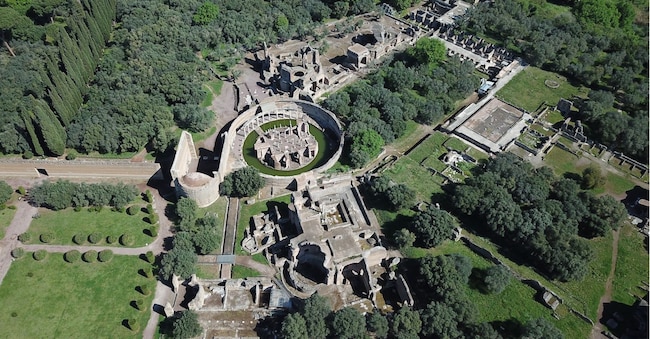
Villa Adriana is a kaleidoscope of art, architecture and archaeology. Layers to leaf through like pages of culture, traversed also by the geniuses of the Renaissance, Leonardo, Michelangelo and Raphael. Andrea Bruciati and Giuseppina Enrica Cinque expertly re-read the Unesco site with the volume Villa Adriana agli albori del Rinascimento (Villa Adriana at the dawn of the Renaissance), which is the culmination of decades of painstaking research, with a wealth of data, not infrequently unpublished and often little known or neglected and not fully exploited to offer "paths of thought that aim to mend a fabric worn down by the inadequacies of memory".
From 1432, when, on the road to Tivoli, the ante litteram archaeologist Ciriaco d'Ancona glimpsed majestic architectural remains from Ponte Lucano, which could be identified with the Tiburtine ruins, until 1461, when Pius II, born Enea Silvio Piccolomini, had an initial campaign of investigations undertaken on the site, the villa was revealed and the discovery of the Muse (four of which are now in the Prado) spread the word of the Tiburtine wonders. In 1496, a young Michelangelo painted a panel in which the Virgin shows torsion of the bust and posture similar to the Arian Muse; Leonardo notes in a folio of the Atlantic Codex his first experience at Villa Adriana in 1501 and it is found, for example, in the postures of the female characters in the Vergine with St Anne, Child, St John and the Lamb. Raphael mentions his visit in connection with Cardinal Pietro Bembo's letter (1516) and he had certainly been able to admire the Muse in the 'vigna del papa' at Monte Mario, in whose gardens they had been located since 1519. Architecture, wall decorations and grotesques shaped the personalities of the three geniuses of the Renaissance, and the essay reveals how the role of ideal bridge between Michelangelo, Leonardo and Raphael can be ascribed to the anonymous Morto da Feltro, "a character conveyed by Vasari as a master of grotesques and frequenter of Villa Adriana, but who, in the light of the investigations conducted, becomes a key figure for re-reading the whole of the events according to an interpretation congruent with the sources". According to Vasari, Morto da Feltro "found [...] grotesques more similar to the ancient manner than any other painter" and, working in Rome between 1492/1494 and 1506/1507, he left his name on the vaults of the Domus Aurea, written in Greek and Italian, and also - as Giuseppina Enrica Cinque explains - at Villa Adriana, on the plaster of a cryptoporticus originally covered with paintings. The personality of Morto da Feltro emerges powerfully from Bruciati and Cinque's multidisciplinary research and is the key to the fortune of the Tivoli site during the Renaissance: from that golden age, Muse and grotesques became world heritage sites.
Andrea Bruciati, Giuseppina Enrica Cinque, Villa Adriana agli albori del Rinascimento. Leonardo, Michelangelo, Raffaello, Dei Merangoli, pp. 496, € 110


