Protected enchantments

An app to conquer the warranty segment

Three art companies with different business models propose to auction houses to expand coverage to the lower end of the market

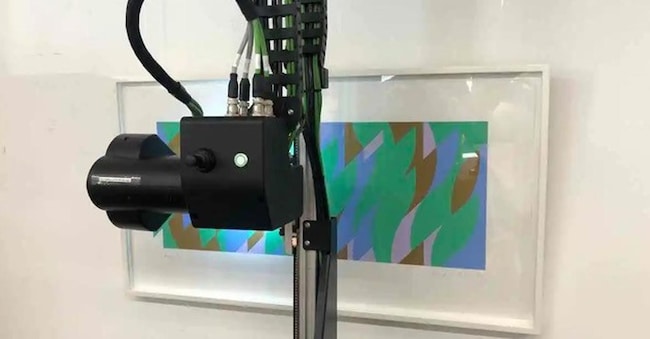
Un dispositivo Artclear scansiona Leap, una stampa di Bridget Riley, prima della vendita presso Forum AuctionsCOURTESY OF ARTCLEAR

4' min read

4' min read

Guarantees are a tool that tends to eliminate the 'competition' that takes place during an auction both in the auction room and online. The market already knows the verdict. The fact that a work of art has already been 'adjudicated' before the final allocation by the auctioneer makes the spectacle less interesting and limited to the 'guarantee' players of irrevocable bids and the price tamed to the seller's wishes. Despite the reduction in the number of guaranteed lots at auctions over the past year, it should be remembered that guarantees are an instrument used, above all, at the top end of the art market.

In a report last October, ArtTactic noted that guaranteed lots were down 22% year-on-year for evening sales of postwar and contemporary art in the first half of 2023, but accounted for over 54% of evening sales of the same segment in the first half of last year (by hammer value).

Loading...

A recent article on the website of the American ARTnews points out that despite the elitist nature of guarantees, interest is not lacking and some companies have decided to collaborate to launch a pilot project to make the guarantee segment more transparent and democratic, two attributes that however do not reflect the art market. Not least because no disclosure is ever made of the agreements underlying the guarantees.

Before going into the details of the project, it should be remembered that auction houses can offer guarantees in two ways. One in direct form: the auctioneer itself is obliged to buy the work, having negotiated a minimum price with the owner. The other type is the third-party guarantee, where the auction house involves another party to share the guarantee or take it over entirely. There are collectors and dealers who are known to often be third party guarantors, whether they actually want the artwork or use this arrangement as a financial vehicle. In any case, the seller is guaranteed a certain price, regardless of the outcome of the auction. Depending on the agreement, if the lot is sold at a higher price, the third party guarantor may receive a percentage of the final price.

The protagonists

.

On the one hand, a London-based technology startup The White Glove, which advertises itself as "the first online marketplace that connects sellers and guarantors", has launched a pilot project with London-based Forum Auctions, an auction house specialising in rare books, manuscripts, limited edition prints from 1500 to the present day, Banksy prints and other works on paper, acquired by Gurr Johns, an art market consultancy, in 2021.

For this project, The White Glove teamed up with Artclear, a blockchain company whose founders, coming from the world of payments and settlement of high-value financial transactions, identified the pain points of the art market, namely high transaction costs and the continuous verification of artworks and associated information. To provide a secure digital asset management system for art, Artclear developed a unique digital certificate tracking technology for the art sector.

How the app works

.

The operation featured the enchantment of a print by Bridget Riley, entitled 'Leap' (edition of 75). Artclear scanned the work with its handheld scanner to create a digital certificate of authenticity stored on the blockchain. The White Glove described the artwork as having 'dual media', referring to both a warranty and a blockchain certificate. Estimated at between $6,500 and $9,000, the print sold for $9,500.

For The White Glove, its 'financial product' can be adopted by any traditional or online auctioneer and 'gives power back to the sellers' by allowing them to negotiate a guaranteed minimum sale price before the auction. "If bids exceed that price, the seller and the guarantor split the profits, which means less risk and more benefit for everyone," the company explains on its website. In essence, The White Glove handles all financial transactions directly with the guarantor. This means that the guarantor pays or receives funds from The White Glove, simplifying the entire process. The company's business model provides for two sources of income. The first is a commission, in which the auctioneer pays The White Glove in exchange for an irrevocable bid, and the other is the 'upside share split between the guaranteed price and the final adjudication price'. The percentage that White Glove receives is subject to negotiation'.

The goals of the app

.

For The White Glove, the goal is to demonstrate the potential for innovation in the area of guarantees, while making them more transparent and accessible to all. How? By offering guarantees at a more affordable price, thus expanding the assets that can be guaranteed beyond high-end works. The company believes, in fact, that its system can be applied to low-priced works of art, as in the case of Riley's edition, but also to other luxury items. The aim is to expand the market - the company points out - and to ensure that the model can be adopted not only by small art houses, but also by larger ones, such as Sotheby's and Christie's, and "set a new standard in the art market". For the larger auction houses The White Glove offers a service aimed at simplifying the operation of collateral at the "lower end of the market". For its part, Artclear, meanwhile, stated that its partnership with The White Glove aims to increase art liquidity by making transactions easier. The hope is also to make it easier to secure ownership of goods and provenance information.

Copyright reserved ©
Loading...

Brand connect

Loading...

Newsletter

Notizie e approfondimenti sugli avvenimenti politici, economici e finanziari.

Iscriviti