
An ascetic Brokeback Mountain at the Quirino Theatre
Live music is provided by the compositions of Dan Gillespie Sells and the voice of Malika Ayane
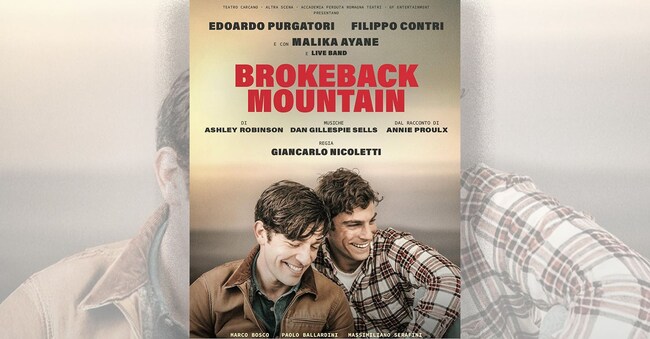
Twenty years after its entry into the collective imagination, Brokeback Mountain arrived in the theatre with a naturalness and timing that did not blunt the tale, but made it even more true and demanding. The stage version does not compete with Ang Lee's Oscar-winning film on the ground of icon or immediate emotion, but chooses a more severe, almost ascetic confrontation with what remains when a story has already been seen, loved and discussed. The theatre thus becomes an instrument of verification and precision thanks to Giancarlo Nicoletti's direction, which works by subtraction and trust in the text, in its gaps and repetitions, but above all, in the actors. Edoardo Purgatori and Filippo Contri do not seek to 'interpret' Ennis and Jack, but to inhabit them with grace and extreme skill, accepting that their relationship never asks to be clarified to the end. Purgatori builds a compact Ennis, governed by an inner discipline that borders on self-punishment: every gesture is measured, every word is preceded by an assessment of the damage. Contri, on the other hand, gives Jack a restless quality, a drive towards what could be and what has no place in the world as it is. Their encounter is one of silence and excess, of shyness and fears, of joys hidden and then revealed, of jeans and dirty shoes and sweaty bodies, of kisses, hugs, effusions and contacts given without really knowing how it works, but given, and this is important.
Their encounter does not produce synthesis, but friction, and it is in this mismatch that love takes shape, without ever becoming a solution. The live music, entrusted to the compositions of Dan Gillespie Sells and the voice of Malika Ayane accompanied by the orchestra, does not perform an illustrative function, but is a structural presence, a sound memory that organises the emotional time of the performance. The singing does not explain what happens, but guards what cannot be said, offering the story further depth without indulging in the temptation of commentary. Gradually, what emerges with greater clarity is that Brokeback Mountain (in which Mimosa Campironi and Matteo Milani also star), is not about an impeded love, but a love that struggles to become biography. Jack and Ennis love each other and try to do so despite the difficulties of the time and place they live in. Their bond is not born of illusion, but of a mutual recognition that precedes choices and yet, once brought back into ordinary life, that same love fragments into intermittent returns, suspended promises and a continuity always postponed.
The Mountain
The mountain, then, reveals its deepest function right from its title: it is not a refuge, nor a romantic symbol, but the place where the truth of experience is possible, because it is temporary. There, love exists without having to negotiate its legitimacy, whereas elsewhere, it must measure itself against an order of the world that cannot accommodate it without deforming it. The theatre makes this fracture perceptible with an almost cruel clarity, because what is missing weighs as much as what is present. When the story seems to run out, there is no catastrophe left, and the bond between the two boys does not dissolve, but retracts into memory, continuing to exert its pressure on the next time. Jack and Ennis do not embody a missed happiness, but a truth recognised in a place that does not allow it to be held. Brokeback Mountain thus bids farewell to the viewer without offering consolation, but reminding us that not everything that is authentic manages to become stable and that some loves, though fully lived, remain irreducible to the form of shared life, until the finale.
Brokeback Mountain, directed by Giancarlo Nicoletti with Edoardo Purgatori and Filippo Contri, compositions by Dan Gillespie Sells with the voice of Malika Ayane, will return to the theatre by the end of the year.

