
Epic and solemn, a memorable race

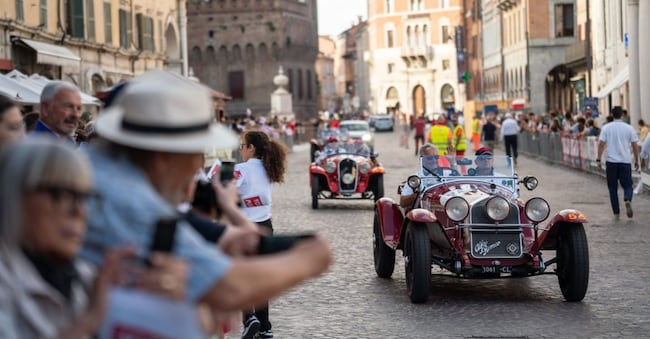
You have to climb into one of those old, noisy cars – an old Bugatti, an Alfa from the 1930s – to recognise the signs of a language that retains something epic and solemn at a time when the solemnity of the epic is no more, supplanted by the dimension of time understood as the here and now. Epic and solemn is the sound of the engines undergoing final tests in Piazza della Vittoria, in Brescia, as they prepare for the great challenge. No setting works better than this place, which flaunts the straight lines of an architectural rationalism born of the very same era in which the Mille Miglia was born. In Piazza della Vittoria, anything goes: the cars make their entrance like ladies, not in the least daunted by wearing outdated attire; indeed, it is precisely their being outside any sense of contemporaneity that makes them an eternal symbol, the essence of a dream that has captured the human imagination ever since the twentieth century took its first steps. One need not be overly familiar with the world of literature to revive the myth of speed that, over a hundred years ago, fully embraced the idea of modernity. That idea would remain forever, and no subsequent technological invention would be able to dent it. This is the message that, upon their appearance, the four-wheeled models convey the moment they peek out from beneath the marquees at the scrutineering area. There is a desire to put on a show, a sense of wanting to be seen by both expert connoisseurs and curious onlookers unaware of the wonders of mechanics. But it is precisely this feeling that lends something exceptional to the preparations underway. One does not linger in those parts merely to take photographs. One wanders around the cars, admires the bodywork, studies the position of the levers, if only to take part in a collective ritual. What is surprising, however, is the way these mechanical jewels are treated with great respect, almost with surprising care: the same care one would reserve for an elderly parent, frail with age and perhaps in need of care and attention. The cars parked in Piazza della Vittoria really do resemble elderly figures, and it always arouses great wonder, as soon as they are started, to feel the power of the pistons, the crackling thunder that escapes from the exhaust pipe, and we all look at one another with that surprised smile, which implies the same thought: ‘Did you see that power? You wouldn’t think they were capable of so much!’ In fact, they belong to a world so remote as to appear like archaeological finds. They are, of course, but of a species so rare as to render any comparison with everything produced since—let’s call it the automotive lineage—meaningless, so that the miracle everyone awaits takes place: the cars in which the organisers travel, the modern cars leading and bringing up the rear of the procession, are barely noticed by anyone because they belong to a predictable, everyday repertoire. It is not they, in fact, that capture the attention of those present, and as the procession moves through the streets of Brescia, winding its way up and down the hairpin bends leading to the castle area before gliding back down the streets of the city centre, it goes without saying that the raised arms of the people lining the roadside are all directed towards saluting the pre-war racing cars. Wherever the procession passes, from the small village on the shores of Lake Garda to the larger towns along the route from Brescia to Padua, the same ritual always takes place: people gather at the roadside, waiting under the scorching June afternoon sun, then suddenly prick up their ears at the sound of an unusual engine announcing itself from behind a bend and launch into a greeting that feels like a bygone era, moving and moved. A salute to the celebrities parading through the country lanes, like a dream aligned with the line of grass marking the verge. The passage of the vintage engines lasts but a few moments, yet it has the duration of a dream which, when recounted, unfolds at the leisurely pace of a novel.


