Intervention

An important day for European competitiveness

Mercosur represents an opportunity for trade and investment with a potential market of 700 million people

by Ursula Von der Leyen

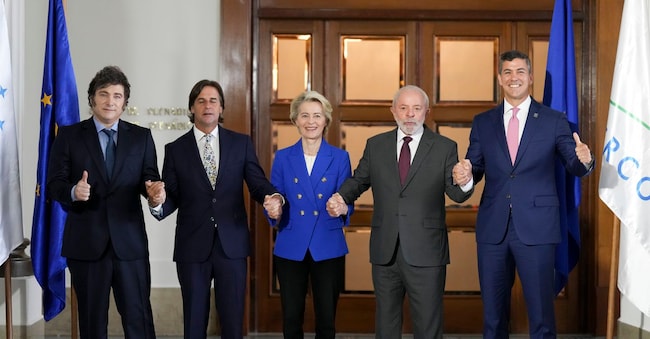
Da sinistra, il presidente dell’Argentina Javier Milei, quello dell’Uruguay Luis Lacalle Pou, la presidente della Commissione europea Ursula von der Leyen, il presidente brasiliano Luiz Inacio Lula da Silva e quello del Paraguay, Santiago Pena

4' min read

4' min read

Europe has always been an active continent on the trade front, but currently faces a world of increasing trade barriers. Our companies and farmers face increasing restrictions, unfair competition and geopolitical uncertainties, all of which threaten their competitiveness. The new partnership between the EU and Mercosur represents an opportunity to reverse this trend. That is why I went to Montevideo this week: to conclude the negotiations and lay the foundations for a beneficial and intensified cooperation with a large and fast-growing market of more than 260 million people.

Five years ago we reached an initial agreement in principle between the European Union and the Mercosur countries: Brazil, Argentina, Uruguay and Paraguay. However, the agreement raised concerns in various sectors of European society and economy, from farmers to consumer associations and environmental NGOs.

Loading...

We have listened carefully to these voices, and in five years of negotiations we have addressed the underlying concerns one by one. The agreement we have now reached includes the strongest forms of protection ever built into a trade agreement. It protects our most essential economic sectors, including agriculture and food. It protects our consumers by enforcing strict standards and prioritises the protection of our planet and its green lungs. This is not the same agreement as five years ago, it has been transformed. Today we can say with confidence that it is a better deal for European citizens.

This new partnership comes at a crucial time for Europe. The global landscape has become more fragmented and conflictual than before. Last year, the scale of global trade restrictions more than tripled. To meet these challenges, we must strengthen ties with like-minded partners.

The EU and Mercosur will create a market of 700 million people. This market will primarily benefit the tens of thousands of European companies - half of which are small and medium-sized enterprises - that already trade with Latin America. Mercosur duties on European products are high: 35 % for fashion products, 27 % for wines and up to 55 % for other agri-food products. The agreement will eliminate almost all duties on all products, which will save EU exporters up to EUR 4 billion per year.

- And it will open up this dynamic market to European exporters.

It is also the most comprehensive agreement ever negotiated for the protection of European food and drink. More than 350 European products will be protected by a geographical indication. This means that it will be illegal to sell imitations or fakes. For example, 'Parmesan-type cheeses' will no longer be sold in Mercosur supermarkets, only the original, 'made in Italy'. For the first time ever, European inspectors will be able to carry out checks and put an end to such practices.

With this agreement, European farmers will benefit from new guarantees. We negotiated import ceilings for sensitive agri-food products: Mercosur imports will only represent a small part of European consumption: 0.1 % for pork and 1.5 % for beef. It is essential that Mercosur exporters meet the same high standards as European producers. To ensure that this is always the case, we have agreed on stricter controls and closer cooperation with local authorities in Mercosur countries.

The European Commission will closely monitor market developments following the implementation of the agreement, especially in the agricultural sector. We will ensure that the partnership with Mercosur is a win-win for European farmers and all European consumers. In order to guard against the unlikely event that the implementation of the new agreement exposes the agricultural sector in Europe to negative consequences, we intend to build up a strong reserve of at least EUR 1 billion: this is the insurance policy we offer our farmers and our rural areas. Together with the European agricultural sector, we will initiate new measures to simplify and reduce the bureaucracy they have to deal with.

The agreement is also good news for European industries that depend on raw materials from abroad. The demand for critical minerals needed for clean and digital technologies will triple by the end of the decade. The global race to control their production and trade is already on. Mercosur countries are among the world's largest producers of lithium, iron ore, nickel and other minerals. The new partnership will reduce or eliminate export duties. It will eliminate export restrictions and monopolies. And it will diversify our suppliers by reducing excessive dependencies. On both imports and exports, the EU-Mercosur agreement will strengthen Europe's competitiveness in all sectors.

The economic interest of this agreement is clear. But for Europe, trade agreements are not only about economics. This new agreement is also a geopolitical necessity. Trade partnerships are a way to build and strengthen communities of shared values. This also applies to our partnerships with Mercosur. We have much in common with the Mercosur countries: history, culture and languages. We are all convinced that climate change is the crucial issue of our time and the agreement reflects our common commitment to the Paris climate agreement and the fight against deforestation. The EU and Mercosur also share the conviction that international cooperation is the true engine of progress and prosperity. While other powers move in the opposite direction, we choose to stand united on the world stage, for freer and fairer trade.

That is why today is a good day for Europe and Mercosur. A generation of leaders has dedicated years to reach an agreement on the best terms for Europe. Now is the time for future generations - consumers and businesses, families and farmers - to benefit. This is the way we act to achieve our common goal of strengthening Europe's competitiveness.

Copyright reserved ©
Loading...

Brand connect

Loading...

Newsletter

Notizie e approfondimenti sugli avvenimenti politici, economici e finanziari.

Iscriviti