
An integrated approach is needed for household investment
BNP Paribas and SDA Bocconi are launching an innovative family office to address the generational challenge and the issue of overly conservative investments

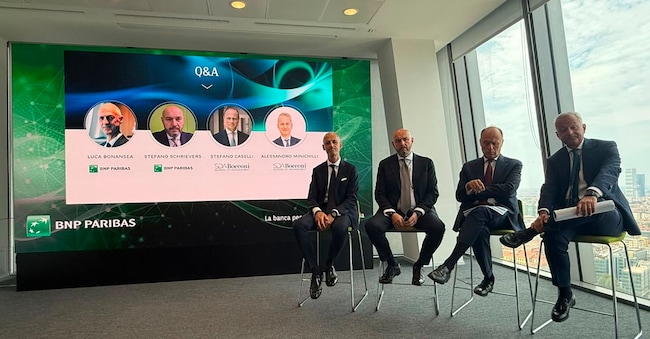
Italia sits on total wealth of 12.8 trillion euros, ranking as Europe’s third-largest economy in terms of financial wealth, but it faces an unprecedented paradox and demographic challenge: on the one hand, over 2 trillion euros lie idle in bank deposits; on the other, the country is preparing for the largest generational transfer in its history, with over 1,000 billion euros of total assets set to change hands over the next decade. It was against this striking backdrop of Italian savings that the ‘Diamond Tower Family Strategy’ initiative was unveiled – a new family office model born out of a strategic partnership between BNP Paribas and SDA Bocconi School of Management, presented in Milan by Luca Bonansea (BNP Paribas), Stefano Schrievers (BNP Paribas), Stefano Caselli (SDA Bocconi) and Alessandro Minichilli (SDA Bocconi).
The event provided an opportunity to illustrate how the asset management industry must inevitably transform itself in order to respond to the real pressing needs of the country’s economic and social fabric, shifting the focus from the mere allocation of capital to a strategic and integrated approach to the family.
The data presented during the meeting paint a picture of a veritable ‘liquidity trap’ and a governance crisis. Italians’ financial wealth has grown significantly in recent years, reaching 6.3 trillion euros in 2025. However, 45 per cent of this investable capital remains tied up in extremely conservative instruments, such as deposits and insurance policies. Added to this lack of movement is a generational issue: around 80 per cent of private wealth is currently held by the ‘over-55s’ age group. This generation now faces the task of managing a monumental handover – involving 470 billion in financial wealth alone by 2036 – in a context where 60 per cent of those aged over 65 still do not involve their children in investment decisions and 65 per cent do not discuss the issue of generational succession with their adviser. The risk of a profound disruption is even more pronounced when looking at the business landscape: 49 per cent of Italy’s top 1,000 companies are family-owned, yet as many as 63 per cent of these businesses do not have a structured succession plan.
These figures underscore the need for a paradigm shift in the market. As the presentation highlighted, the traditional model of financial advice is no longer sufficient to address the complexity of wealth portfolios that combine liquid assets, property, businesses and relational assets. Wealth must be understood as a ‘unique whole’. To bridge this gap, BNP Paribas and SDA Bocconi have structured the Diamond Tower project around four fundamental pillars: Strategy, Governance, Advisory and Education. It is no longer – as was explained – simply a matter of selling products or measuring returns, but of engaging with high-net-worth families to understand their long-term objectives, their risk tolerance and the alignment of interests amongst the various family shareholders.
To ensure independence and the absence of conflicts of interest – crucial considerations when a bank offers Family Office services – the initiative involves a separate team operating at a higher level of ‘Family Strategy’, distinct from the mere provision of financial products. At the heart of this offering is the new Family Strategy Lab, a permanent research centre established within SDA Bocconi. The Lab aims to analyse the family’s needs and develop a proprietary model that will culminate in the delivery of a ‘Family Strategy Roadmap’: a bespoke action plan that guides future decisions regarding decision-making structures, rules and agreements.

