“Homo faber”

An island of light in Venice

The biennial event showcasing the finest in global craftsmanship runs until 30 September on the island of San Giorgio Maggiore

4' min read

Translated by AI
Versione italiana

4' min read

Translated by AI
Versione italiana


Five hundred craftspeople from seventy countries around the world; 500 pairs of skilled, capable and talented hands, which have created the more than 700 objects that are the undisputed stars of ‘Homo Faber’, the biennial event that brings the island of San Giorgio in Venice to life from 1 to 30 September.

Loading...

To call it an international exhibition is now an understatement: ‘Homo Faber’, now in its fourth edition, has established itself as a cultural movement, a global community centred on craftsmanship and promoting creative arts and crafts, complemented by the ‘Homo Faber Guide’ platform (a sort of Michelin Guide for fine craftsmanship), the “Homo Faber NextGen” educational programme and the “Homo Faber Young Ambassadors” project, which enables students from the world’s leading international schools of applied arts to act as cultural ambassadors within the exhibition spaces.

The stated aim of Alberto Cavalli (executive director of the Michelangelo Foundation for Creativity and Craftsmanship, which organises and promotes ‘Homo Faber’ in partnership with the Giorgio Cini Foundation and the Cologni Foundation for the Arts and Crafts), is to help the public discover that there are still hundreds of master craftspeople, designers and young creatives around the world capable of creating beauty through the work and skill of their own hands. This realisation can change our perception of the value of things and help us rediscover the importance of a high-quality, long-lasting artefact, as opposed to the ‘disposable’ items with which we often surround ourselves and which are suffocating the planet.

Homo faber e il potere della luce

Photogallery17 foto

A shift in aesthetic and ethical approach

In short, an invitation to reflect and to embrace an aesthetic and ethical shift, which in this edition takes the form of 15 immersive installations conceived by the British artist and designer Es Devlin (the set designer behind Milan’s Library of Light, the closing ceremony of the London Olympics and concerts by Beyoncé and Lady Gaga, to give a few examples), who is the creative director of “Homo Faber 2026”.

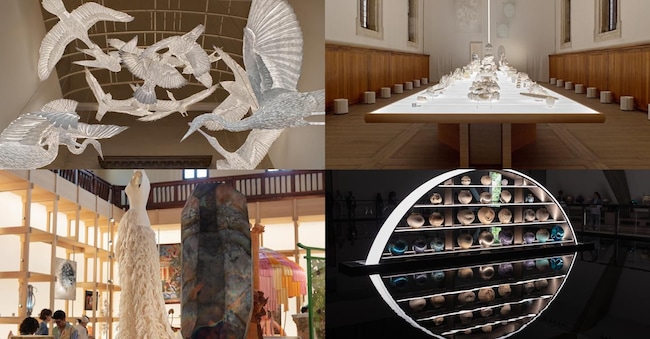
Es Devlin made her mark straight away, in a precise and unmistakable way: with refined and poetic elegance, she transformed the halls, cloisters and gardens of the Giorgio Cini Foundation into ‘An Island of Light’.

From the reconstruction of a vast artisanal workshop (A Language of Hands) complete with all the tools and materials of the world of artistic crafts, to the Alphabet of Objects – where objects are displayed on a rotating structure and cast shadows on the walls that resemble letters of an alphabet – everything in this exhibition is enhanced by its interplay with light.

And to demonstrate that craftsmanship has by no means disappeared from the world, rising from the surface of the Cini Foundation’s swimming pool – like a great moon reflected on the sea – is a luminous structure housing a selection of ‘moon jars’, the Korean vessels used to carry water. These jars have been crafted by master artisans from around the world, using various materials, and an identical copy of each is on display on either side of the pool.

In A Rooted Ascent, natural materials serve as the source of inspiration for artefacts created by woodworkers and weavers under the watchful eyes of visitors. Other craftspeople are at work in the central pavilion of a large workshop where the public can watch expert parchment and gemstone carvers, art restorers, wire sculptors and embroiderers working with precious metals at work.

There are three workshops to choose from: two sessions with European master craftspeople on the traditional Japanese techniques of kintsugi and hanko (participation fee €10; booking essential at homofaber.com) and a free workshop dedicated to the Japanese art of origami, in which each participant creates and contributes a white flower which, over the course of the month, will come together to form an original collective work of art.

Loading...

And whilst the Venice Film Festival is in full swing at the Lido (2–12 September), on the island of San Giorgio everything proceeds at a ‘leisurely pace’: in the Palladian cloister, amidst the ethereal sounds of Gregorian chants, a large rotating mirror installed in the centre of a pool of water reflects the surrounding geometric forms and the light that constantly changes throughout the day.

The journey concludes at the Borges Labyrinth, where a long tapestry designed by Es Devlin and crafted by the master artisans of the Bonotto workshop using wool, recycled plastic and washi paper takes centre stage. This work, which reminds us of our unbreakable bond with nature – featuring fish, grasses, butterflies, flowers and birds – took five hundred hours to complete.

And for those wishing to extend their ‘Homo Faber’ experience in Venice, throughout September it is possible to visit the 130 artisan workshops in the city listed in the ‘Homo Faber Guide’, to discover the traditional crafts practised there.

“Homo Faber, An Island of Light” – Venice, the Island of San Giorgio Maggiore, 1–30 September 2026.

Copyright reserved ©
Loading...

Brand connect

Loading...

Newsletter

Notizie e approfondimenti sugli avvenimenti politici, economici e finanziari.

Iscriviti