
A three-thousand-year Olympic leap
The exhibition at the Fondazione Rovati celebrates sport by juxtaposing antique ceramics with Usain Bolt, oil lamps with running scenes and the Rome 1960 torch

If the exhibition 'The Olympic Games. Una storia lunga treila anni' (The Olympic Games. A history spanning three thousand years), currently underway at the Luigi Rovati Foundation in Milan, were a fabric, it would be silk organza. Precious and interwoven with stories, history, art, jumps, races and cultures that mingle to give us back a plot that began in 776 B.C. (more or less, there is no certainty about the date) and is full of a sense of eternity. A thousand rivulets from a thousand angles because that is what running or javelin throwing are, in ancient Greece as today: the body of man in its perfection, a step away from the divine, which carries, with the glory of Olympia, names, gestures, images through the centuries to assure us of values forever: agonism, the confrontation between peoples, the Olympic truce, victories and defeats. And all this natural interweaving of stories flows powerfully in the exhibition curated by Anne Cécile Jaccard, Patricia Reymond, Giulio Paolucci and Lyon Pernet, and realised in collaboration with the Olympic Museum (Lausanne) and the Musée Cantonal d'Archéologie et d'Histoire (Lausanne).
The tale of sport, with a view of the Games in Milan Cortina, is organised in five thematic areas (Olympic Memories, Athletes and Icons, Trials and Competitions, Games for Eternity and Symbols of Victory), which are developed between the main and underground floors of the palace: the Olympic experience is passed on through a material and visual heritage. Thus, the torch, which became part of the Five Circles ceremonial in Berlin 1936, was already a distinctive element of the Lampadoforie, the relay races with torches in ancient Greece: in weaving these subtle references, which at the same time surprise and show continuity of gestures, one perceives long and careful research. And also an enthralling display: for instance, underneath the torch of Rome 1960, essential and filiform, there is a oinochoe from the end of the 5th century B.C. attributed to the Ferrara Painter, depicting an athlete with a torch. Sweat wipes, such as unguentari, balsamari, speak of the post-competition period and converse with creams, medical kits and sports bags from modern editions of the Games. And how can one not be surprised by the contiguity between the left foot with a terracotta sandal from the Hellenistic period and the running shoes of Michael Johnson, double gold medallist in Atlanta 1996, or Usain Bolt's singlet used in the 100 metres at Beijing 2008? Sport was a public space in Greece and Etruria, but it was also an everyday occurrence: oil lamps are decorated with running scenes or with athletes, and so are ancient coins, such as the tetradrachm from the Mint of Pella with the laureate head of Zeus or the stater with the pair of wrestlers.
In the Ontani Room, under the eyes of the protagonists of the Italian artist's watercolours on paper, runs a parade of competitions, which are a test of human excellence and an instrument of civic education. The vascular painting bears witness to how much sport was in everyday life: on the walls of amphorae, lekythos and kylix, athletes running, others throwing the javelin or the discus, and, together, the shoes of Nawal El Moutawakel, gold medallist in Los Angeles 1984, or the baton that the Italian national team members Lorenzo Patta, Marcell Jacobs, Fausto Desalu and Filippo Tortu exchanged from hand to hand for their historic triumph in Tokyo 2021 in the 4x100 relay. The journey, which takes place from a vaulted crater with athletes, competition judges and flute players introducing the competitions with music (which often accompanied the competitions) to the gloves used by Pierre de Courbertin in 1883, is also a way of discovering and following what Luigi Rovati, after whom the Foundation is named, said: 'I have always collected with the same method I used to form my life as a researcher: I collect elements for knowledge'.
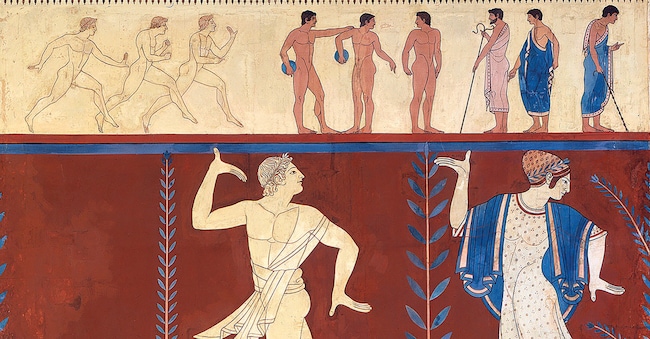
Sport is knowledge, it is a plunge into art that in this exhibition is possible thanks to the experience - sensory and physical - of entering the Tomb of the Olympians of Tarquinia (520-510 BC). After the discovery, the pictorial film was transferred onto nine panels that, for the first time, left the National Archaeological Museum of Cerveteri and Tarquinia. There is silence in the burial chamber: on the walls, boxers, long jumpers, discus throwers and gladiators are perfect in their tensing muscles, in their yearning for victory. The athletic gesture is self-representation of the deceased, who thus celebrates the best of his life. This silence speaks of agonism, of memory. Of eternity. The physical effort has made the athletes immortal and they seem to converse with Mario Schifano's work entitled The Tomb of the Olympians.
In the rooms, ancient masterpieces and modern objects follow one another, colours overlap and you seem to hear the shouts of an excited stadium for the chariot race. Then comes the glory of victory, recounted on the underground floor. For the ancients, only the winner counted, there was no podium, and the prize in Olympia was an olive crown, sacred to Zeus, or, in Athens, the Panathenaic amphorae, filled with olive oil from the olive groves of the goddess Athena. Amidst medals and awards from past editions, from Amsterdam 1928 to Athens 2004 to Turin 2006, shines a display case that cannot better convey the intimate sense of this exhibition that can speak as powerfully to a child as it does to a lover of antiquities. Next to it are a 4th-3rd century BC gold diadem with dozens of olive (or laurel) leaves and the oak-leaf crown won by German sailor Joachim Weise at the 1936 Berlin Games. In between more than two thousand years and the greatness of man grappling with limit and perfection, which no one sang better than Pindar: 'Creatures of a day, what is man? What is he not? He is a shadow's dream. But when the splendour rains down, gift of the god, a shining light and a sweet life spreads over men' (Pythics, VIII, vv. 95 ff.). Forever.


