
Ancient cathedrals and farming islands reveal the lagoon’s more tranquil side
Away from the crowds of St Mark’s Square lies an ancient world steeped in history, just waiting to be discovered

Key points
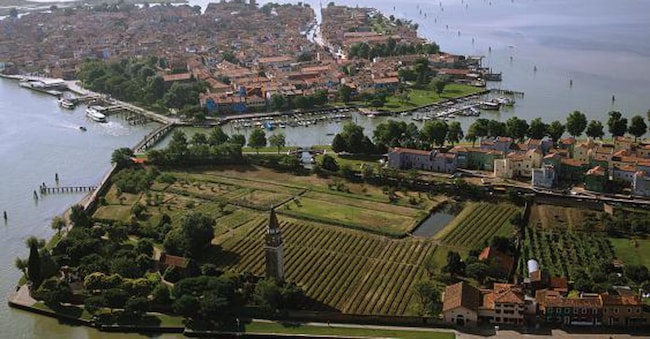
From the top of Torcello’s bell tower, on the clearest of days, one can enjoy a view of Venice as it once was. In the distance, the city’s skyline and its landmarks—St Mark’s Square and the Rialto Bridge—are visible, tourist icons surrounded by their daily throngs of people. But here, ten kilometres away as the crow flies, all is calm and quiet. Only the occasional sound of a vaporetto or motorboat engine breaks the spell of a place that, in some ways, seems to have been frozen in time. Torcello, Burano and Mazzorbo are the names of the main islands in this northern corner of the lagoon. It is on Torcello that Venice can be said to have been born, given that the oldest finds date back to Roman times and that the present cathedral, built around the year 1000 on the foundations of an earlier Christian place of worship dating from 639, was for a long time the residence of bishops and the chosen seat of the first doges.
Between Vignole Island and San Francesco del Deserto Island
There was, therefore, a time when the islands served as the lagoon’s agricultural heartland, providing the ideal habitat for the crops necessary for the subsistence of the earliest communities. With thousands of inhabitants, trade flourished, with wine playing a privileged role, produced from vineyards capable of thriving in a hostile environment, with little soil depth available (on average one metre of soil before reaching the water table) and a salinity level higher than what agronomists consider tolerable for vines. Yet here the vine has always found a place, as revealed by the place names on the island of Vignole and that of San Francesco del Deserto, once called ‘the island of the two vineyards’. But whilst there was already certainty regarding the existence of the vineyards, until 25 years ago little was known about the grape varieties cultivated there; for example, that the wine of yesteryear was Dorona, an ancient cross between Garganega and Bermestia. It was doubted whether any plants still existed, until Gianluca Bisol, a name synonymous with the history of Prosecco, happened to visit the property of Nicoletta Piccoli Emmer, an antique dealer by profession, and her private garden, where, ready to be permanently uprooted, he found a few Dorona vines.
Torcello, the iconic grape variety
This is the story of the ‘miracle of Torcello’, in which a grape variety that symbolises Venetian identity has been brought back to life and put back into production after decades of neglect. Today, Bisol’s Dorona is grown in three micro-vineyards, each covering one hectare, located respectively on Torcello, Mazzorbo and the uninhabited island of San Maffio. Three crus, united under the name Venissa, offering three distinct expressions and just a few hundred bottles, whose significance extends beyond the exquisite wine itself to the historical memory of these islands, where very few residents now live (Torcello itself seems to have barely five) and where the silence of the lagoon, apart from the vaporetti, is broken only by the chatter of children on a school trip. Wines and vineyards aside, whilst in Mazzorbo the ancient church of Santa Caterina houses the oldest bell in the Venetian lagoon, cast in 1318 and having always eluded repeated military attempts to melt it down to make cannons, in Torcello, in the cathedral, you can admire the spectacular Venetian-Byzantine mosaic depicting the Last Judgement, try sitting on the legendary ‘Throne of Attila’, treat yourself to a charming lunch at the Michelin-starred Venissa restaurant, or at the more affordable yet equally excellent osteria of the same name, and sample the Dorona wines produced from the vineyards surrounding the restaurant itself. And, of course, climb to the top of the bell tower to admire a panorama of bell towers and islands, flocks of seagulls and little egrets, canals and salt marshes in perpetual balance between air and water, vineyards and cultivated fields. In short, not the Venice of the Biennale, not the one of gondolas and monuments to be seen at least once in a lifetime, but perhaps the Venice as seen by the first people who arrived there over a thousand years ago and gave it its name.

