
Ancient, modern, contemporary: in search of the three faces of Athens
Its rich artistic heritage (two UNESCO sites, 178 museums, 44 ancient monuments) ranges from the Parthenon to the Niarchos Foundation Cultural Centre

Key points
Say ‘Athens’ and it is impossible not to invoke the gods. Starting with the name that the Greek capital owes to the goddess Athena. The story of how she became the city’s protector after winning the contest against Poseidon – the inhabitants deemed the gift of the olive tree she offered more useful than the spring of salt water he offered – is written and whispered everywhere. Even the taxi driver who takes me from the airport to my destination tells me the story, whilst the Acropolis, in all its sacred splendour, peeks out through my window. Millennia later, the fate of that choice continues to imbue meaning into the sites and monuments which, in a constant leap through time between the ancient and the modern, characterise the dynamism of Athens. Two UNESCO sites, one hundred and seventy-eight museums, forty-four ancient monuments. These are just some of the figures that make the Greek capital a destination rich in cultural and historical attractions. Pleasant and easy to explore on foot, Athens reveals with every step what makes it unique in the world.
The Acropolis and the Agora
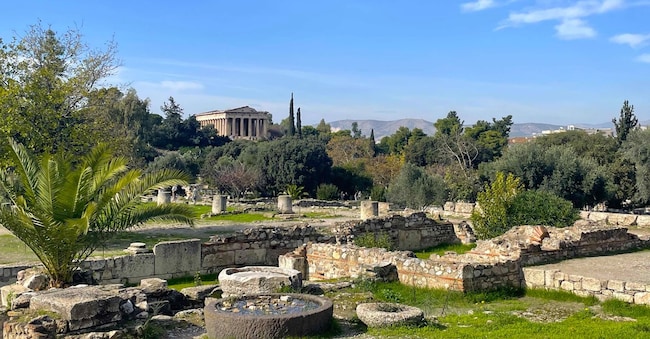
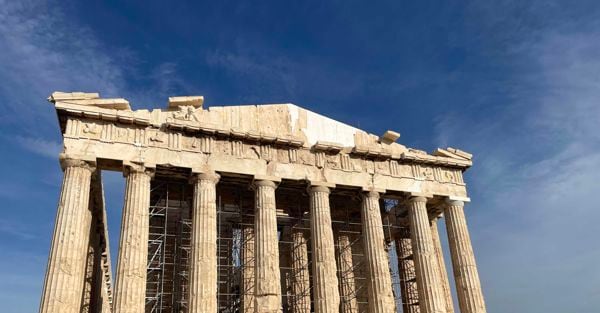
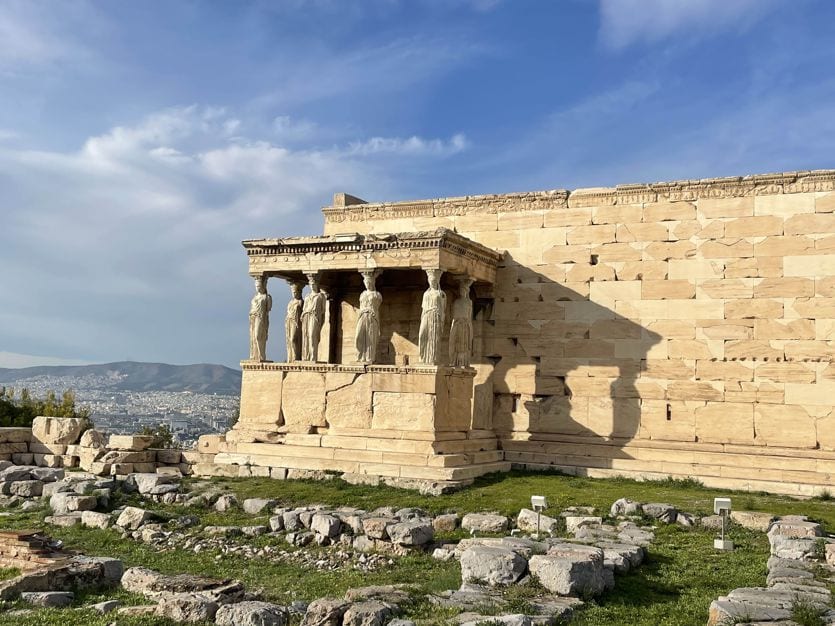
A rocky hill 150 metres high, characterised by a flat plateau and steep slopes with caves and natural freshwater springs, which together provided both safety and everything necessary for life. This is what, ever since the Neolithic period, has made the Acropolis a particularly favourable site for settlement. The sacred rock of Athens has become famous over the centuries for the architectural masterpieces that dominate it. The Propylaea, the Parthenon, the Erechtheion – with its loggia of caryatids – and the Temple of Athena Nike, erected in the 5th century BC on the initiative of Pericles: every year, millions of visitors from all over the world flock to the Acropolis to see them up close. After walking across a plateau boasting 2,500 years of history, the Acropolis Museum, which overlooks Dionysiou Areopagitou Avenue at the foot of the hill, helps to put it all into context and to understand the worship of the goddess Athena as the city’s protector. Opened in 2009, it immediately became a landmark on the international museum scene, housing votive offerings, vases and statues in clay and metal, as well as the famous marble statues of the Kores. Don’t miss a break at the café on the second floor, from where you can admire a splendid view of the sacred rock, whilst on the top floor you can explore the magnificent Parthenon Gallery. Sunset is the best time to climb Philopappos Hill and find a different vantage point from which to photograph the Acropolis, whilst strolling through the cobbled streets surrounded by olive trees. It is also within the Plaka, the city’s oldest neighbourhood, that the ancient Agora, founded in the 6th century BC, is situated. Frequented by thinkers, historians, politicians and philosophers who laid the foundations of Western culture, it is the public space where democracy was born. The main attractions for visitors are the Temple of Hephaestus – the best-preserved in the whole of Greece – and the Stoa of Attalos, which was once a colonnaded arcade lined with traders and market stalls.
All the stops in the city
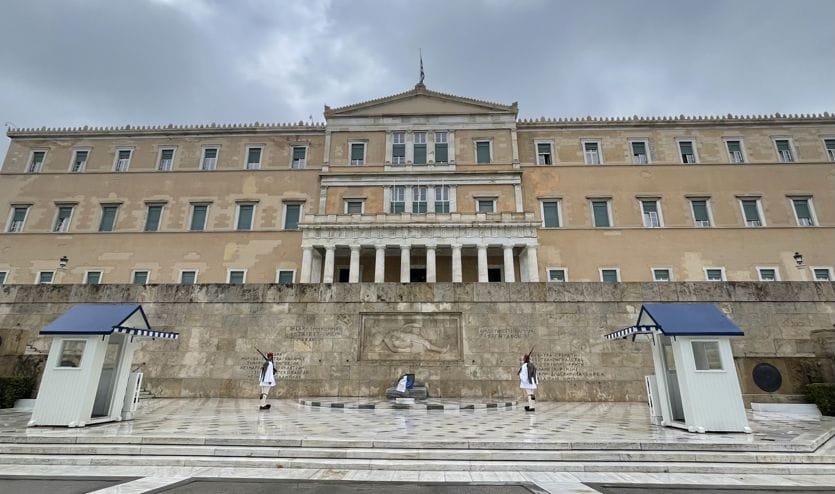
Narrow streets lined with tables and chairs from bars and tavernas, souvenir shops, cats constantly on the lookout for food, a constant stream of tourists, voices speaking different languages mingling together, street vendors and locals. This is the chaotic daily life experienced at the foot of the Acropolis hill. Leaving the streets of Plaka behind, there is a wealth of activities and places to explore, revealing other aspects that make this city unique. For example, you can head to the Parliament building in Syntagma Square, where, at the stroke of every hour, you can witness the changing of the guard by the Evzones who stand guard at the Tomb of the Unknown Soldier; you can treat yourself to a refreshing stroll through the National Gardens, commissioned in 1838 by Queen Amalia of Oldenburg and home to over seven thousand trees and forty thousand shrubs; or, by visiting the Panathenaic Stadium, you can imagine what the first Olympic Games, held in 1896, must have been like. Athens offers a wealth of unmissable cultural, historical and artistic sites. For example, there is the Benaki Museum, which offers an immersive journey through Greek civilisation from the Bronze Age to the 20th century; the National Archaeological Museum, one of the largest museums in the world, boasts the richest collection of Greek artefacts ranging from prehistory to late antiquity; the National Museum of Contemporary Art in Athens (EMST) promotes contemporary art, and the National Gallery, which houses twenty thousand works of art, including pieces by great international masters such as Auguste Rodin, Francisco Goya and Antoine Bourdelle. We recommend setting aside some time to visit the extraordinary Stavros Niarchos Foundation Cultural Centre, which is situated about five kilometres from the centre of Athens. Designed by the architectural firm Renzo Piano Building Workshop, it is a public space freely accessible to all, where visitors can take part in a wide range of cultural, educational, sporting, environmental and recreational activities and events. The SNFCC comprises the Greek National Opera, the National Library of Greece – which even features rooms dedicated entirely to children – Stavros Niarchos Park, one of Athens’ largest green spaces, and a canal with fifty-nine vertical water jets and ten fountains that put on themed choreographed displays every day.
All the flavours of the Mediterranean on one plate
Greek culture also shines through in its cuisine. A gastronomy that brings out all the flavours of the Mediterranean thanks to a wide range of traditional dishes. Souvlaki (meat skewers with vegetables), moussaka, soutzoukakia (meatballs in sauce) and a variety of salads are just some of the dishes to try in Athens. From tavernas to casual street food spots, from luxury restaurants to cosy bistros, Athens has a wealth of options to suit every taste. If you’re looking for a selection of places to eat, amongst the koutoukia (traditional tavernas located in basements), you might opt for Saita or Diporto; to appreciate and savour the philosophy of meze – that is, sharing the main dishes of Greek cuisine in small portions – you can stop off at Scholarchio in Plaka. Among the restaurants offering a modern take on Greek cuisine are Fita in Neos Kosmos and Merceri in the Thisio neighbourhood. In Keramikos, the restaurant CTC Urban Gastronomy offers a sublime journey through Greek culinary history via the dishes of the multi-award-winning Michelin-starred chef Alexandros Tsiotinis. The cuisine at Pharaoh, the restaurant opened in 2022 and helmed by chef Manolis Papoutsakis, has also been awarded a Michelin star; he relies exclusively on wood-fired ovens and charcoal grills to bring traditional dishes back to life in their purest form. The Athenian Michelin scene, which currently boasts thirty-eight restaurants, also includes Simul in Kolonaki. A culinary journey through Greek gastronomic delights is undoubtedly an integral part of any exploration of Athens.

