
And Giotto painted his Francis
The Assisi frescoes show how Giotto changed art, putting the spirituality of the saint into frescoes and influencing all Umbrian masters
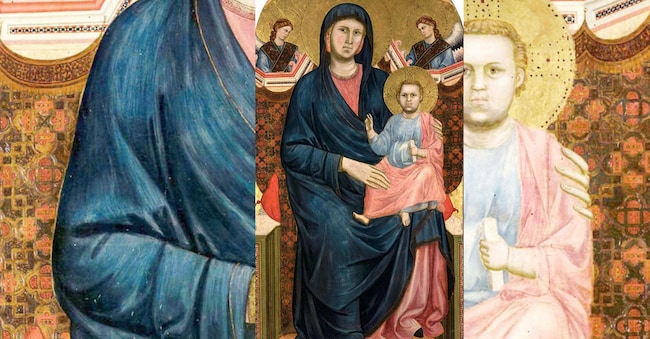
There is a curl that marks the artistic and social revolution that swept through 14th-century Umbria to open the door to modern art. It is the one that discreetly emerges from the veil of the Madonna Enthroned with Child and Two Angels (Madonna of San Giorgio alla Costa, circa 1290). Giotto was little more than twenty years old, he had breathed in the teachings of Duccio, Cimabue and Arnolfo but he was already beyond them and that curl forever unhinged art because "Giotto - as Cennino Cennini writes in the Libro dell'arte (late 14th century) - remutualised the art of painting from Greek into Latin and reduced to modern ebe the most accomplished art that I ever had". So, who better than he could decorate the basilica of Assisi, Ecclesia specialis, caput et mater of the Franciscan order. In 1288, Nicholas IV, the first Franciscan pontiff, issued the bulls Reducentes ad sedule so that the alms of the Porziuncola and the tomb of Francis would be destined to "facere conservari, reparari, hedificari, emendari, ampliari, aptari et ornari" the upper basilica, which was still bare, while the lower one had been decorated in 1260 by the Master of St Francis. A teeming cosmopolitan building site opened, workers came from all over and even Giotto, following Jacopo Torriti, but his two scenes from the Stories of Isaac made history: his art is a study of truth, of nature and the human heart. Lights, shadows and volumes disrupt the Byzantine rigidity. And nothing will ever be the same again. This is the change recounted at the National Gallery of Umbria in Perugia by "Giotto and St Francis. Una rivoluzione nell'Umbria del Trecento", curated by Veruska Picchiarelli and Emanuele Zappasodi, a research and popularisation exhibition in continuity with the historical exhibition on the Master of St. Francis in 2024. This too is proposed as a founding moment of research because it has the ambition of illustrating the vitality of a phase marked by Giotto's magisterium, which is a magnet for attracting and nurturing the Umbrian masters of the site.
The walls wrapped in a blue reminiscent of certain backdrops of the upper church leave room for infinity to immerse oneself in what Zappasodi calls 'a visionary passionality, capable of sublime tenderness and seething violence'. It is the very young Giotto of the Madonna di San Giorgio alla Costa, with a throne that looks like an architecture, kufic characters and Mary's sweetly inclined face, or of the Polittico di Badia, where the impalpability of St Benedict's beard is enough to grasp the change of epoch. That did not go unnoticed by the many artists present in Assisi: "The Umbrians,' writes Veruska Picchiarelli, 'were the first admiring spectators of that figurative revolution ... they were also, and above all, the indispensable accomplices of the first decisive stages of that upheaval, which appeared as such also by virtue of the lightning speed with which it saw the light'. The 'passion of the Umbrians' - as Roberto Longhi defined it - shines through in the Master of the Farneto and the Master of the Cross of Gubbio, who close their careers within the first decade of the 14th century, reworking the new instances. The Master of Cesi and Palmerino di Guido worked longer and had time to absorb Giotto's poetics, as can be appreciated in the St. Magdalene visited by Zosimus, a work that has just entered the Perugia collections, with Christ Blessing between St. Francis and St. Catherine of Alexandria. Without Giotto, the tunic offered by Zosimus to Magdalene would never have been so red, so alive.
In Assisi, Giotto frescoed the humanity of Francis and, in the lower church, the chapel of St Nicholas, decorated with Palmerino di Guido, and the Stories of Childhood are a figurative and stylistic sampler, as shown by the Trittico of the Master of Paciano reconstructed for the first time or the Perugian miniatures in the choir books of St Dominic. Giotto, whose Feminine Head, the only extant fragment of the sails, is presented, does not stop, works, matures and the Stories of the Magdalene (1307-1308) mark his entry into the Gothic style, which also veils the magnificent Pentecost from the National Gallery in London. Painting became rarefied, silenced to leave space for the Spirit, and Simone Martini, like Pietro Lorenzetti, who arrived in Assisi in the second decade, could not help but be captivated by it. The former, in the frescoes of the chapels of San Martino and Santa Elisabetta, unfolds his elegance; the latter completes the decoration envisaged but never realised by Giotto and the Maestà of Cortona on display is a masterpiece of feeling like one of his stained-glass windows.
Giotto's assistants included the Master of Figline, who coordinated the stained glass work, and above all Palmerino di Guido, the only Umbrian painter documented with Giotto in Assisi in a deed dated 1309. These were shining years, of exchanges and contaminations, also documented in the essays - among others - by Andrea De Marchi, Laura Cavazzini, Alessandro Bagnoli and Francesca Pasut. The decorations of Assisi, also narrated by an immersive docufilm, sow beauty, which, like an echo, travels to Umbria, on this side and on the other side of the Tiber, and permeates Italia. In those years, no more than three decades, from 1290 to 1320, for the first time after classicism, there is a common language, made of humanity, softness and poetry. In the Vite (1568), Giorgio Vasari recounted it as a 'most sweet and united manner', the same as in the Maestà con San Francesco, a fresco detached from the Porta di San Rufino in Assisi in 1880. The author, who remained unknown for a long time, was recognised in Puccio Capanna, who closes the exhibition. It is the year 1341 and his Francis speaks of the way, truth and life and, as we descend towards the plain, the flowering brooms seem eternal 'coloriti flori et herba' because Francis himself sang them.
Giotto and Saint Francis. Una rivoluzione nell'Umbria del Trecento, Curated by Veruska Picchiarelli and Emanuele Zappasodi, Perugia, National Gallery of Umbria, until 14 June 2026


