Collecting natural history specimens

It’s time for Jodi, the 47 million Tyrannosaurus up for auction

At Sotheby’s New York, the skeleton of a Nanotyrannus confirms that fossils are the latest trophy items to be displayed

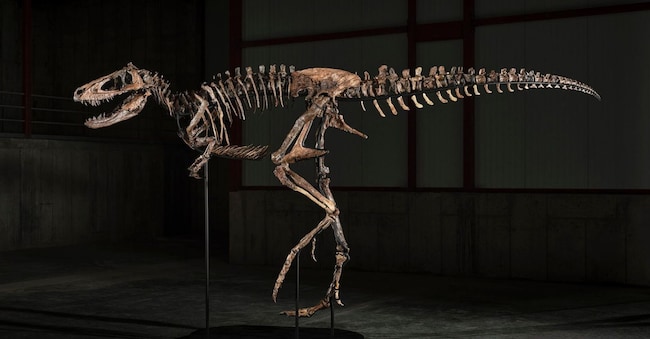
Jodi, scheletro montato di Nanotyrannus (circa 67 milioni di anni fa), Formazione di Hell Creek, Montana

6' min read

Translated by AI
Versione italiana

6' min read

Translated by AI
Versione italiana

Dinosaurs continue to roar – a notion put forward in *Jurassic Park*, but not shared by scholars – in places quite out of their element: auction houses. It is a fact that the cycle that began in October 2020 with the sale of ‘Stan’ seems far from over: on the evening of 27 October, another dinosaur triumphed amongst the skyscrapers of Manhattan, ‘Jodi’, which changed hands from Sotheby’s for the staggering sum of 47.3 million dollars (40.5 million at the hammer), from a modest estimate of 6–9 million. The result is therefore more than five times the upper estimate and secures second place in the all-time rankings for dinosaurs sold at public auction: it is surpassed only by the Tyrannosaurus rex ‘Gus’ ($50.1 million, also at Sotheby’s, last July). The Stegosaurus ‘Apex’, meanwhile, slips to third place on the podium (44.6 million in 2024). Not bad for a ‘minor’ predator, lacking the fame of its more celebrated relative, and which, until a year ago, was considered by many to be nothing more than a ‘juvenile specimen’ of that species.
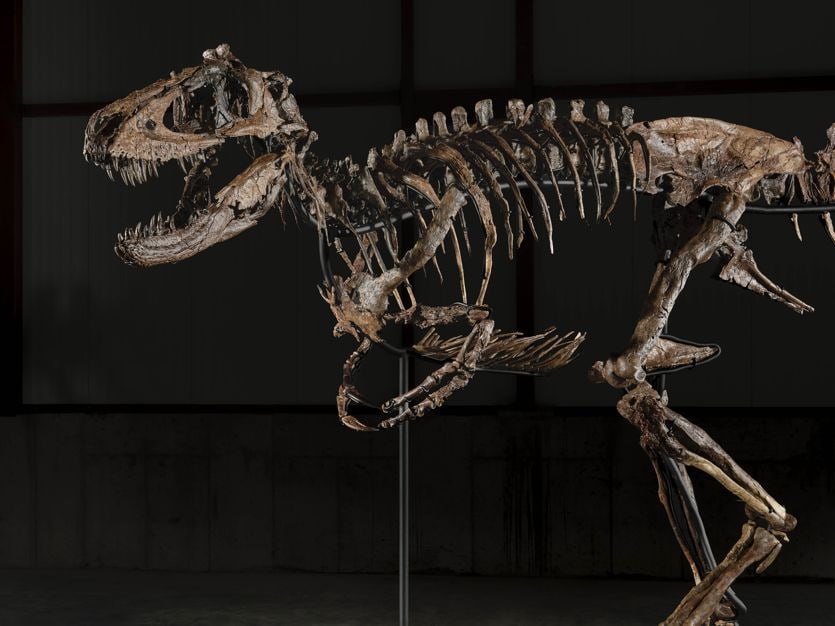
Jodi, scheletro montato di Nanotyrannus

The story and profile of Jodi, the last dinosaur to be auctioned

The fossil was discovered in 2019 in Montana, in the Hell Creek Formation on land in Garfield County. It is named after the landowner, the rancher Jodi Pierson, as stated by Sotheby’s. The discovery was no coincidence, having taken place some 13 kilometres from the site of the famous ‘Dueling Dinosaurs’ by a non-academic palaeontologist, Clayton Phipps, the rancher’s cousin, nicknamed the ‘Dinosaur Cowboy’ precisely because he had unearthed the Dueling Dinosaurs (the story is recounted in the 2020 Discovery Channel series *Dino Hunters*).

Loading...

Jodi is a nano-tyrannosaur, a specimen of *Nanotyrannus lancensis* – to use the scientific terminology – dating back 67 million years, almost six metres long and two metres tall. It is a separate genus from Tyrannosaurus: for more than 80 years, the scientific community was divided on this issue, only reaching a consensus on 30 October 2025, when a study by Lindsay Zanno and James Napoli published in Nature – following the examination of over 200 tyrannosaur fossils – established that Nanotyrannus is a genus in its own right, contemporary with T. rex at the end of the Cretaceous period. But with its own ecological niche. It is divided into two species: N. lancensis and N. lethaeus.
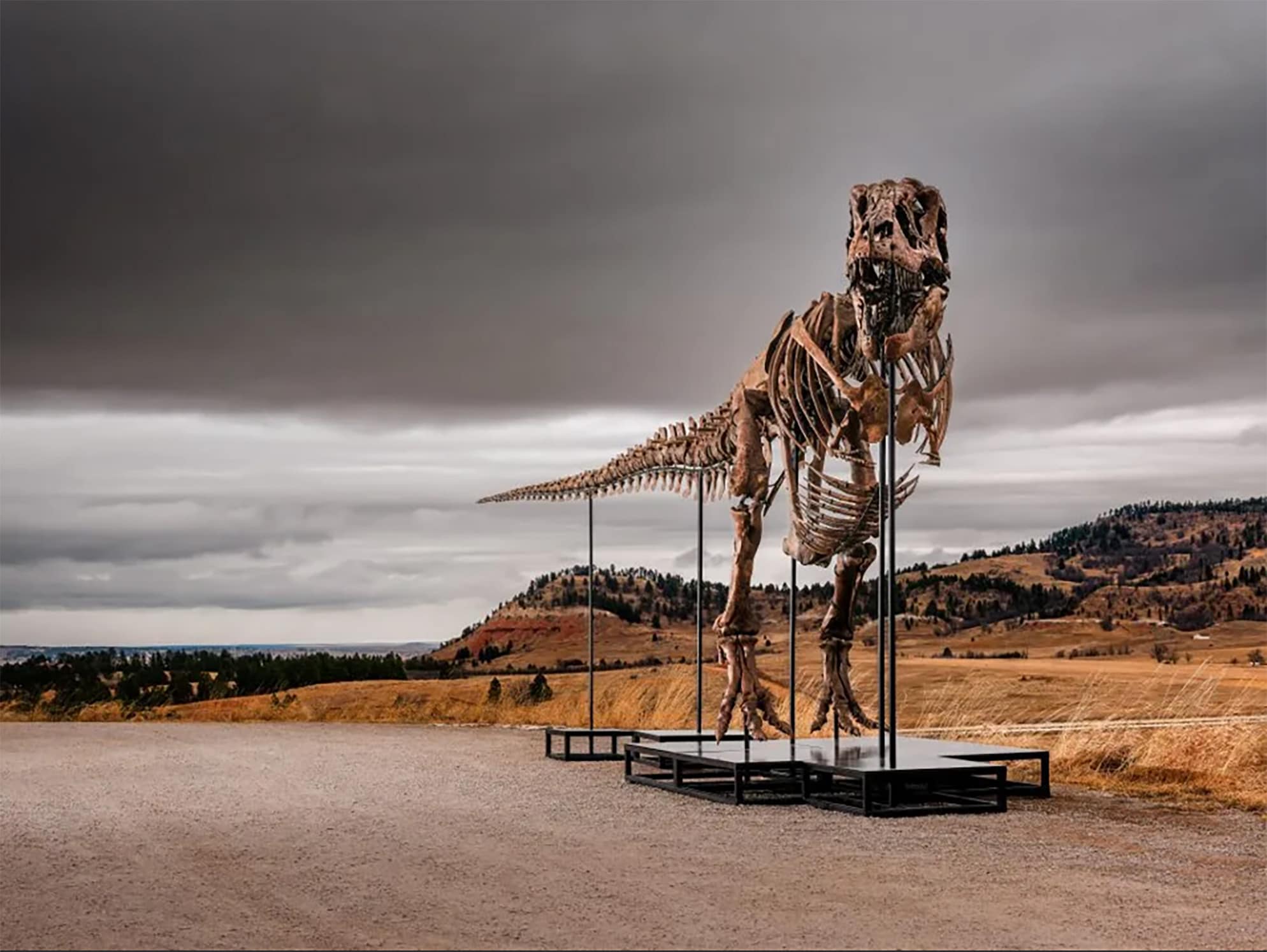
Gus trex (Matthew Sherman Sotheby’s)

There are over 150 morphological differences compared with the ‘common’ tyrannosaur. An adult nanotyrannosaur measured around 5.5 metres, compared with 12 metres for a T. rex; it also had significantly longer forelimbs and larger claws; more teeth: up to 17 tooth sockets in the lower jaw (compared with 12–13 in its ‘cousin’) and fewer caudal vertebrae (35 compared with 40–45). Cassandra Hatton, vice-president of Sotheby’s and global head of the Science and Natural History department, explained: ‘For decades, scientists have debated whether Nanotyrannus was simply an adolescent T. rex or represented an entirely different genus of dinosaur. The debate has now been settled.’

The factors behind the auction’s resurgence: novelty, quality, rarity

The nano-tyrannosaur has therefore only recently been discovered and, at present, there are just three skeletons known. The ‘Jodi’ specimen consists of 191 fossilised bone elements. The skull stands out as being essentially complete (53 bones and around 50 teeth at various stages of eruption); the pelvis, the furcula (a bone in the thorax) and all four claws on the hand are also intact. For the auction house, this is the ‘finest Nanotyrannus available’, second only to the spectacular ‘Bloody Mary’, discovered in the same area in Montana and now housed at the North Carolina Museum of Natural Sciences. Beyond its new scientific classification, however, Jodi is no stranger to the market: it had already made an appearance in 2023 at Frieze Masters in London, under the name Chomper. At the time, it was still believed to be a juvenile Tyrannosaurus rex, and the London-based dealer David Aaron (who was offering it for $20 million) failed to sell it. Three years after that flop, the seller, who had purchased it in 2021, got his revenge and financial compensation at a public auction, thanks to several new factors (notably its name and scientific classification).
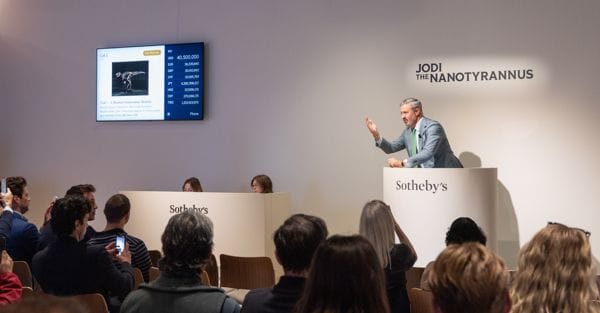
Ben Levine

From Sue to Gus: thirty years of revivals

The first dinosaur ever to go under the hammer dates back to 1997. The buyer of that lot – the Tyrannosaurus rex known as ‘Sue’ – was the Field Museum in Chicago; the auction house was, once again, Sotheby’s. The figure? $8.36 million, a record at the time (adjusted for inflation, that would be around $17.5 million today). But it was the pandemic-stricken October of 2020 that marked the turning point. On that occasion, it was Christie’s that broke new ground, including the T. rex ‘Stan’ in its New York evening sale, alongside masterpieces by Cézanne, Picasso, Pollock, Monet, Rothko and Twombly. After twenty frenzied minutes of telephone bidding, someone snapped it up for $31.8 million, starting from a minimum estimate of six. The dinosaur had officially become a trophy item, a worthy counterpart to high-end collectables, be they blue-chip artworks, rare watches or jewellery of magnetic beauty.

Then, in July 2024, it was the turn of the Apex stegosaurus, which – at 150 million years old and showing some understandable signs of arthritis – fetched a record $44.6 million at Sotheby’s. The buyer, whose identity is known, is the founder of the hedge fund Citadel, Ken Griffin, who subsequently loaned it to the American Museum of Natural History in New York. But the inhabitants who have preceded us on this planet over the past five years have begun to repopulate it (albeit in a ‘differently alive’ manner): on 16 July 2025, for example, a ‘juvenile’ ceratopsian from the Late Jurassic – also one of only three in existence – rose to $30.5 million from an estimate of $4–6 million. At the same auction (where 95 per cent of the lots were sold), a Tyrannosaurus rex foot changed hands for 1.76 million, up from a minimum estimate of 250,000 dollars. And finally, along came the bold Gus, who, on the 2026 anniversary of the French Revolution, stormed his own Bastille: 43 million at the hammer and 50.1 million including premiums after 19 minutes of bidding, against a starting estimate of 20–30 million – the highest price ever paid for a dinosaur.

Auction houses are not missing out on this segment

Christie’s established a science and natural history department as early as 2016, holding two sales a year. In November 2025, even Phillips – known and renowned above all for its unrivalled watches, photography and multiples) by holding its first-ever natural history auction, the highlight of which was the juvenile triceratops Cera (66 million years old and sold for $5.4 million, against an estimate of $2.5–3.5 million). In March 2026, it was Joopiter’s turn, with the triceratops Trey selling for 5.55 million.
And what about Italia? In December 2021, Cambi made its debut, having included an hadrosaurid – the Hypacrosaurus, renamed Henry – in the catalogue for its Milan auction, alongside the post-war masters.

So, no downsides then? Not exactly: every success story needs one to give it more depth. In November 2022, for example, Christie’s Hong Kong withdrew the T. rex ‘Shen’ – estimated at 15–25 million dollars – from auction. It would have been the first dinosaur to be auctioned in Asia, but palaeontologists at the Black Hills Institute had pointed out that it bore too close a resemblance to ‘Stan’, which the institute itself had reconstructed and studied.

Excessively high admission prices are a burden on museums

The real downside lies in the prices. At these prices, public institutions cannot compete with large private collections, with the risk that these extremely rare and valuable fossil specimens may be withdrawn from scientific research. It is true that billionaires often flaunt their generosity by lending them to museums, but it is undeniable that these are still loans that can be terminated at any time, perhaps due to the need to sell them off at auction. Auction houses emphasise the benefits of private initiative, without which many finds would remain buried. Jodi’s story provides arguments for both sides: a dinosaur brought to light thanks to a commercial palaeontologist – the same one behind the ‘Dueling Dinosaurs’ – which, once they ended up in a museum, helped clarify what the Nanotyrannus really was.

Copyright reserved ©
Loading...
Loading...

Brand connect

Loading...

Newsletter

Notizie e approfondimenti sugli avvenimenti politici, economici e finanziari.

Iscriviti