
Slight increase in exports of professional catering products
The value is close to 2.1 billion: bestsellers abroad include cookers and hobs, pots and pans
by Enrico Netti
 Aggiungi Il Sole 24 Ore
ai preferiti su Google
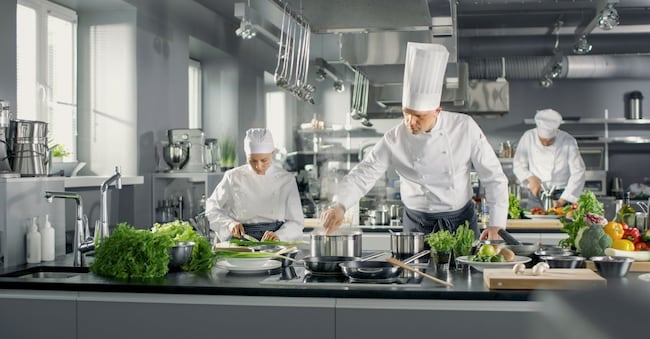
Cookers, hobs and electric ovens, pots and pans are the main items of made in Italy for professional catering that are exported. In 2025, the export of this segment was close to 2.1 billion Euro with a +1.3% over the previous year. In particular, the value of cookers and hobs was 732 million, while for pots and pans another 651 million. The value of domestic production last year was about 3.1 billion with a compound annual growth rate of 3.3% and an increase of 19% over 2019. Domestic demand reached 2.4 billion with an average Cagr of 6.8% compared to the pre covid period.
According to data compiled by ExportPlanning exclusively for the Host Milano Observatory, in 2025 world production for the professional catering sector - cookers, ovens, hobs, cooking appliances and equipment - reached 77.7 billion euros, an increase of around 35% compared to 2019 and a compound annual growth rate of +5.2%. The most dynamic category, with an average growth rate of +10.3% per year, is small electromechanical appliances: a sign of the increasing automation of the most operational aspects. In absolute value, however, the top two types of equipment are pots and pans (EUR 26.9 billion, CAGR +3.8%) and cookers, hobs and electric ovens (EUR 23 billion, CAGR +5.2%), which together account for two thirds of world production.
As far as world trade is concerned, ExportPlanning's forecasts indicate a CAGR of +4.3% in the three-year period 2027-2029, approaching EUR 65 billion compared to EUR 55.8 billion in 2025. The world's leading market is the United States, with EUR 8.4 billion (15.6% share), followed by Germany (EUR 4.8 billion), the Netherlands and Poland (both at EUR 2.5 billion) and France (EUR 2.4 billion). Looking ahead, the largest contributions to demand growth are expected from Europe: Germany leads with +906 million (CAGR +4.5%), followed by Poland (+642 million, CAGR +6%) and the Netherlands (+551 million, CAGR +5%).
In the run-up to Host 2027, new structural trends are emerging that are redefining spaces, menus and service models. Starting with spaces: the professional kitchen is no longer a hidden area, but is increasingly the visible heart of the restaurant. In the most recent projects, the room revolves around the open kitchen, with a layout that combines transparency, theatricality and functionality. The boundary between production and consumption becomes thinner, and the visibility of the process becomes an integral part of the experience offered to the guest. Restaurants today are designed as modular systems capable of changing layout between lunch, aperitif, dinner, private event and delivery pick-up, with furnishings and indoor/outdoor areas treated as a single adaptive system: more than an aesthetic choice, a structural response to the multiplication of consumption occasions. Consumption, in fact, is increasingly pulverised into frequent micro-occasions. The day no longer revolves only around lunch and dinner. Evolved snacks, mini-portions, sharing plates and weekday brunches are reshaping menus and time slots, widening windows of opportunity and requiring more versatile equipment and faster production cycles, often bringing together functions as diverse as catering, bakery, café and food retail.

