2026 World Cup

It’s the world championship of ‘American’ show business: an average of three goals per match

The average number of goals scored in the group stage has never been so high in the last thirty years. A higher total was only achieved at the other World Cup held in the US in ’94

by Marco Bellinazzo

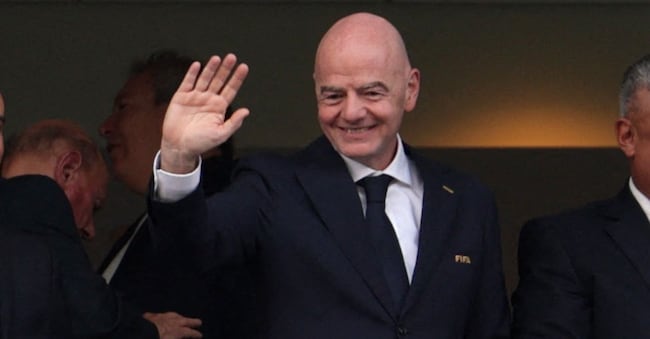
I presidente della FIFA Gianni Infantino REUTERS

4' min read

Translated by AI
Versione italiana

4' min read

Translated by AI
Versione italiana

Operation successful. If the 2026 World Cup was to be the tournament that cemented football’s status as a global show-business platform – the aim of Gianni Infantino’s FIFA – the goal-scoring statistics from the group stage so far confirm that this target has been met. In fact, the average number of goals scored has never been so high in the last thirty years: 3 per match. A higher level was achieved only at the other World Cup held in the Americas, in 1994, coinciding with the introduction of the three-point-per-match system in the World Cup – a move designed precisely to encourage a more attacking and spectacular style of play and to discourage teams from playing for a draw.

The historical time series 1990–2026

World Cup - Teams - Goals - Matches - Goals per match

Loading...

Italia ’90 - 24 - 81 - 36 - 2.25 

USA ’94 - 24 - 117 - 36 - 3.25

France ’98 - 32 113 48 - 2.35

Korea–Japan ’02 - 32 - 109 - 48 - 2.27 

Germany ’06 - 32 - 98 - 48 - 2.04  

South Africa ’10 - 32 - 101 - 48 - 2.10 

Brazil ’14 - 32 - 136 - 48 - 2.83 

Russia ’18 - 32 - 122 - 48 - 2.54

Qatar ’22 - 32 - 120 - 48 - 2.50 

USA–CAN–MEX ’26 - 48 - 218 - 72 - 3.03

The evolution of football as entertainment

Following Italia ’90 – a tournament in which 81 goals were scored in the group stages, averaging 2.25 per match, and which was described as “one of the least spectacular” in history – FIFA took swift action by introducing decisive reforms such as the ban on back-passes to the goalkeeper and the three-point system for wins. It is no coincidence that at the 1994 World Cup in the US, this paradigm shift resulted in 117 goals in the group stages, with an average of 3.25 per match.

However, with the subsequent World Cups in 1998 and 2002, following the expansion to 32 teams, a new global balance was restored, with the average number of goals per match stabilising at just over two (2.35 and 2.27).

In fact, between 2006 and 2010, the figures fell to 2.04 and 2.10, with a return to a more defensive style of play, based on tactical organisation of the highest order and the closing down of space. It was the least prolific World Cup of the modern era.

A surge – rather than a genuine change of pace – was evident in 2014, with 136 goals scored in the group stages and an average that jumped to 2.83, thanks to more widespread attacking quality and a more direct, less predictable style of play developed during that tournament. In subsequent tournaments, however, the average returned to two and a half goals per match (2.54 in 2018 and 2.50 in 2022).

The real turning point, however, came with the 2026 tournament, which saw the competition expand to 48 teams, with 218 goals scored in the group stages and an average of 3.03 goals per match.

The analysis

The average number of goals scored in the group stage, whilst by any measure a partial indicator, provides a good picture of the economic, competitive and entertainment-related evolution of the World Cup.

Looking back at the 2006–2010 cycle, it is fair to say that the World Cup was characterised by a style of football that remained strongly European in nature, with risk management as the priority. The 98 goals scored in the group stages – just over two per match – reflected a dominant tactical culture. This pattern was repeated in 2010: 101 goals and a slightly higher average (2.10). An all-time low in the modern era, characterised by tight matches, a slow pace and a strong focus on defence.

Since the 2014 World Cup in Brazil, we have seen more spectacular tournaments, with the average number of goals rising to 2.83 before stabilising at two and a half goals per match in the two subsequent World Cups, in Russia and Qatar. This is the combined effect of several factors: greater attacking quality across the board, improvements in athleticism, and the consolidation of a technical globalisation of national teams.

If goals are to return to the heart of the football product – as a key element of the spectacle and, consequently, a driver of economic returns – it is the 2026 World Cup that will mark a radical change. With the expansion to 48 teams and 72 group stage matches, the tournament produced 218 goals, bringing the average to 3.03 goals per match.

It’s not just a record: it’s a structural shift. The 2026 World Cup, with an average of over three goals per match, demonstrates that FIFA has chosen a clear direction: on the one hand, to increase the number of matches (+50% compared to the past); on the other, to maximise narrative intensity and use goals as a value multiplier. Goals increase viewers’ attention span, make the match more ‘marketable’, and boost highlights, social media engagement and the development of digital rights.

The 2026 World Cup saw the number of goalless draws halved compared with recent history. Out of the 72 matches, only three ended goalless (Spain v Cape Verde, Cape Verde v Saudi Arabia and Colombia v Portugal), accounting for 4.2 per cent; whereas between 1990 and 2014, the average was almost never below 10 per cent. The exception was the 2018 World Cup, in which there was just one goalless draw.

The new format has had an impact by widening the technical gap between teams and reducing the pressure on them, as it has allowed the eight best third-placed teams from the 12 groups to progress to the knockout stage as well.

The flip side, of course, is less competitive balance, more one-sided matches and the risk of a decline in overall quality. But this is the classic trade-off in modern sport: between excellence and entertainment.

The fact remains that the World Cup has gradually evolved from an elite sporting competition into a global platform for football entertainment. And goals reflect this transformation: they are the highlights of the sporting event, but today they also serve as narrative catalysts, commercial drivers and tools for engagement.

Copyright reserved ©
Loading...

Brand connect

Loading...

Newsletter

Notizie e approfondimenti sugli avvenimenti politici, economici e finanziari.

Iscriviti

Tutto mercato WEB