Awards

Andrea Bajani wins the Strega: 'even males must challenge patriarchy'

"L'anniversario" (Feltrinelli) won 194 votes, second place went to Elisabetta Rasy with 133 votes for "Perduto è questo mare" (Rizzoli), third to Nadia Terranova, with "Quello che so di te" (Guanda, 117 votes), fourth to Paolo Nori, with "Chiudo la porta e urlo" (Mondadori, 103 votes), fifth to Michele Ruol with "Inventario di quel che resta dopo che la foresta brucia" (TerraRossa, 99 votes)

by Lara Ricci

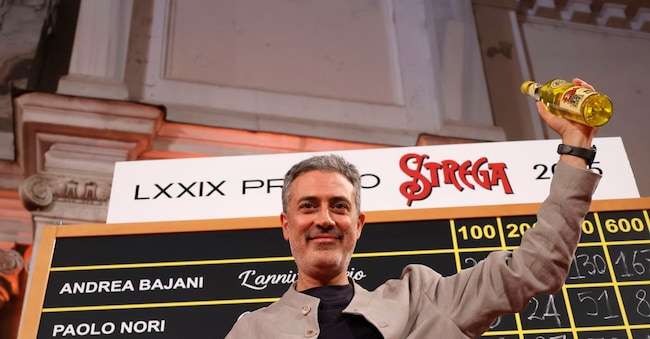
Andrea Bajani, vincitore Premio Strega 2025Ñ Italia Ñ Gioved“ 3 Luglio 2025  - Cronaca - (foto di Cecilia Fabiano/ LaPresse)   Andrea Bajani,winner  Strega Prize 2025Ñ RomeÑItaly Ñ  Thursday , July 3, 2025 - News - (photo by Cecilia Fabiano/LaPresse)

4' min read

4' min read

"Making literature means contradicting the official version. Today the official version is that of patriarchy. With L'anniversario I wanted to tell the story of the need for males to contest it too,' said the writer Andrea Bajani in the nymphaeum of Villa Giulia, in Rome, as he collected the Strega Prize 2025, which he won with 194 votes.

And indeed, it is precisely the rarity of a male writer who undertakes to analyse through literature the system of power that permeates society starting from its founding element, the family, and the destructive effects that this, and the violence inherent in it, produces not only on women, but also on men, that surprises and intrigues those who read The Anniversary (Feltrinelli).

Loading...

The contestation of patriarchy, here, takes the form of a long portrait of the mother, told through analgesis starting from the last time the narrator (who is probably the author) saw her. Bajani traces in family episodes and in the very image the son had of his mother the effect of his father's actions and the culture in which they were immersed. Micro-violence, sometimes, such as saying 'this is a book for your mother' to say that it was ugly, or actual physical violence.

A portrait that is not easy because 'If I have never written about my mother, nor had a thought about her, it is because in order to do so she must be separated from my father', he writes. In order to do so, he relies on fiction, a 'device' that allows him to imagine a woman he never really knew, nor really paid attention to, because she was so crushed by a violent, despotic and self-centred man ('he wanted her to be nothing so that he could be something, and she wanted to be nothing so that being nothing was at least something'), that she became invisible even to herself. This is the original and dramatic idea at the heart of the book, which is developed with effectiveness and psychological finesse.

The protagonist's mother is not dead, but he has been denying himself to his family for ten years, having lost track of her. And the family of origin becomes a sort of 'phantom limb' for him. A choice that he does not live with the guilt of an abandonment, but as an evasion, as a claim to a right, the author clarified during the ceremony of the most famous Italian award. A decision that is still seen as scandalous, 'because scandalous is what people tell themselves but do not have the courage to tell others'.

Through a polished language, purged of emotions and strong tones - the voice of one who emerges, finally, from a very long, exhausting suffering - and a pitiless analysis of himself, Bajani delineates the figure of a woman who 'alone did not consider herself sufficient'. A woman who began to live as if behind soundproof glass, convinced she was so insignificant that everything around her, including her children, also became insignificant. Who, in order not to live in fear, walled herself in indifference.

The penetrating analysis of the first part of the book, effective above all in rendering the image of the invisible mother, falls somewhat flat in the second part, less resolved and less convincing. For example in the interpretation of the episode in which the mother - in order not to upset the father who wanted to go on holiday and who had by then turned off the general water tap - brushes her teeth by dipping her toothbrush into the toilet. If the aim was only not to antagonise the father, as Bajani claims, why not simply give up brushing his teeth? The impression is that this scene hides something else - self-harm, masochism - other effects that patriarchy can generate on its victims, and that would be interesting to explore. However, the author only hints at a 'familiarity with abjection'. In the same way, the idea that the father, through violence, demands love is unconvincing, and seems to undermine an overall vision of the mechanisms on which patriarchy is based, if not actually falling into the stereotypes that this culture conveys.

The figure of the father, which we hope will be at the centre of one of the author's next novels, stands out instead in the book that came second: Perduto è questo mare (Rizzoli, 133 votes), by Elisabetta Rasy. A father from whom she had distanced herself, as she had distanced herself from her father-land, Naples, and who is recounted in parallel with a putative father, a father friend, the writer Raffaele La Capria. Nadia Terranova, a Strega finalist for the second time, came third with Quello che so di te (Guanda, 117 votes), again a family portrait, that of her great-grandmother interned in an asylum for 11 days in 1928. In fourth place was Paolo Nori, with Chiudo la porta e urlo (Mondadori, 103 votes), in which Raffaello Baldini's poems become a short story and - not far behind - in fifth place, newcomer Michele Ruol, with Inventario di quel che resta dopo che la foresta brucia (TerraRossa, 99 votes), a tale, through familiar objects, of the two children a couple has lost.

Copyright reserved ©
  • Lara Ricci

    Lara Riccivicecaposervizio curatrice delle pagine di letteratura e poesia

    Luogo: Milano e Ginevra

    Lingue parlate: Inglese e francese correntemente, tedesco scolastico

    Argomenti: Letteratura, poesia, scienza, diritti umani

    Premi: Voltolino, Piazzano, Laigueglia, Quasimodo

Loading...

Brand connect

Loading...

Newsletter

Notizie e approfondimenti sugli avvenimenti politici, economici e finanziari.

Iscriviti