
Android changes skin with Gemini Intelligence: the operating system is now an agent AI
by Gianni Rusconi
 Aggiungi Il Sole 24 Ore
ai preferiti su Google
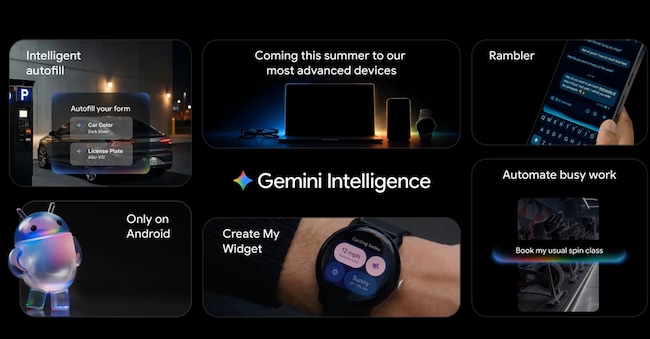
No longer just an operating system, but a cognitive platform capable of understanding context, anticipating user intentions and acting autonomously within applications, browsers and services. From the Android Show 2026, the event with which Google anticipated the main novelties that will animate the upcoming I/O (from Android 17 to the debut of Googlebook laptops up to the new AI functions for Chrome, Android Auto and Wear OS), 'Gemini Intelligence' took the stage, a sort of new umbrella brand that gathers together all the artificial intelligence functionalities integrated in Mountain View's mobile operating system and that represents, in essence, the passage from the era of the 'reactive' smartphone to that of the 'agentic' phone. Google, in fact, is absolutely convinced that it has introduced one of the most profound transformations ever seen in the Android experience and describes Gemini Intelligence as a true 'AI layer' integrated into the operating system. As for the timing of the release, the new platform will initially only debut on selected devices (in particular the future Pixel 10 and the Samsung Galaxy S26) and then extend to tablets, cars, laptops and wearable devices by the end of the year, without Google having specified precise dates for the launch on the European market.
From chatbot to 'intelligence layer'
The transformation on which BigG relies is above all conceptual: if until now Gemini was perceived as an advanced artificial intelligence assistant, an alternative to competing chatbots, Gemini Intelligence instead enters the heart of the operating system. Android is consequently no longer presented as an environment running applications, but as an intelligent infrastructure capable of coordinating services, personal data and interactions in real time. The breakthrough, if it can be called such, is that Gemini does not just answer questions but can perform actions, and was created precisely to make Android 'much more proactive' in the management of everyday activities. Google speaks in this sense of 'task automation', i.e. the automation of multi-step actions within apps.
What does this mean in concrete terms? That the user can ask the smartphone to organise a complex task (e.g. booking a taxi ride, buying products, searching for information in Gmail, comparing online offers, or something else), leaving it to the system to perform the various steps. Gemini Intelligence, as several insiders observe, marks an evolution that brings Android closer to the concept of an 'AI agent', a transversal intelligence that orchestrates functions and services, overcoming the concept of separate applications requiring continuous input. And Google, rightly, 'celebrates' this evolution by calling it a transition 'from operating system to intelligence system'.
The smartphone understands what it sees
One of the most innovative aspects of Gemini Intelligence concerns its ability to interpret visual context. The AI, in other words, can analyse what appears on the smartphone screen, read screenshots, images and open content in apps to transform them into operational actions. During the presentation, Google's executives demoed some emblematic functionalities of this capability: from taking a picture of a tourist brochure to search for similar travel experiences on booking platforms to using a shopping list received by e-mail to automatically create an online purchase order to retrieving information from Gmail or Google Photos to complete forms and bookings. The underlying objective is to eliminate the fragmentation typical of the mobile experience, where the user is forced to copy data between different applications.
To overcome this limitation, Gemini Intelligence's technology exploits OCR algorithms and computer vision systems to 'understand' what appears on the display, and thanks to the integration with Gmail, Photos and Wallet, the new Autofill function allows Android to fill in complex fields using contextual personal data, always with the user's consent. Google, in short, seems to have given a boost to the idea of differentiating its Android operating system by 'augmenting' it with AI capabilities, and it does so by emphasising the issue of privacy. Gemini Intelligence, as BigG's managers emphatically reiterated, only acts after an explicit request from the user and always leaves the final confirmation for sensitive actions such as purchases or bookings to the same user: will it be enough to ensure that the functions are opt-in, and therefore controllable and deactivatable, so as not to fall into the trap of personal data violations? This is the issue that Gemini Intelligence is likely to raise.

