
Mission to Antarctica to study climate: the icebreaker Laura Bassi sets sail from Trieste
The icebreaker Laura Bassi departs from Trieste to create a worldwide archive of ice samples threatened by climate change, supported by the international Ice Memory project

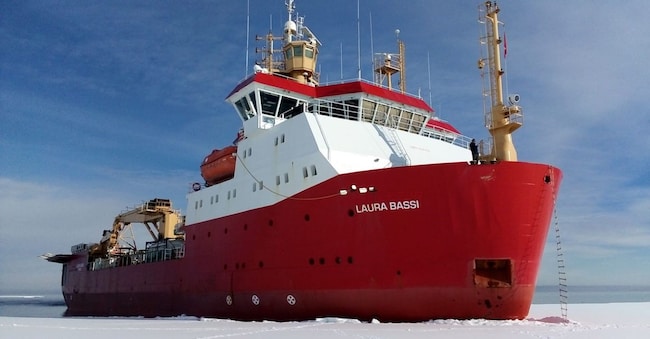
The mission, one of the objectives of which is to create a kind of climate database through the creation of a worldwide archive of samples from glaciers threatened by climate change, has begun. The icebreaker ship Laura Bassi, owned by the National Institute of Oceanography and Experimental Geophysics, has set sail from the port of Trieste with the destination (arrival is expected in December) Antarctica, after a passage through New Zealand.
Shipment
"The Laura Bassi expedition in the austral summer of 2025-2026 will be divided into two phases: the first, dedicated to the provisioning of the Mario Zucchelli base, will begin at the end of November," says Franco Coren, director of the Naval Infrastructure Management Centre of the National Institute of Oceanography and Experimental Geophysics. "We will then convoy with the icebreaker ship of the Korean Antarctic project, the Araon. The two vessels will alternate along the route to support each other in navigation, the appointment is at the beginning of December at the edge of the ice," he argues. "Afterwards, we will return to New Zealand for the second part of the mission, focused on five scientific projects, which will last until the beginning of March.
The renovated ship
The initiative, which benefits from the recognition of Unesco, has among its founders the Polar Science Institute of the National Research Council (CNR-Isp) and the Ca' Foscari University of Venice, as well as four other European institutions. Also supporting the project is the National Antarctic Research Programme.
La nave parte con un nuovo assetto in seguito a un piano di ammodernamento e manutenzione straordinaria, realizzati grazie a uno stanziamento di 4 milioni di euro del Ministero dell’Università e della Ricerca nell’ambito del Fondo per l’edilizia e le infrastrutture di ricerca. A bordo, oltre alla strumentazione scientifica e ai materiali per la quarantunesima campagna del Programma Nazionale di Ricerche in Antartide, saranno trasportate anche le carote di ghiaccio raccolte nell’ambito dell’iniziativa internazionale Ice Memory, guidata dalla Ice Memory Foundation. Quelle estratte nel maggio 2025 sul Grand Combin (Svizzera) e nel 2016 sul Monte Bianco (Francia). I campioni attraverseranno due emisferi con un viaggio di oltre cinquanta giorni da Trieste fino all’Antartide. «Il trasporto dei campioni in Antartide realizza un sogno sul quale abbiamo lavorato per un decennio - ricorda Carlo Barbante, professore all’Università Ca’ Foscari Venezia, cofondatore del progetto Ice Memory e vice-preside
World Ice Archive
The aim is to create a worldwide archive of samples from ice threatened by climate change, a kind of climate database available to the next generation of scientists. The ice holds valuable information about the atmosphere of the past - greenhouse gases, aerosols, dust and pollutants - that is crucial for understanding the evolution of the Earth's climate and environment.

