Australia

Who is the politician with the Apulian father who put the Left back in government

The son of a single mother and of Italian descent, he has built a political career centred on social equity, public health and economic recovery. His personal story embodies redemption and pragmatic leadership

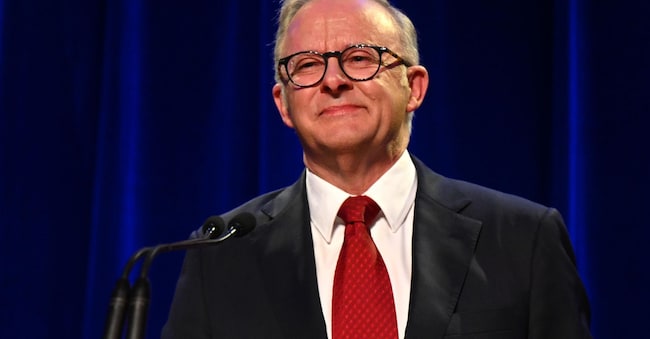
by Angelica Migliorisi

Il primo ministro australiano Anthony Albanese. (EPA/Lukas Coch)

6' min read

Translated by AI
Versione italiana

6' min read

Translated by AI
Versione italiana

It is a story of social and political redemption that of Anthony Albanese, Australia's first prime minister who won a second consecutive three-year term in 21 years. With 55% of the count completed but only 14 seats still to be filled, his Labor Party won 86 MPs, ten more than the absolute majority threshold.

The possible Trump effect

Donald Trump's long shadow may have had an effect on Australian voters' choices by penalising Peter Dutton, lader of the conservative opposition coalition, for his ideological ties to the US president.

Loading...

If now Labour led by Albanese seems destined to reconfirm its leadership, a few months ago the situation was different. The centre-right coalition - bringing together Liberals and Nationalists under Dutton's leadership - was ahead in the polls. Then the international climate changed and Trump's return to the White House unleashed shockwaves in Canberra as well. The US administration's decision to introduce new customs tariffs and the chaos generated by the downsizing of federal agencies, replicated by Dutton in his shadow programme, alarmed many voters.

The electoral debate, initially focused on taking stock of Albanese's three years of government - perceived by a section of public opinion as timid and compromising - has thus gradually turned intoa collective reflection on who can best protect national interests in an increasingly unstable global context.

Australia, voto al via: elettori alle urne in costume da bagno

The son of two worlds leading Australia

Anthony Norman Albanese, born in Sydney on 2 March 1963, has been Australia'sPrime Minister since 2022 and leader of the Labour Party since 2019. Growing up in council housing in the Camperdown district, without ever knowing his father until adulthood, he built his public identity on progressive engagement.

The Origins

His mother, Maryanne Ellery, told him for years that his father had died in an accident. In reality, Carlo Albanese, an Apulian steward from Barletta, had met her in 1962 on a ship bound for Southampton, but had then returned to Italia where he was already betrothed to another woman. Anthony only discovered the truth at the age of 14, but decided not to search for his father while Maryanne was alive. After her death in 2009, he began a long search that took him to Barletta, where he hugged Carlo for the first time and met his two half-brothers. 'He hugged me, it was an incredibly generous gesture,' he recounted.

Humble roots and early commitment

Albanese grew up with her mother and maternal grandparents under difficult economic conditions. Maryanne worked occasionally as a cleaner and the family survived on her grandparents' disability and old age pensions. She attended Catholic schools, including St Mary's Cathedral College and laterstudied economics at Sydney University. He became involved in politics at a very young age, joining Young Labour at 15 and siding with the left of the party.

After graduation, he worked as an assistant to Minister Tom Uren, a key figure in his education. In 1989, he was elected deputy general secretary of the party in New South Wales, a position he held until 1995.

Entry into parliament and political career

In 1996 he was elected MP for the Grayndler constituency in the heart of Sydney. In his first speech in the House, he spoke in favour of multiculturalism, indigenous rights, public infrastructure and same-sex couples, an issue he campaigned for for years. He was among the first to propose legal recognition of same-sex couples for pension rights.

From 2001 he joined the shadow cabinet (a group of MPs from the official opposition whose job it is to 'shadow' each minister in the incumbent government) and held roles of increasing responsibility, eventually becoming, with Kevin Rudd's victory in 2007, Minister of Infrastructure, Transport and Regional Development. Under the Gillard government, he played a key role in the running of parliament during the minority government.

In 2013 he was appointed deputy prime minister in Kevin Rudd's brief return to the executive, but the Labour Party was defeated in that year's election. Albanese ran for the leadership, but was defeated by Bill Shorten, despite having the majority of votes among the membership.

From opposition leader to prime minister

In 2019, after another party defeat, Shorten resigned and Albanese was elected unopposed leader of the Labour Party. He led an election campaign focused on healthcare, wages and the cost of living. Despite a false start, with public wrangling over economic statistics, he managed to win the confidence of the electorate and put Labour back in government in 2022.

Cultural and Civil Reforms

His government supported gender equality, LGBTQIA+ rights and increased funding for women's health. She reformed parental leave, incorporating retirement into maternity leave and expanding the days available. He promoted laws to limit minors' access to social media  and proposed rules against online disinformation, later withdrawn for lack of parliamentary support.

On the aboriginal rights front, he attempted to introduce an 'Indigenous Voice to Parliament' by referendum, but the proposal was rejected in 2023. He did, however, include symbolic recognition of indigenous communities in the legislative assembly.

Foreign Policy

Albanese then had the merit ofreopening dialogue with China after years of tensions and relaunching the alliance with France, India, the United States and the United Kingdom. He travelled to Ukraine, Vietnam, Indonesia, the Philippines and the Pacific countries. The signing of the treaty with Tuvalu guaranteeing climate assistance and shelter for environmental refugees was historic.

He attended the G7 and the NATO summit, affirming a multilateral and collaborative vision. He opposed the return of nuclear power and promoted an expansion of renewables, while approving the extension of some coal mines, a choice criticised by environmentalists.

The current government plan

On his website, the prime minister has put his government plan in black and white: a package of economic measures designed to give Australian families and workers a break. Every taxpayer will benefit from tax reductions not only for the current year, but also for the following two years, with the average benefit exceeding AUD$2,500 per year when fully implemented.

Added to this is an additional $150 rebate on electricity bills for all Australian households and about one million small businesses. An extension of what has already been put in place with the previous $300 rebate.

Another key measure provides for an automatic minimum deduction of USD 1,000 per worker, without the need to fill out forms or keep receipts. The aim is to prevent low- and middle-income citizens from paying more tax than they should.

Strengthened public health care accessible to all

Central to Labour's agenda then is the rebuilding of Medicare. After years of cuts that made it difficult to access a doctor at no cost, the executive has embarked on the largest ever investment in Australia's public health system. The commitment is to ensure free visits to the GP for all citizens.

The plan includes increased financial support for family doctors to incentivisebulk billing, the mode that allows patients to pay nothing for visits. There is also a bonus for doctors' offices that offer this service to every patient, as well as training for new doctors and nurses.

Closer, faster, cheaper care

As for drugs, the maximum price for a prescription will be further lowered to $25. In parallel, the government is investing one billion dollars to enhance mental health support.

Sixty-one free mental health centres are already in operation under Medicare and 31 more are planned. The focus is on accessibility and simplicity: no bureaucracy, no fees, just concrete assistance.

Ongoing initiatives include the strengthening of the Headspace programme for young people, the opening of specialised centres for young people with complex needs, and the training of new mental health professionals.

The Leader and the Man

Anthony Albanese built his leadership on personal credibility. After a serious car accident in 2021, he changed his lifestyle and took on the campaign alone, without spin doctors. Passionate about music, sports (former board member of the South Sydney Rabbitohs rugby team) and a Hawthorn supporter in Australian football, he is known for his straightforward style and understated rhetoric.

He has a son, Nathan, with the former deputy premier of New South Wales, one of Australia's federated states, Carmel Tebbutt, from whom he separated in 2019. Since 2020 he has been linked to Jodie Haydon, an economics expert. In 2024 he announced their engagement. He is Australia's first divorced premier and was also the first to become engaged while in office.

Copyright reserved ©
Loading...

Brand connect

Loading...

Newsletter

Notizie e approfondimenti sugli avvenimenti politici, economici e finanziari.

Iscriviti