
Anthropic launches Claude Fable 5, bringing Mythos to market
Claude Fable 5 is the first model in the Mythos family to be made available to the public; it combines the capabilities of Anthropic’s most advanced model family with a control system that filters the most sensitive requests. This development could reshape the relationship between innovation, security and cybersecurity.

For months, the name Mythos has circulated as an urban legend in the world of artificial intelligence. A model so powerful that it has attracted the attention of governments, regulators and security agencies. A system kept under wraps behind restricted access, pilot programmes and control protocols. In the very weeks when Brussels was fine-tuning the rules of the AI Act and Western capitals were beginning to treat artificial intelligence as a strategic technology, Anthropic was working behind the scenes.
Now, the lab founded by former OpenAI researchers has decided to open a window of opportunity. It is called Claude Fable 5 and is the first model in the Mythos family to be made available to the public. It can be thought of as a more powerful brain with a speed limiter. However, when the conversation enters high-risk areas, the system hands control over to a less powerful but safer model. The new AI model could reshape the relationship between innovation, safety and cybersecurity.
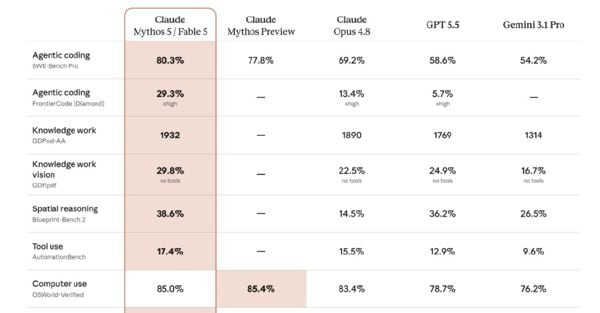
Anthropic describes Fable 5 as a “Mythos-class” model. In other words: it belongs to the most advanced category ever developed by the company. According to internal tests and early customer feedback, the model outperforms all previous generations of Claude in programming, complex analysis, handling large amounts of information and visual capabilities. The longer and more complex the task, the greater the advantage.
The analytics firm Hex claims that Fable was the first model to exceed 90% in a benchmark designed for complex, long-running analytical tasks. That’s a ten-point improvement on the previous-generation Opus. The real innovation, however, isn’t just the power. It’s the way Anthropic has chosen to distribute it.
The dual brain
Fable 5 uses a security system reminiscent of air traffic control. When a user asks a question deemed high-risk, the model does not respond directly. The request is redirected to Claude Opus 4.8, a less powerful but considered safer system. There are two areas under the strictest surveillance: cybersecurity and biology. These are precisely the sectors that cause the greatest concern to governments and regulatory authorities. On the one hand, there is the possibility of automating sophisticated cyberattacks. On the other, there is the risk of misuse in the life sciences.


