Cybersecurity

Anthropic launches Claude Fable 5, bringing Mythos to market

Claude Fable 5 is the first model in the Mythos family to be made available to the public; it combines the capabilities of Anthropic’s most advanced model family with a control system that filters the most sensitive requests. This development could reshape the relationship between innovation, security and cybersecurity.


by Luca Tremolada

REUTERS/Dado Ruvic/Illustration REUTERS

3' min read

Translated by AI
Versione italiana

3' min read

Translated by AI
Versione italiana

For months, the name Mythos has circulated as an urban legend in the world of artificial intelligence. A model so powerful that it has attracted the attention of governments, regulators and security agencies. A system kept under wraps behind restricted access, pilot programmes and control protocols. In the very weeks when Brussels was fine-tuning the rules of the AI Act and Western capitals were beginning to treat artificial intelligence as a strategic technology, Anthropic was working behind the scenes.
Now, the lab founded by former OpenAI researchers has decided to open a window of opportunity. It is called Claude Fable 5 and is the first model in the Mythos family to be made available to the public. It can be thought of as a more powerful brain with a speed limiter. However, when the conversation enters high-risk areas, the system hands control over to a less powerful but safer model. The new AI model could reshape the relationship between innovation, safety and cybersecurity.

Loading...
A Mythos for everyone, but with the brakes on

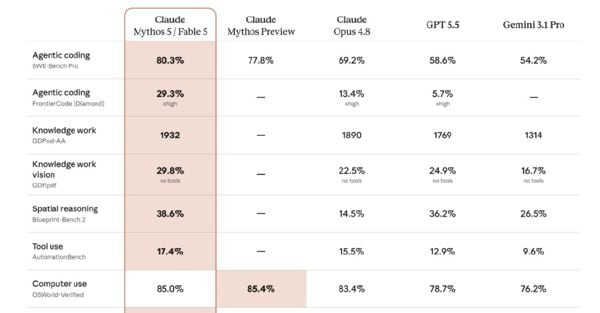
Anthropic describes Fable 5 as a “Mythos-class” model. In other words: it belongs to the most advanced category ever developed by the company. According to internal tests and early customer feedback, the model outperforms all previous generations of Claude in programming, complex analysis, handling large amounts of information and visual capabilities. The longer and more complex the task, the greater the advantage.

The analytics firm Hex claims that Fable was the first model to exceed 90% in a benchmark designed for complex, long-running analytical tasks. That’s a ten-point improvement on the previous-generation Opus. The real innovation, however, isn’t just the power. It’s the way Anthropic has chosen to distribute it.
The dual brain

Fable 5 uses a security system reminiscent of air traffic control. When a user asks a question deemed high-risk, the model does not respond directly. The request is redirected to Claude Opus 4.8, a less powerful but considered safer system. There are two areas under the strictest surveillance: cybersecurity and biology. These are precisely the sectors that cause the greatest concern to governments and regulatory authorities. On the one hand, there is the possibility of automating sophisticated cyberattacks. On the other, there is the risk of misuse in the life sciences.

Anthropic claims to have subjected the system to thousands of hours of testing, red teaming and jailbreak attempts without finding any universal vulnerabilities. According to initial data, over 95% of conversations are still handled entirely by Fable without the fallback system intervening. In practice, the company is attempting an industrial experiment: making cutting-edge technology accessible without handing over its most sensitive functions to users.

How much does it cost

Anthropic has set the price at $10 per million tokens input and $50 per million tokens output. For developers, this means they can integrate Fable 5 via the Claude APIs whilst keeping costs in line with the high end of the market. At the same time, Claude Mythos 5 is also being launched – the full version of the platform – though this remains reserved for authorised partners and controlled-access programmes such as Project Glasswing, which focuses on cybersecurity. The difference is substantial. Fable is the commercial product. Mythos is the limited-access laboratory.

What’s changing in the race for strategic AI?

The launch of Fable 5 signals something far greater than a mere technological update. The artificial intelligence industry is entering a new phase. It is no longer enough simply to build the most powerful model. One must demonstrate the ability to govern it. OpenAI, Google, Anthropic and the other major research labs are gradually transforming artificial intelligence into a dual-use technology, like nuclear energy or advanced cryptography: useful for the market, but powerful enough to require public oversight.

The result is a paradox, yet another one

The smarter the models become, the less they can be left entirely to their own devices. Fable 5 is probably the first commercial example of this new generation of AI: extremely powerful, accessible, but with safeguards designed not as an afterthought, but as an integral part of the product. The real question is not whether it will work. The real question is how long these guardrails will be able to keep pace with the acceleration of artificial intelligence.

Copyright reserved ©
  • Luca Tremolada

    Luca TremoladaGiornalista

    Luogo: Milano via Monte Rosa 91

    Lingue parlate: Inglese, Francese

    Argomenti: Tecnologia, scienza, finanza, startup, dati

    Premi: Premio Gabriele Lanfredini sull’informazione; Premio giornalistico State Street, categoria "Innovation"; DStars 2019, categoria journalism

Loading...

Brand connect

Loading...

Newsletter

Notizie e approfondimenti sugli avvenimenti politici, economici e finanziari.

Iscriviti