
Antifascism in Europe: a mosaic of resistance between memory and new challenges
In the EU, anti-fascism takes different forms but retains a common function: that of a social and political response to the advance of the far right
by Silvia Martelli and Lorenzo Pace (Il Sole 24 Ore), Petr Jedlička (Denik Referendum, Czech Republic), Lena Kyriakidi (Efsyn, Greece), Hannah Kriwak (EUobserver, Austria) and Francesca Barca (Voxeurop, France)
 Aggiungi Il Sole 24 Ore
ai preferiti su Google
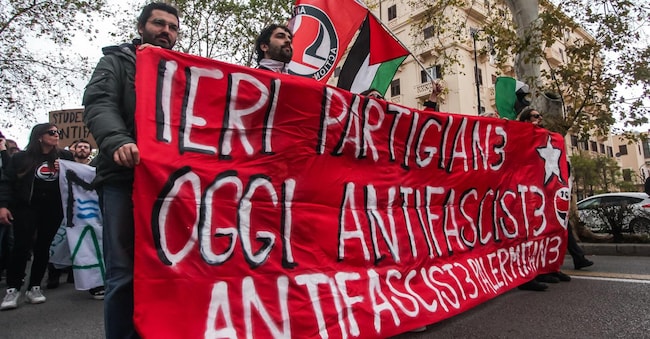
In recent years, the issue of anti-fascism has returned to the centre of the European public debate. In a context marked by the advance of extreme right-wing movements and parties, the re-emergence of nationalisms and growing political polarisation, forms of mobilisation have reappeared in many European countries that explicitly refer to historical anti-fascism or reinterpret its values in a contemporary key.
Antifascism in Europe is not a unitary movement, but a mosaic of local experiences, autonomous collectives and social networks that move with different modalities, languages and objectives. In some contexts, such as Italy and Greece, the anti-fascist tradition is rooted in the memory of the Resistance and in the Constitutions born after the Second World War. In others, such as France and Spain, it has turned into a form of urban and cultural activism, linked to the fight against racism, inequality and authoritarianism. In central European countries such as Austria or the Czech Republic, anti-fascism is instead more fragmented, often confined to militant or academic spaces, but nevertheless present as a garrison of democratic memory.
Common to all experiences are the absence of a central structure, the autonomous dimension and the ability to connect the historical legacy of anti-fascism with contemporary issues such as civil rights, social inclusion and the defence of freedoms.
Despite national differences, anti-fascism remains a recognisable political language, which continues to represent one of the main forms of opposition to the radicalisation of the right in Europe.
Italy
Antifascism is a central theme in Italy. It is so, eighty years after the end of Benito Mussolini's regime, because it is a founding value of the Constitution. And it is so despite the fact that there is no single organisation representing it in the country. Not a registered 'Antifa', not a party, not a central leadership. But dozens of small collectives and student networks that mobilise autonomously against neo-fascist groups, racism and authoritarianism. They often develop within social centres, i.e. occupied and self-managed spaces. There are about two hundred of them in Italy and, recently, the most important one in Milan - the Leoncavallo - was evicted after thirty-one years.


