
Antik Batik 'reconquers' Italia from Milan
The brand founded in Paris 34 years ago by Gabriella Cortese presents a Biffi collection and focuses on the charm of fabrics and embroidery

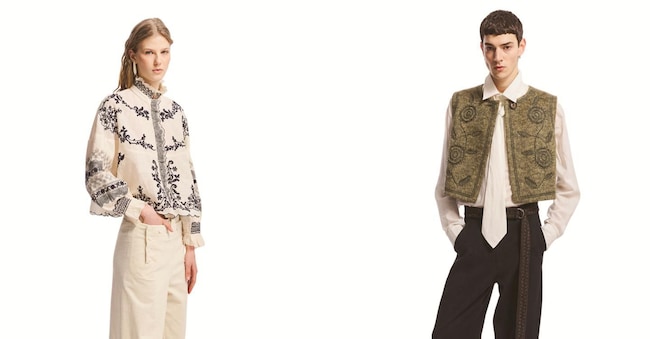
Poetry. This is Gabriella Cortese's favourite word: she uses it not to indicate single poems but worlds, concrete and dreamy at the same time. First there is her own, creative and entrepreneurial universe: in 1992, as a young Italian emigrant (from Turin, to be precise) in France, she founded the accessories and then clothing brand Antik Batik.
A few years had passed since his arrival in Paris, which at the time was even more competitive for fashion than it is today, because Milan had not yet challenged or caught up with it as the European and perhaps global capital of ready-to-wear. "I think it happened to several creatives or at least people who were passionate about fashion: I realised that there was no brand that reflected me or with which I felt a strong affinity. At the time,' Gabriella Cortese recounts, 'not many people saw the handmade, textile cultures and craft techniques of distant countries as a real opportunity. I had been struck by what I had seen in my travels, particularly to India, and I thought of bringing together two universes, two dimensions of life: on the one hand the Indian traditions and that approach to clothing and accessories, and on the other my lifestyle as an inhabitant of a large European city, who nevertheless felt like a citizen of the world'.
There is also a touch of poetry - or perhaps magic - in Gabriella Cortese's educational background: born in 1965, she studied ballet for many years and when she moved to Paris she worked for a while at the Crazy Horse, at the same time attending the Sorbonne and discovering that her creative vein could find an outlet in fashion, which in turn was linked to her passion for travel.
The name of the brand immediately reveals the cards, we might say: "In India and Nepal, I came into contact with local artisans and tried to understand and perhaps learn embroidery, weaving and batik techniques in particular. From these experiences, Antik Batik was born,' says the creative and entrepreneurial woman. 'Right from the start, it was clear to me that production had to remain artisanal, and I am proud to say that I have been working with the same ateliers for over thirty years and I feel the ethical and solidarity value of this choice, because craftsmanship is under threat all over the world. There is a lack of generational transition, even in India, and the cultural and historical value of the handmade is not fully understood. With Antik Batik, I believe I have shown the vibrancy and potential of craft techniques: there is a lot of me, my taste, my lifestyle in the brand. I have not simply drawn on, or worse, copied, what is created locally. There is a kind of creative osmosis between my team and the craftsmen with whom we work'.
Alongside the single-brand store in Paris, Antik Batik has just reopened its seasonal space in Saint Tropez and there are two others, also for the warmer months, in Marbella and Mykonos. But in 34 years Gabriella Cortese has built up a distribution network in multi-brand stores in several European countries and in American and Chinese department stores, flanked by direct e-commerce, which today absorbs about 40% of sales. Then there are initiatives such as the one just started in Milan, with a capsule presence at Biffi, in Corso Genova, the result of the meeting with Carla Cereda, who carries on the Biffi family's project of multi-brand research and quality. "We are and will remain a niche brand and I continue to follow everything, I admit: it is the price of independence and a way of not betraying myself," adds the founder. Handicrafts have a social value, as I said, but also an economic value and our positioning reflects this. However, Antik Batik is not a luxury brand in the most widespread sense of the term. However much raw materials and other costs increase, I refuse to raise price lists from season to season: if the price changes, it is because there must be something authentically new or of higher quality'.


