Formula 1

Antonelli reigns supreme in Madrid: eighth victory and a lead in the World Championship

An 81-point lead with nine races still to go. Kimi Antonelli has secured yet another resounding victory on a track that is new to everyone and fraught with pitfalls, even for the veterans.

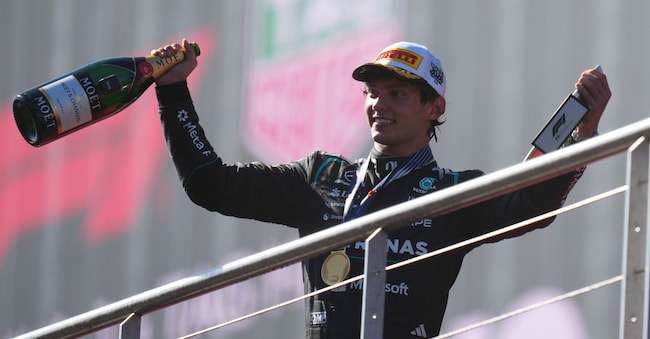
Il pilota italiano della Mercedes Andrea Kimi Antonelli.  (APS)

7' min read

Translated by AI
Versione italiana

7' min read

Translated by AI
Versione italiana

Andrea Kimi Antonelli is no longer just winning races: he is starting to take the World Championship. In Madrid, he secured his eighth victory in fourteen Grands Prix – his second in a row following his masterpiece at Monza – and once again turned a Sunday that initially looked set to belong to others into a victory. Lando Norris started from pole and, in the opening laps, had the pace to pull away, but the Virtual Safety Car and, above all, a disastrous pit stop by McLaren cost him the lead. When he got back into the thick of it, he found Max Verstappen ahead of him.
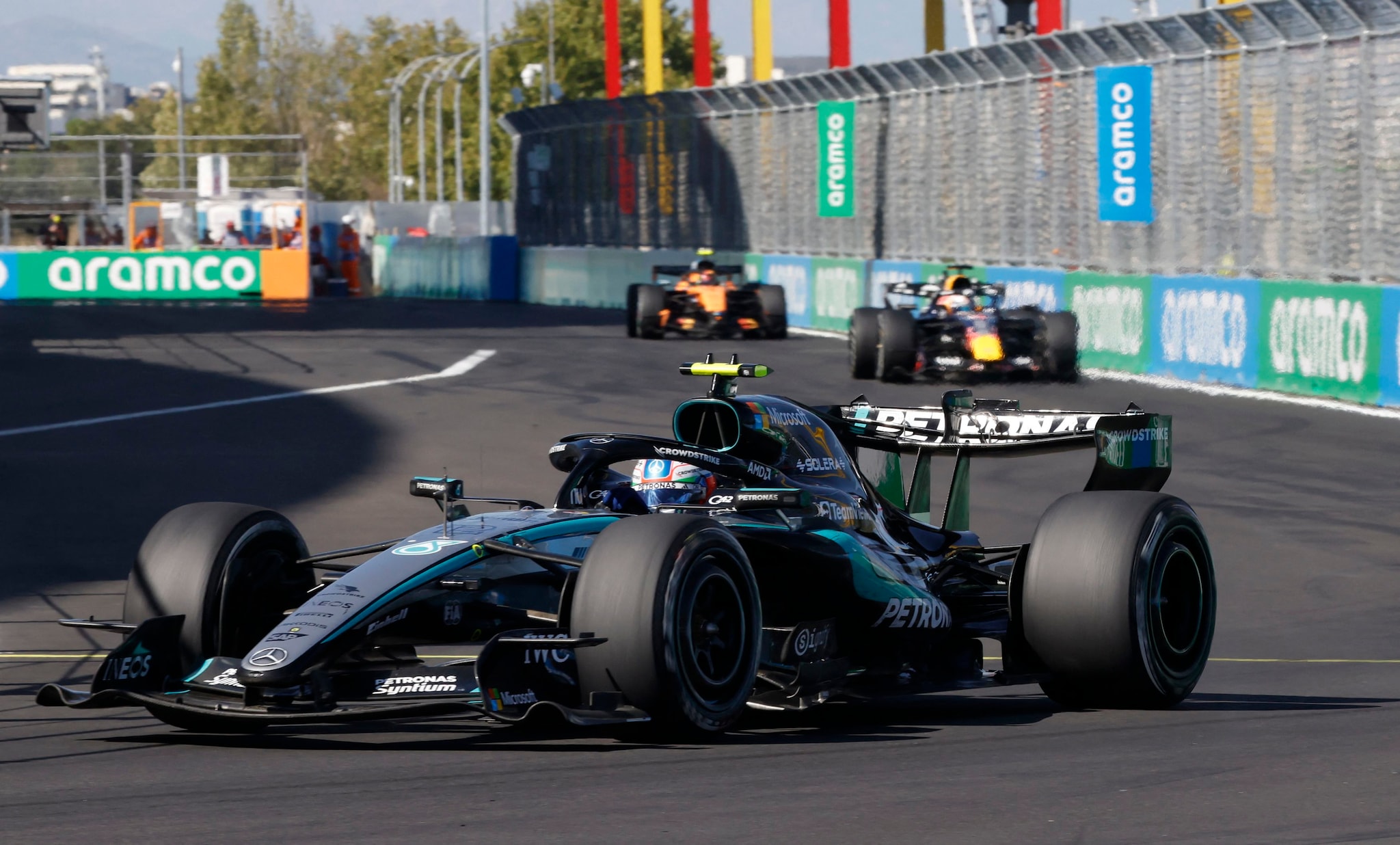
Andrea Kimi Antonelli, Mercedes. (Reuters)

The Dutchman fended off every challenge right up to the chequered flag and finished second, with Norris third, Charles Leclerc fourth and George Russell fifth. In the world championship standings, the gap is widening: Antonelli moves up to 292 points, Russell remains the closest challenger on 211, whilst Lewis Hamilton is stuck on 191 following his zero-point finish in Madrid – his first retirement of the season. No Italian has won the world championship since Alberto Ascari’s two titles in 1952 and 1953. With nine races to go, the young man from Bologna, who turned twenty a few weeks ago, leads by a margin of eighty-one points.

Loading...

Meanwhile, the circuit has delivered on the promise it made right from the start. The idea of a Formula 1 circuit in Madrid had emerged amidst concerns about funding, protests from local residents and environmental campaigns, with no shortage of hostility from Barcelona. In the end, the Madring did indeed become a reality: 5.416 kilometres and 22 corners laid out around the IFEMA exhibition centre, an initial investment of 83.2 million euros, a contract running until 2035, 110,000 seats and the first covered, air-conditioned paddock in the history of the championship.

A track that wrecks cars

Even before the lights went out, Madring had already explained what sort of circuit it would be. Throughout the weekend, between practice sessions and races, there was a significant number of red flags, collisions with the barriers, and chassis and suspension parts needing replacing. James Vowles, Williams’ team principal, described it as ‘a track that wrecks cars’. Freddie Slater, who measured those walls himself, explained how it works: the corners are tight, and on the exit the barrier never moves away, so you either push right up to it or you’re too slow. Sergio Pérez tried to defend it, describing it as “no more dangerous than Jeddah”, but in the meantime the weekend has seen a Formula 2 car go up in flames and, during yesterday’s final free practice session, Lewis Hamilton and Oliver Bearman both crashed into the barriers.

The explanation lies almost entirely in a single bend, the Monumental, a parabolic bend approximately 550 metres long with a gradient of 24 per cent – thirteen and a half degrees – which is taken in a full six seconds: according to Pirelli, it generates the highest vertical load of the entire season, not because of the gradient itself but because of how long it is sustained. It’s the sort of thing you’d expect from days gone by, or rather, from American circuits. And no wonder! The exit is blind. Shortly before that, the second chicane is tackled at 340 orari over kerbs that leave no room for even millimetre-sized errors. Hence the decision to bring the harder compounds – C2, C3 and C4 – to a circuit that Pirelli classifies in the same category as Barcelona and Silverstone. At least on paper. Because after an almost frenetic start, the first Grand Prix on the Spanish capital’s new circuit gradually revealed the other side of the Madring: that of a track on which it is extremely difficult to follow and, above all, to overtake, and where strategy ends up carrying more weight than the direct battle between the drivers.

Norris, who started from the first pole position in the history of the Madrid circuit, led until the fourteenth lap, when Stroll’s crash brought out the Virtual Safety Car: Antonelli stopped immediately, but he did not, as he had just passed the pit lane entrance. On his return to the track, he lost seven seconds due to a wheel gun issue: a human error, as the team later admitted. Ferrari, meanwhile, had already lost half the race: on lap five, Hamilton braked too early and let everyone pass him – “I’ve got no brakes” – and on lap seven he retired, after a season in which he’d scored points in every race.

That left Leclerc, and Maranello opted for the only possible strategy: to extend his stint and wait for a Safety Car. On lap 39, the Monegasque driver asked over the radio what the target was; without a Safety Car period, fourth place was the best he could hope for. On lap 48, Ferrari stopped waiting: a pit stop saw him return to the track in fourth place ahead of Russell, exactly as the calculations had predicted.

From then on, the race effectively came to a standstill. Antonelli managed his lead without conceding any ground, whilst Verstappen defended second place effectively and, crucially, prevented Norris from capitalising on the McLaren’s pace in the closing stages to mount a comeback. The Briton remained third until the chequered flag, whilst Leclerc held on to fourth place ahead of Russell. Further back, Piastri never really managed to get back into the race. The inaugural Madrid Grand Prix thus concluded with Antonelli taking the win ahead of Verstappen and Norris: the eighth victory of the season for the World Championship leader, who once again proved best able to capitalise on a race that, for long stretches, seemed to belong to others.

No one makes the decisions in Maranello

Leaving things to chance is what Ferrari has done all week. At Monza, seven days earlier, Hamilton and Leclerc had made contact at the first corner and the Briton had called for written rules: “There are no rules here.” He then withdrew the request: such decisions would have come “many, many weeks too late”. Vasseur hasn’t changed a thing and, on the eve of the Madrid race, he reiterated: “We’ve chosen to have two number one drivers. Lewis knew that; it’s written in the contract.” Eddie Irvine does not share this view; he was present in the paddock at Monza but this weekend is busy with his latest passion, aviation, to mark the 100th anniversary of the Aero Club Milano. A member and owner of a ‘traditional’ aircraft which he keeps in the hangars at Bresso, after talking about his latest passion for seaplanes – which he loves to fly with ease and confidence between Miami and his home in Exuma in the Bahamas – he explains how, in his day, it was crucial to have a “clear leader” like Schumacher and to have the patience not to change the team’s set-up in the paddock. As a former world championship runner-up and a pioneer who laid the foundations for the magical Schumacher era, he is fully qualified to declare that Ferrari’s results in his day were the best, thanks to Todt’s stability and decision-making ability. “Change is never a good thing in Formula 1. When I joined Ferrari with Michael, they wanted to get rid of Todt because the first year had been very difficult. But Schumacher said that if Todt left, he would leave too. And they certainly couldn’t afford to lose Michael.” There is no explicit endorsement of Fred Vasseur, but the precedent speaks for itself. On the driver line-up, however, Irvine is explicit: the current pairing “isn’t ideal”; he would have preferred “Leclerc and Sainz or Hamilton and Sainz”, because “Leclerc is too fast for Hamilton and Hamilton doesn’t make mistakes: they end up costing each other points, and Ferrari isn’t strong enough to afford that’. Seven days after the sparks flew at Monza, this sounds less like an opinion and more like a report.

A superb race from Verstappen, who never seems to lack driving skill: as usual, he takes home more points than his car’s average potential would suggest. It isn’t ‘yet another’ good year for him: last year, McLaren’s exploits put a stop to his run of World Championships; this year, it’s Mercedes doing the job, though that alone isn’t enough to explain the standings. Russell isn’t performing as he should, because Antonelli is there when it counts: faster in qualifying, faster in the race. He still makes plenty of mistakes, but he makes fewer when it matters, and the result is more significant points. By the end of the year, no one will accuse him of being lucky to have that seat: he’s there, and it shows. Much to the chagrin of his ‘lanky’ team-mate who, just like in 2025, is squandering opportunities in an even more obvious way.

Loading...

For the home team, there was none of the satisfaction seen in motorcycling: the debut yielded nothing – quite the opposite, in fact. Sainz Jr started in 20th place, had a collision with Alonso, received a five-second penalty and retired on lap 46. Spain, which for twenty years has filled the MotoGP grids with the consistency of an industrial system, is now represented in Formula 1 by a former Ferrari driver at Williams and a 45-year-old in an Aston Martin that isn’t performing. Waving the chequered flag was Carmelo Ezpeleta: a paradox, given that the Italian Grand Prix was taking place at Misano, where Marc Márquez went on to claim a victory that may well have buried Italian rider Marco Bezzecchi’s dreams once and for all, whilst he was in Spain celebrating an Italian.

But the Madring, in fact, is inherently contradictory. It has delivered a different and questionable ‘sporting product’, something more complicated than it had promised: a track that proves extremely costly when you make a mistake, where avoiding the wall is easier than overtaking the car in front. The winner is the one who makes the fewest mistakes, just like in IndyCar. And in Madrid, for the eighth time in fourteen races, it was a 20-year-old from Bologna.

Copyright reserved ©
Loading...

Brand connect

Loading...

Newsletter

Notizie e approfondimenti sugli avvenimenti politici, economici e finanziari.

Iscriviti

Tutto mercato WEB