
Antonino Zichichi and his legacy, from nuclear physics to popular science
A key figure on the international scientific scene, Zichichi has made his mark on nuclear physics and popularisation, founding prominent institutions and schools, while stirring up debate for his personal positions

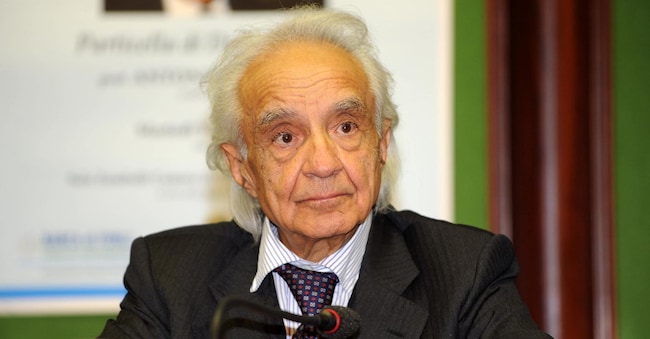
Italian physics mourns the loss of Antonino Zichichi, who passed away today at the age of 96. There are many reasons to remember him: internationally renowned particle physicist, prominent presence at CERN in Geneva, full professor at the University of Bologna, President of the National Institute of Nuclear Physics (INFN) and of the European Physical Society, visionary scientist who pushed for the realisation of major projects of international relevance, pioneer of the televised popularisation of physics that also included a meritorious battle against astrology. His character, with his particular way of posing, pierced the screen and became a well-known figure to the general public, so much so that he entered the gallery of Crozza's most successful imitations. According to my daughter, nothing better describes the attitude of the theoretical physicist than Crozza-Zichichi's phrase 'the lift in the vacuum, who repairs it?
In my career I have heard a lot about him but never had the opportunity to meet him. However, having participated on several occasions in the conferences organised in Erice at the Ettore Majorana centre for scientific culture, which he founded in 1963, I can say that his presence was always palpable.
Thanks to the international schools, the village of Erice has been reborn to new life, proving that culture is a powerful driver of development.
Zichichi profoundly believed in the value of scientific research as a tool to deal with planetary emergencies and, also in Erice, in 1973, together with other famous physicists, he founded the international organisation World Federation of Scientists.
In 1980, when he was at the head of the INFN, he contributed to the birth of the Gran Sasso National Laboratories, an extraordinary infrastructure for cutting-edge research in various fields of nuclear and subnuclear physics. Under kilometres of rock, in the tunnels of the Gran Sasso, they study neutrinos, the most elusive particles in the universe, and try to understand the nature of mysterious dark matter.

