
Antonio Ligabue: the torments of a visionary on show in Turin
Over 90 works by the painter at the Società Promotrice delle Belle Arti
2' min read
2' min read
The Ligabue exhibition, curated by Giovanni Faccenda, winds its way through 8 rooms in a corpus of 71 paintings, 8 sculptures and 13 drawings and is the first realised with the Augusto Agosta Tota Foundation for Antonio Ligabue, almost a year after the death of Augusto Agosta Tota, who was the artist's friend, promoter and scholar. The works come from private collections, from the famous self-portraits to the Tiger Head of 1953 and Leopard of 1955, from the Motocyclist of 1954, to the Siberian Crossing of 1959; from the sculptures Lion and Lioness of 1935, to Panther of 1938, Crouching Lioness of 1940, to the Bust of Gorilla of 1956; from drawings with animal figures to the Pencil Self-Portrait of 1955.
Ligabue was bullied, locked up in a psychiatric hospital, lived in extreme poverty, experiencing a deep inner agony, an enormous sense of loneliness, a constant search for consent, love, understanding: here his 'story' is told through his artistic journey, the impact conveyed by his bright colours, his relationship on canvas with nature and animals, up to his self-portraits, which represent an important portion of his artistic production.
Animals and Nature
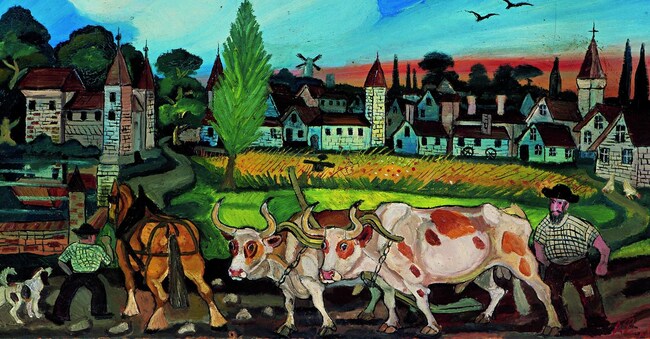
In each of the self-portraits, in addition to Ligabue's half or full-length figure, an animal always stands out in the background, more or less large, in the foreground or background, together with him: it may be a fly on his forehead, or a butterfly just above the nape of his neck, a dog just behind or a bird in the distance, all of which serve to anchor the man in the story, to tell not only the character in a neutral, two-dimensional way, but the person in his entirety, in his depth, in his letting the world, nature all around him, pass through him. At the same time, in the paintings in which Ligabue is not portrayed, the animals dominate, fight, appear in the foreground with a determined spirit of survival, as in the cockfight or the cat with the mouse in its mouth, as in the dogs hunting or the bird of prey attacking the fox. What is striking in these images is the gaze. If that in the self-portraits often looks like a dull, desolate gaze, that of the animals tells instead of a certain vitality, an energy, a tension, almost an excitement, a fibrillation and a pulsating desire, not only to cling to life with all their strength, but to challenge it.
The life, psyche and history of the artist and the man
.Ultimately, this exhibition, with over 90 works, tries not only to illustrate the life, psyche and tormented history of Antonio Ligabue as a man and artist, in the path of a raw and visionary genius, always evolving, recounting - through his works - the passionate research with which he knew how to invent and renew, innovate and stimulate emotional suggestions, alternating between the popular and the refined; there is another desire, and that is to emphasise the redemption of the last, showing the two faces of a fragile man and at the same time a great protagonist of European Expressionism.
Ligabue, Promotrice delle Belle Arti in Turin, Valentino Park, curated by Giovanni Faccenda, until 26 May 2024

