Sports interviews

‘Anything is possible – don’t set yourself limits.’ In the words of Usain Bolt, the record-breaking athlete

Although he retired nine years ago, his 100-metre record remains unbroken. The world’s fastest man has lent his name to a watch featuring the colours of his native Jamaica.

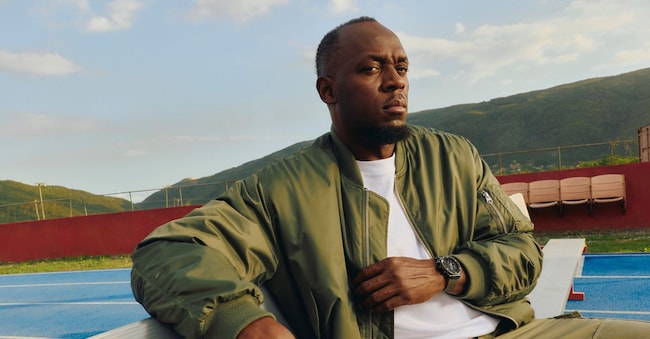
Usain Bolt è nato il 21 agosto 1986 in Giamaica. In carriera ha vinto 8 oro olimpici e 11 mondiali. Nella foto indossa il Big Bang Reloaded Usain Bolt di Hublot.

5' min read

Translated by AI
Versione italiana

5' min read

Translated by AI
Versione italiana

In the world of athletics, no event attracts more attention than the 100-metre sprint final. Whether at the Olympics or the World Championships, it is always the most eagerly anticipated event, the one in which the fastest men on the planet take to the track. It usually keeps millions of people all over the world glued to their screens. This was particularly true between 2008 and 2016. The reason? Standing in the starting blocks was the Jamaican Usain Bolt: the greatest sprinter of all time. Throughout his career, he racked up unparalleled successes in the 100 metres, as well as in the 200 metres and the 4x100-metre relay. He broke record after record, winning gold medals and shattering times on the track. An athlete who has redefined the boundaries of athletics: nine years on from his retirement from racing, Bolt is now one of Hublot’s brand ambassadors, having collaborated with the brand to create the Big Bang Reloaded Usain Bolt model, a limited edition of 200 pieces. 

What was your first thought when you woke up the day after you retired from racing? I was probably just happy not to have to get up and go to training. I don’t miss the aches and pains from intense training, but I do miss the competition and the thrill of racing in front of packed stadiums all over the world. Fortunately, I’m still very active and I’m always travelling: my life hasn’t changed that much. 

Loading...

What did you like most about that period? Everything revolved around competition. I lived for the big moments and usually performed at my best when the pressure was at its peak, such as at the Olympic Games or the World Championships. 

Your first ever medal came with a second-place finish. Looking back on that moment, could you ever have imagined what would happen next? No. When I started out, I never thought I’d achieve such success. It proved that ‘anything is possible, don’t think limits’ (everything is possible, don’t set yourself limits, ed.): that’s my motto, which I still pass on to young people today. 

Your 100-metre record of 9.58 seconds, set in Berlin in 2009, remains unbroken to this day: how does it feel to be the fastest man in the world? It’s brilliant. I’m also the fastest man ever, living or dead (he smiles, Ed.). When I think of how many people there are in the world, the fact that I’ve managed to run faster than all of them makes me very proud. 
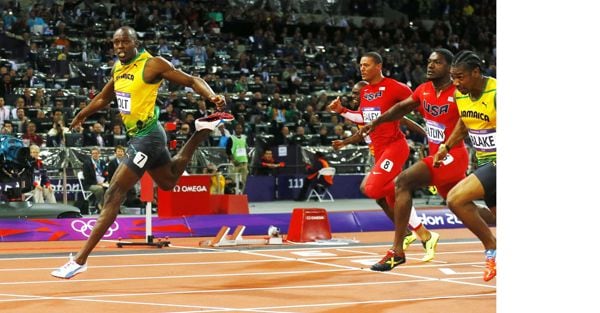
Bolt mentre taglia il traguardo da vincitore in 9”63(record olimpico) il 5 agosto 2012 nella gara dei 100 metri piani di atletica delle Olimpiadi di Londra. ©ANSA EPA/KERIM OKTEN

I read that, for you, victories mattered more than records. Why is that? That’s true. I’ve always focused on winning the most important titles. The thing I’m most proud of is having achieved this consistently across three consecutive Olympic Games (Beijing 2008, London 2012 and Rio 2016, ed.): records come and go, but medals last forever.

You’ve won so many times. If you had to choose the most important and memorable victory of your career? I’d say the Under-20 world title in the 200 metres, which I won on home soil in Jamaica in 2002 when I was just 15, but also my first Olympic gold in the 100 metres at the 2008 Beijing Games.

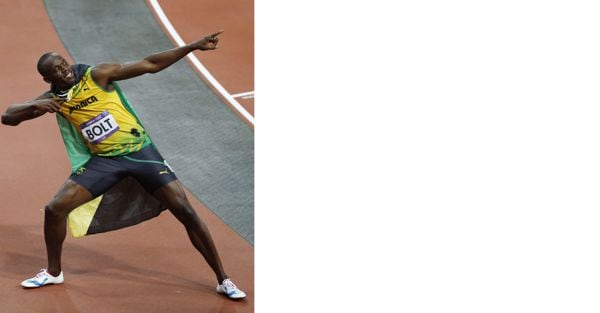
Il festeggiamento con l’iconica posa “Lightning Bolt”. ©ANSA EPA/DIEGO AZUBEL

Every spectator at your finals has wondered at least once: I wonder what’s going through his mind in those few seconds of the race… My main focus was on running the race exactly as my coach had told me to. In training, we spent months working on the various aspects of the race.

At the 2008 Beijing Games, you celebrated for the first time with the ‘Lightning Bolt’ move, which went on to become one of the most iconic in sport, on a par with those of football stars. How did it come about? Before those Games, I was in Jamaica. A dancer friend of mine told me that, if I won, I’d have to perform a dance to entertain the crowd. I did that celebration after the 100-metre race. People liked it, so I carried on doing it and it quickly became my signature move.

Do you still follow athletics? Yes, last year I went to the World Championships in Tokyo and this September I’ll be at the World Championships in Budapest.

Loading...

Who do you see as the favourite in the 100 and 200 metres at the upcoming 2028 Los Angeles Olympics? It’s still too early to say. A lot can happen between now and then. I think I’ll be able to give a clearer answer after the 2027 athletics season. 

Moving on to your life today: you embarked on a music career with a debut album that was a hit. It’s something I started during the pandemic, when we couldn’t travel much. We’re working on a few things, but I don’t devote as much time to it as I did back then, because I’m also involved in other projects. 

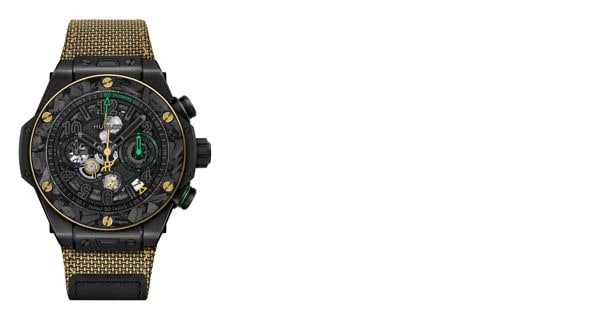
Il Big Bang Reloaded Usain Bolt di Hublot, modello in edizione limitata a 200 esemplari, ha la cassa in ceramica nera, la lunetta in carbonio e oro giallo e il fondello (in carbonio all’esterno e in vetro zaffiro al centro) personalizzato. Il quadrante scheletrato placcato nero e gli inserti in giallo e in verde rimandano alla bandiera giamaicana. Inoltre, la lancetta dei secondi cronografici, color oro e verde, è a forma di fulmine, a ricordare il Lighting Bolt, la famosa posa del campione dopo ogni vittoria. Costa 29.400 euro.

Which ones? I look after my business interests with various partners in the property sector and so on. I take part in many charity events for the Usain Bolt Foundation and other organisations. Last June in London, I captained the ‘World XI’ team at SoccerAid for UNICEF, raising £16.4 million for charity. 

Are you satisfied with what you’ve achieved so far with the Usain Bolt Foundation, which supports young Jamaicans through educational and sporting projects? There’s always more that can be done, but I try to do my very best to give something back to the community: through this foundation, but also through other organisations. 

What does Jamaica mean to you? I am very proud to be Jamaican and to represent my country around the world.

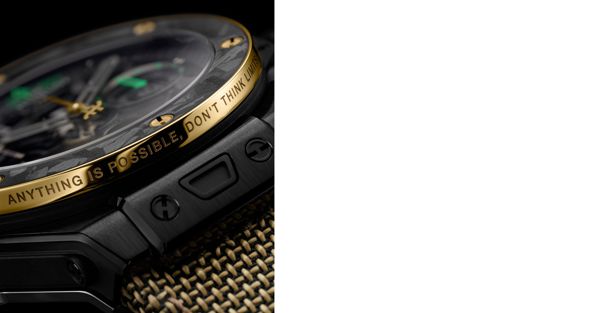
Together with Hublot, you recently launched a special watch bearing your name. I’ve been one of their ambassadors since 2010. Ours is a fantastic collaboration. I was actively involved in the creation of the Big Bang Reloaded Usain Bolt. Alongside the gold and green colours that evoke those of Jamaica, there are so many details that are significant to me and my career: from the upside-down ‘9-5-8’ digits (my world record time in the 100 metres), to the lightning-shaped seconds hand, right through to my motto ‘Anything is Possible, Don’t Think Limits’ engraved on the gold bezel. But also the clay surface of the track where I used to train as a child, featured on the case back. 

La parte in oro giallo della lunetta del Big Bang Reloaded Usain Bolt presenta il motto dell’ex velocista: “Anything is Possible, Don’t Think Limits”.

What are your hobbies? I enjoy playing dominoes and football, watching sport and TV series online, being a dad and spending time with friends.

Speaking of football, everyone remembers your time in the sport. Who’s your favourite player? I’ve always been a fan of Cristiano Ronaldo. First and foremost because of my connection with Manchester United, but also because I think his drive and determination to remain at the very top of the sport for so long are extraordinary.   

Copyright reserved ©
Loading...
Loading...

Newsletter

Notizie e approfondimenti sugli avvenimenti politici, economici e finanziari.

Iscriviti