
Aosta Valley, 2026 grape harvest: quality and production hold up despite record-breaking heat and drought
A vintage characterised by extreme weather events and an early harvest. Jans: ‘Nebbiolo is two weeks ahead of schedule.’ Grosjean: ‘Excellent potential for quality.’ Gerbore: ‘Emergency irrigation is crucial: we will need reservoirs that are not just for consortia.’

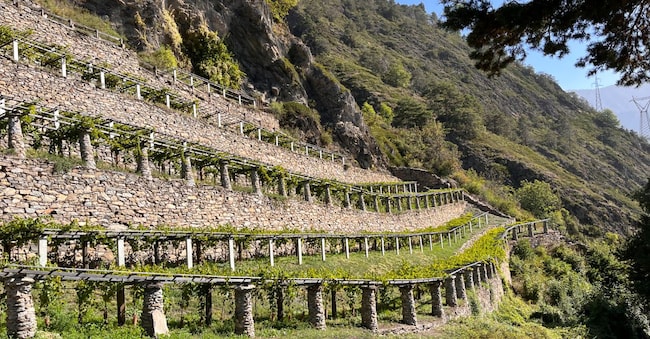
Five hundred hectares of vineyards and an annual production ranging from 1.8 to 2 million bottles. Fifty per cent of these are destined for the regional market, with another significant proportion going to the Italia market and a portion sold abroad, with the percentage varying between 10 per cent and 40 per cent depending on the winery. These are the figures for wine in the Aosta Valley which, despite a vintage characterised by drought and record-breaking heat, has held its own in terms of both production and quality.
This is down to a form of viticulture that, now more than ever, is truly heroic: work is often carried out at high altitudes, by hand, on steep slopes. Here, the work involved takes up to 700–800 hours per hectare, compared with the average of 150 hours for an Italian vineyard.
“We were expecting a sharp drop due to the heat, but overall we reached 5,000 quintals, just as in 2025, with only a modest decline in the yield of late-ripening grape varieties,” explains Andre Gerbore, president of Cave des Onze Communes, a winery producing 500,000 bottles with 140 members spread across eleven municipalities.
The grape harvest was also ‘better than expected, both in terms of quantity and quality’, according to Alessandro Jans, president of Caves de Donnas, in the lower valley: a cooperative with around 50 members and 18 hectares of vineyards, producing around 900 quintals of Nebbiolo and Pinot Gris grapes, which yield 80,000 bottles annually.
Hervé Grosjean, producer and owner of the family estate dating back to the 1600s, also speaks of ‘excellent quality potential’ and emphasises that ‘after mid-August, we went from a very dry season, with heatwaves reaching as high as 40 °C, to a period with cooler temperatures and a particularly interesting daily temperature range’.


