
Aosta Valley: no new solar projects, but there is no shortage of potential
Far from meeting its 2030 targets, the Region is awaiting the equal treatment of hydroelectric power and photovoltaic power, the latter of which can also grow alongside agriculture and the Cer

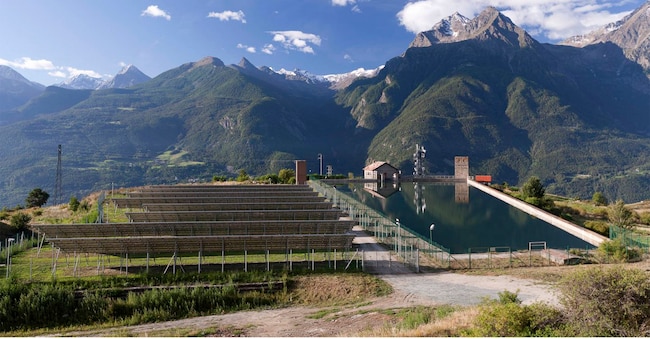
Photovoltaics is far from being a priority for the Aosta Valley. The figures speak for themselves, but that is not the only indication. No applications have been submitted or are under consideration for the construction of new regional plants. Moreover, the initiatives of the Autonomous Region and CVA for this Alpine region are focused on hydroelectric power and hydrogen – the cutting edge of renewable energy technology. Photovoltaics remains on the back burner, due to the complex topography of the region and the potential conflict with agriculture.
Hydroelectric power accounts for 95 per cent of renewable energy in the Aosta Valley, and the project by CVA to modernise the Hône 2 plant – a project costing over 150 million – is currently the largest investment in the sector in the whole of Italia. ‘We believe that, despite the Aosta Valley’s leading position in hydroelectric power, solar power could offer interesting opportunities, given that the Region has identified areas suitable for the installation of solar power plants. Equally interesting for businesses are the initiatives linked to energy communities and the possibility of integrating solar installations, particularly on new industrial buildings and production facilities.”
Legambiente’s latest report essentially makes two points: the Region is, amongst Italian regions, the furthest from the targets set at national level; furthermore, the hydroelectric sector raises the issue of the refurbishment of existing plants. ‘The region is the furthest from the targets set for 2030. Over the last five years, around 35 megawatts of capacity have been installed in the Aosta Valley, averaging 7 megawatts per year, compared with the more than 320 megawatts that are expected to be installed by 2030. The region is just over 10 per cent of the way there,” explains Alice De Marco, director of Legambiente Piedmont and Valle d’Aosta.
On the one hand, as the experts from the Autonomous Region point out, the GSE is expected to publish the parameters for equating the generation capacity of geothermal and hydroelectric sources with that of photovoltaic sources, in order to determine the region’s actual contribution to achieving national targets. On the other hand, however, as the director of Legambiente points out, the Aosta Valley can do more and, when it comes to photovoltaics, it must step up its efforts. Not to mention agrivoltaics. ‘Take, for example, what has been done in Piedmont, in Pomaretto, to overcome the perceived conflict between photovoltaics and agriculture. There, they have managed to restore historic vineyards on terraced slopes and have used photovoltaic panels to protect the vines from increasingly hot summers – something that could also be done in the Aosta Valley,” adds De Marco.
Given the lack of planning in the photovoltaic sector, renewable energy communities (REC) could be the key to boosting photovoltaic generation in the Aosta Valley, as revealed by a study commissioned by CVA from the Polytechnic University of Turin and carried out in collaboration with local councils and 29 SMEs in the region. The cartographic analysis made it possible to quantify the potential for installing photovoltaic systems in terms of both power capacity and production potential. Furthermore, in collaboration with the Polytechnic University of Milan, a tool has been developed that enables analyses to be carried out, both at municipal level and in relation to primary substations, based on data on power, production and consumption.


