Spirits

Aperitivo day, how the ritual is changing between alcohol free and cocktails with premium spirits

In the large-scale retail sector alone, sales of 430 million euros, but Italians are not giving up eating out despite the crisis, with mixology in Europe heading for a 500 billion euro business

by Maria Teresa Manuelli

 (Adobe Stock)

4' min read

Translated by AI
Versione italiana

4' min read

Translated by AI
Versione italiana

26 May sees the celebration ofWorld Aperitivo Day, the fifth edition of an event instituted by the Mww Group that every year returns to photograph a phenomenon firmly rooted in the lives of Italians, and not only. But behind the rhetoric of the toast there is a market that is growing, articulating and becoming more and more premium at a pace that few other consumer segments can boast.

The quality of an indispensable ritual is growing

Giving the measure of the phenomenon are the data presented by NielsenIQ during the opening conference of Aperitivo Festival, at the Milano Certosa District. According to the research,38% of Italians - one in three - have consumed at least one aperitif in the last three months, an increase of 2.6 percentage points compared to 2024. Forty-five per cent, or almost one in two, say they enjoy it at least once a month. Numbers that are part of a broader picture on out-of-home entertainment: 73% of Italians go out at least once a week, 94% at least once a month.

Loading...

Economic pressure does not affect the ritual. Six out of ten consumers continue to consider eating out an indispensable pleasure, also shifting their choices towards higher quality: 25% opt for premium drinks, 43% prefer to consume less but better. "The aperitif today is no longer just a ritual outside the home, but a transversal consumption occasion that consumers are increasingly recreating even at home, looking for quality, conviviality and experience," commented Matilde Ciroldi, senior beverage analyst at NielsenIQ.

It is difficult to isolate the business linked to the aperitif (and its various formulas) alone, but it is certainly an important slice of the mixology world that, according to an analysis by Fiere di Parma last year, at European level - on a market that includes mainly spirits but also sparkling wines and complementary products (sodas, concentrates, equipment, etc.) - is worth 465 billion euro, with a forecast growth of 4% that will bring the value close to 580 billion by 2028.

This is confirmed by data from the large-scale retail trade: the aperitifs and vermouth segment reached 254 million euro last year, up 2.6% in value and 2.1% in volume. Extending the perimeter to other related categories - gin, non-alcoholic aperitifs, sparkling wines and ready-to-drinks - the segment exceeded EUR 430 million, up 2.7% in value. On the domestic side, 8.3 million Italians consume aperitifs at home, two million more than in 2019.

Gen Z and new consumption

Driving the evolution of the market is Generation Z. Three out of five young people go out for an aperitif every week, with a marked preference for cocktails, spritzes and alcohol-free and low-alcohol propositions. 63% of Italians already choose alcohol-free aperitifs. Among the emerging trends reported by NielsenIQ, tap drinks (cocktails on tap) are attracting growing interest: 60% of Italians aged 18-34 say they have already tried them, and the majority would consume them again.

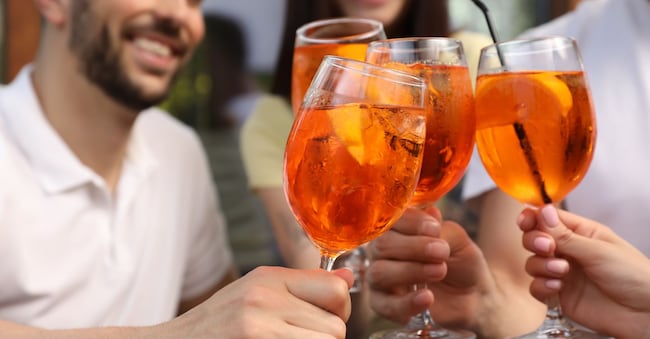
Parallel to this is the growth of the spritz phenomenon as a common language of conviviality. According to a Martini survey conducted with OnePoll on a sample of 1,000 Italians,for 64% of respondents, the spritz is synonymous with the aperitif. Its appeal is transversal among Gen Z and Millennials, who recognise its ritual as well as its taste.

Premium and no-lo trends

The market is therefore moving along two parallel tracks: on the one hand, premiumisation, with adult consumers willing to spend more in order to drink better; on the other hand, the light sociability of young people, who favour low and no alcohol and seek in aperitifs above all an opportunity to get together. Companies preside over both fronts with increasingly differentiated strategies.

On the premium side, for example, Belvedere Vodka launched Cosmo Spritz, which reinterprets the structure of the spritz in a super premium key. Vermouth Carlo Alberto, a Compagnia dei Caraibi brand, celebrated 26 May with White Blossom, a serve that combines Riserva White - made from 27 botanical herbs and Piedmontese DOCG grapes - with floral tonic, reviving vermouth's historic role as the matrix of the Italian aperitif.

On thebeer experimentation front, in March Heineken Italia launched Birra Messina Note di Melograno: a low fermentation lager at 5% alcohol, enriched with pomegranate juice, designed explicitly for aperitif time. The launch is supported by an AstraRicerche survey of over 1,000 Italians, according to which for 63% of those interviewed, curiosity and the desire for novelty guide their choice of aperitif drink, while for almost one young Gen Z in three, choosing what to drink is an identity gesture.

Sanbittèr, a brand of the Sanpellegrino Group, has instead chosen a travelling format: the "Ci Sta Tour" takes a truck to the squares of ten Italian cities, from San Benedetto del Tronto to Rimini, transforming the aperitif into a moment of encounter.
From catering, finally, comes Pizzium's move: on the occasion of World Aperitivo Day, the Neapolitan pizza chain born in Milan in 2017 launches Aperipizzium, combining Margherita, Marinara and hot focaccia with the Aperol Spritz in six cities - Milan, Rome, Turin, Florence, Bologna and Ferrara - with DJ sets starting at 6.30pm. A sign that the aperitif increasingly aspires to become a complete consumption occasion, where food is an integral part of the experience.

Copyright reserved ©
Loading...

Brand connect

Loading...

Newsletter

Notizie e approfondimenti sugli avvenimenti politici, economici e finanziari.

Iscriviti