
Aperol Spritz beats Champagne with 1.5 billion servings
French sparkling wine hits 1.35 billion. With annual growth of 17 per cent over twenty years, Campari has revitalised a drink that originated in the 19th century, transforming it into the orange-coloured symbol of ‘Made in Italy’

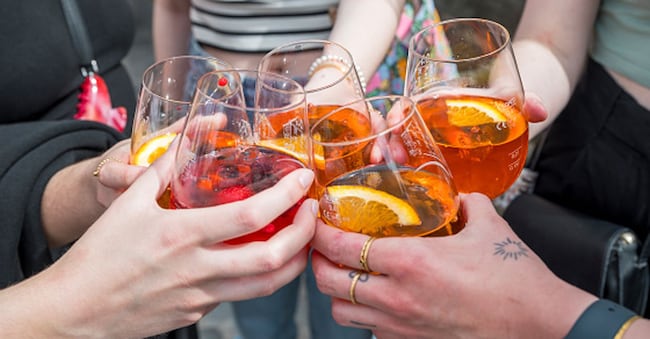
The colour associated with ‘Made in Italy’ is no longer just red, but also orange – the orange of Aperol Spritz. This is the conclusion to be drawn from the figures released by the Campari Group, according to which, with 1.5 billion servings worldwide, Aperol Spritz has overtaken Champagne, which stands at 1.35 billion flûtes. “We do not have an estimate of the number of flûtes,” commented the Comité Champagne, “the only certain figure is that we put 265 million bottles on the market.”
This milestone is just the latest achievement for Aperol Spritz following twenty years of phenomenal success. “Over the last twenty years,” explains Gabriele Ornaghi, Managing Director of the Campari Group, “global consumption of Aperol Spritz has risen from 60 million to 1.5 billion. Of these, 395 million are consumed in Italia.”
Regardless of the estimates, all the figures point to an extraordinary success in the markets, which is the result of the marketing strategy implemented by Campari following its acquisition of Aperol (a company founded in 1911 but taken over by the drinks giant in 2003) and which, year after year, has become the symbol of Italia and the Italian way of life.
Campari acquired Aperol in 2003 and, to revitalise the historic bitter brand, devised a strategy centred on the Spritz – a drink that originated in Veneto in the late 19th century amongst the Austrian soldiers stationed in the north-east. Italian wine, including white wine, was too strong for them, so they asked for it to be diluted with water. Later, mineral water or, subsequently, soda water was used instead – hence the name, derived from the German verb ‘spritzen’, meaning ‘to splash’ or ‘to spray’.
The soldiers have come and gone, but the custom has remained and spread throughout the 20th century, particularly in the Venetian provinces of Venice, Padua, Treviso and Rovigo. In the 1960s, the Spritz began to appear, combining Aperol with another Italian beverage phenomenon: Prosecco. Aperol and Campari, therefore, simply revived the tradition of the north-east, replacing the trattoria-style glasses with white wine glasses – more elegant and ‘premium’ (with ice and a slice of orange) and offering a drink with a lower alcohol content than wine (around 8 degrees) at a higher price than a beer but lower than a cocktail. Its success has been unstoppable.


