
Belonging to space, the most disregarded of rights
In her latest book, urban planner Elena Granata reconstructs the mechanisms of an expropriation, that of shared space, and how this translates into a lesion of citizenship
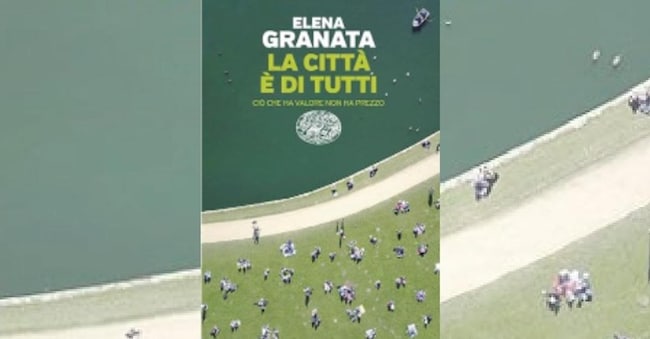
There is a right that of all is perhaps the least expressed and consequently least respected. It is the right to belong to the place one inhabits, connoting belonging with an existential value. A value that has an impact on health, quality of life, well-being and in some ways even happiness. It is on this right, but above all on its systematic disregard, that urban planner Elena Granata reflects in her latest book entitled La città di tutti - Ciò che ha valore non ha prezzo (in bookshops for the Passaggi series by Einaudi).
Granata returns in this work to a theme that is dear to her - just consider two of her previous publications: Placemakers. Gli inventori dei luoghi che abiteremo and Il senso delle donne per la città -: claiming the right to be decisive, to have a role, a part in an experience that is performed daily, that conditions, but on which more and more often (particularly in large cities, with Milan in the lead) one has no say.
This is the experience of space, the space in which one lives, traverses, observes, breathes and even smells. It is a process that, although usual and repeated, is difficult to bring into focus, victims of what Granata does not hesitate to consider an expropriation. Urban geometry sweetens or pains, it can console or conversely demean. Yet, more and more people are induced not to consider, not to value, precisely, this geometry. Certainly the transformation is not recent, it currently has more than one person in charge, but it goes back a long way. Ever since the public city gradually gave way to the market city, the city of shopping centres, gated quarters, speculative building. And it is at this point that 'the citizen gradually becomes a consumer, public space begins to become a shop window', writes Granata. The consequence is bleak: 'The city loses its moral tension: it no longer educates, it no longer welcomes, it no longer redistributes. It becomes the city of those with the most money, competitive, glittering, but unequal,' he continues.
And yet, it was not always so, indeed, there was a precise moment when the direction was quite different: it was the season, temporally placed between the two world wars, when the idea of the welfare state and the city for all was at its highest, because a 'sort of secular faith in the urban project as an instrument of progress' was affirmed. We are in the time that clears the way for an idea: universalism of rights, all citizens are entitled to a minimum amount of goods and services that guarantee their dignity. "Urban welfare is built on this promise: the right to housing (public housing), the right to education (neighbourhood schools), the right to health (parks and health services), the right to mobility (public transport), the right to sociality (accessible public spaces). Citizenship is measured in the quality of shared space'.
Right after right, Granata shows how, instead, we have become half-citizens, that is, how we have been dispossessed of our public space, gradually impoverished, to the point of no longer producing any bond of belonging with the places where one perhaps lives, works, studies. One is physically there in those houses, in those schools, in those offices, but there is no belonging, no sharing. And it is not a question of possession. Today's city, Granata points out, 'is a city not for everyone, not of everyone, of some more than others'.

