Digital Economy

AI agents in the workplace: Appian unveils a dashboard to monitor costs and results

The American company is introducing a system to coordinate artificial agents, including those from different suppliers. CEO Matt Calkins said: “Agents do not manage other agents well; their errors are amplified.”

4' min read

Translated by AI
Versione italiana

4' min read

Translated by AI
Versione italiana

LONDON – Four years after the tsunami caused by ChatGPT, artificial intelligence has moved beyond the confines of individual productivity to become part of business processes. This transformation often began at the grassroots level, with employees independently using generative AI tools, and continued as businesses adopted these technologies. It is precisely this final step that has proved the most complex: integrating AI into operational activities means tackling issues of security, data management and governance. It is therefore not surprising that caution still prevails in many companies.

Such caution becomes even more necessary with the proliferation of AI agents – programmes capable not only of answering questions, but also of carrying out tasks, consulting company archives and interacting with other software. In short, to act autonomously. But the more these agents proliferate, the harder it becomes to manage them. Who decides which tasks to entrust to them, who checks that the results are correct, and, above all, who monitors the cost of their work?

Loading...

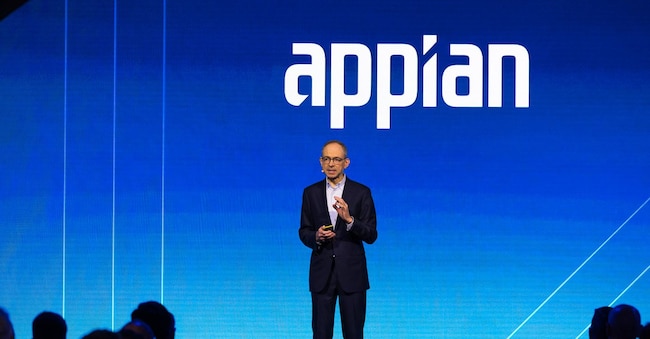
Appian, an American company specialising in business process automation, is seeking to address this need; during the Appian Europe event, currently taking place in London, it unveiled new features for its ‘control plane’. This acts as a sort of control centre designed to coordinate, monitor and evaluate the activities of artificial agents – including those developed by other suppliers – by integrating them into business processes.

“Artificial intelligence is not a technology that can operate on its own,” explained Matt Calkins, co-founder and chief executive of Appian, during his speech. “Software is deterministic, whilst AI is probabilistic. That is why it needs a technological layer that makes its behaviour predictable and accountable.” This distinction becomes essential when AI agents begin operating in sectors such as banking, insurance and public administration, where an error can have financial and legal consequences.

It is not enough to monitor officers

The challenge is not merely to develop increasingly autonomous agents, but to build systems capable of coordinating them without losing control of operations. Because, when artificial intelligence becomes part of the processes on which a company’s operations depend, knowing what it is doing becomes just as important as knowing what it is capable of doing. For this reason, the new system is structured around three functions: control, orchestration and optimisation. The first allows us to identify which agents are operating, monitor their activities, verify compliance with rules and control costs. The second organises the work, assigning different tasks to an AI agent, traditional software or a human operator. If an agent is unable to complete a task, the process can transfer the task to a human operator.

The third function relates to economic value: assessing the performance of staff and their contribution to the company’s results, identifying the most efficient staff and the tasks that would be best automated using less costly tools.

“A control plane cannot simply monitor what the agents are doing and pull the emergency brakes,” remarked Calkins. “We must aim for much more than that.” According to the manager, the aim is to understand not only whether an agent has correctly completed their task, but also whether their intervention has contributed to the success of the entire process.

A prime example comes from Raiffeisen Bank International, a bank operating in Central and Eastern Europe, which is working on automating payment requests. In tests carried out with Appian, the integration of AI agents with traditional automation has led to an 80 per cent reduction in both token consumption – the processing units used by language models – and processing times.

The result came about following a change in strategy. Initially, the bank had entrusted the agents with the bulk of the work, but subsequently limited their role to tasks requiring interpretative skills, whilst using traditional procedures for repetitive and predictable operations.

A decision that addresses a growing economic challenge. “It no longer makes sense to route all queries through the most expensive model we have available,” Calkins emphasised. “Complex queries can be directed to the most advanced models, whilst simple ones can be handled by more cost-effective models. Other tasks can be carried out by traditional software or by people.”

Loading...

This is by no means a minor issue. According to a survey conducted in March 2026 by Harvard Business Review Analytic Services, sponsored by Appian, amongst 385 business leaders, only 16 per cent of respondents stated that they had derived significant, measurable value from their investments in AI. This figure highlights the gap that still exists between the widespread adoption of the technology and tangible economic benefits.

“Ask Appian”: the company is managed using natural language

Alongside the control plane, Appian has announced Ask Appian, a new interface that enables employees to query business systems and request tasks to be carried out using natural language. Rather than switching between programmes to retrieve information or complete a task, users can simply describe what they need. The system will then retrieve the necessary data via Appian’s Data Fabric and activate the appropriate tools.

“The interface of the future will be incredibly simple. And the one after that could be even simpler: voice commands, glasses or something similar,” explained Calkins.

According to the manager, the main difference compared to a standard corporate chatbot lies in the way operations are carried out. ‘Agents do not manage other agents well: their mistakes are amplified. One discrepancy can lead to another.’ This is why Appian proposes alternating the use of artificial intelligence with steps governed by precise, verifiable and modifiable rules. The new features will be rolled out gradually. Some orchestration and control capabilities are already present on the platform, whilst extended monitoring of external agents and additional measurement tools will be introduced in future updates, with an early access programme for interested customers.

Copyright reserved ©
Loading...

Brand connect

Loading...

Newsletter

Notizie e approfondimenti sugli avvenimenti politici, economici e finanziari.

Iscriviti