New course

Apple awards $58 million to new CEO John Ternus. Tim Cook’s pay drops to $47 million

The handover, following fifteen years at the helm of the group, also reshapes the remuneration structure: for the new CEO, a larger portion of his remuneration will be linked to Apple’s performance relative to the S&P 500, whilst Cook will remain executive chairman, ensuring continuity at the top

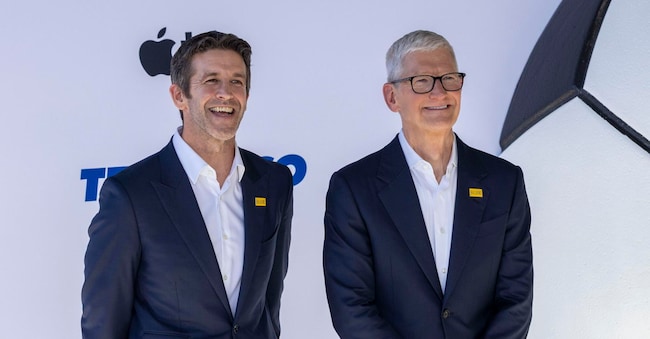
John Ternus (S) e Tim Cook (D). EPA/JILL CONNELLY EPA

4' min read

Translated by AI
Versione italiana

4' min read

Translated by AI
Versione italiana

The change at the top at Apple also brings with it a new remuneration structure. John Ternus, who took over from Tim Cook as chief executive on 1 September, will receive a remuneration package in 2027 with a target value of around 58 million dollars, comprising salary and share awards. Cook, after 15 years at the helm of the group, will remain with the company as executive chairman and will receive a package worth around 47 million, again calculated on the basis of the target value of the shares awarded.

Further details can be found in the documentation filed by Apple on 1 September with the Securities and Exchange Commission (SEC), the US authority that oversees the financial markets. The new remuneration structure came into force alongside the handover at the top of the company.

Loading...

Ternus’s annual salary has been increased to $3 million. From the 2027 financial year onwards, he will also receive an annual share-based award with a target value of $55 million. For his time as CEO during the 2026 financial year, Apple also granted him a pro rata allocation of restricted stock units (RSUs) – that is, rights to receive shares in the company upon fulfilment of the specified conditions – with a target value of approximately 2.5 million.

Finisce l'era Tim Cook in Apple, il nuovo Ceo è John Ternus

Most of the new chief executive’s share-based remuneration will be linked to Apple’s performance. 75 per cent of the bonus scheduled for 2027 will consist of performance-based RSUs and will vest based on Apple’s total shareholder return relative to that of other S&P 500 companies. The remaining 25 per cent will consist of RSUs linked to length of service, which will vest in equal instalments of 12.5 per cent every six months over a period of four years.

Cook’s remuneration package is also changing. In his new role as executive chairman, his annual salary will fall from $3 million to $2 million with effect from 26 September 2026. For the 2027 financial year, Apple has also approved a share-based award with a target value of $45 million.

Compared with Ternus, a smaller proportion of Cook’s share-based remuneration will depend on Apple’s relative performance in the markets. 50 per cent of the bonus will consist of performance-based RSUs linked to the company’s total shareholder return relative to other companies in the S&P 500. The remaining 50 per cent will consist of time-based RSUs, vesting in half-yearly instalments of 12.5 per cent over a four-year period.

Apple has also set out a specific condition regarding Cook’s potential departure. Should the executive retire after the first anniversary of the grant date, the shares will continue to vest in accordance with the established terms, including the performance requirements for the performance-related component, and will in any case be settled in accordance with the originally scheduled dates.

The new package represents a reduction compared with the remuneration Cook received as chief executive. In 2025, the executive received a total of $74.3 million: $3 million in salary, approximately $57.5 million in share awards, $12 million through the non-equity incentive scheme and approximately $1.76 million in other forms of remuneration.

However, the 58 million stated for Ternus and the 47 million for Cook do not necessarily represent guaranteed sums in relation to what the two managers will actually receive in 2027. In fact, these figures represent the sum of their basic salary and the target value of their respective share-based awards. The actual value of the awards may vary depending on the performance of Apple shares and, for the performance-based component, on the company’s results relative to those of other S&P 500 companies.

Any cash incentives are also excluded from the calculation. Apple did not specify the amount of these in the document filed with the SEC. More comprehensive information on executive remuneration is normally provided by the company in the documentation prepared for the annual general meeting.

Loading...

The new remuneration scheme coincides with one of the most significant transitions in Apple’s recent history. Cook is stepping down as chief executive after 15 years, during which the group’s market value rose from around 350 billion to over 4,500 billion dollars. Over the same period, annual revenue grew from $108 billion to $416 billion, whilst profits exceeded $112 billion.

Ternus, who has now been appointed head of hardware engineering at Apple, therefore inherits a company that is much larger than the one entrusted to Cook in 2011, but also faces a number of strategic challenges. Foremost amongst these is artificial intelligence, a sector in which Apple needs to make up ground following delays in the development of new Siri features. Added to this is the need to continue the diversification of the supply chain, reducing dependence on China without squeezing margins.

The process is already underway. Apple has expanded production in India and Vietnam and aims to manufacture the majority of iPhones destined for the US market in India by the end of 2026, whilst some devices, including AirPods and iPads, are also assembled in Vietnam.

Cook’s continued role as executive chairman nevertheless ensures continuity during the transition phase. Ternus takes over the operational leadership of the group, whilst the executive who has guided Apple through its greatest period of economic expansion remains at the helm of the board of directors. The new remuneration structure also reflects this different distribution of responsibilities: for Ternus, 75 per cent of the share-based award will depend on Apple’s relative performance, compared with the 50 per cent envisaged for Cook.

Copyright reserved ©
Loading...

Brand connect

Loading...

Newsletter

Notizie e approfondimenti sugli avvenimenti politici, economici e finanziari.

Iscriviti