Books

April is the most poetic of months

From the Premio Strega dozen to the kermesse, the books that make prophecy and those to be forgotten
by Matteo Bianchi

3' min read

Translated by AI
Versione italiana

3' min read

Translated by AI
Versione italiana


The fateful dozen of candidates for the third edition of the Premio Strega Poesia now serves as a watershed in terms of what new things to look out for. Certainly, Federico Italiano's latest collection, 'Godzilla' (Guanda), allows the reader no escape route in the face of an increasingly aberrant social reality, devoured by uncertainties, false myths and nonsense. "As much as the reference is deliberately pop," comments Mario Santagostini, director of the series in verse, "films dedicated to the demonic creature have nothing to do with it. Italia critically traverses its time, dissipating all imaginative consolation with the inexorable pace of endecasyllables, and interweaving collective trauma with the cultural construct of the monstrous".

Loading...

A pact of truth

A mythical nucleus in close contact with the present constitutes the dynamic framework of Carmen Gallo's 'Procne Machine' (Einaudi), a volume capable of producing associations, of retracing epochs and linguistic approaches that are apparently disparate. At the centre of this symbolic operation, Gallo places the dimension of violence: 'He cut off the root of her language with his sword'. The mythical core, articulated between rape, mutilation and consequent revenge, makes it possible to highlight the persistence of forms of oppression in history. The figure of Philomela, deprived of her voice, becomes an emblem of a silencing that goes beyond a dated context to extend to the current political level, in which the denial of speech confirms itself as one of the most radical drifts of domination.

Stratified time

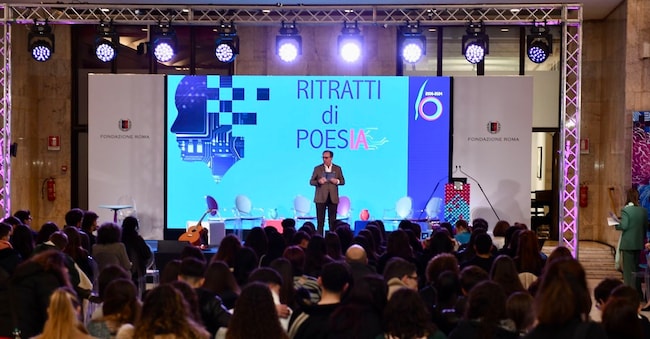
"There is only one time and that is the time we live in": this is the almost brutal consideration, given its simplicity, from which Sonia Gentili's "Un giorno di guerra" (Aragno), one of the protagonists of "Waiting for Portraits of Poetry", a cycle of thematic meetings awaiting the nineteenth edition of the Roman kermesse, soars. Organised and directed respectively by Carla Caiafa and Vincenzo Mascolo, it will be held on Friday 10 April, at the Auditorium Conciliazione, with over fifty invited poets and their experiences in verse. Gentili, implicitly, takes a polemical stance towards reality: between the pages, he does not conceive of an 'elsewhere', a salvific time, or a time 'separate' from that which envelops and overhangs human beings. Everything happens within material time, so the 'day' in the title imposes itself as a concrete form of finiteness; while 'war' stands alongside it as an unquenchable condition of existence that encompasses every slightest conflict, especially if everyday. And the writer is its battlefield.

The poet makes politics

"We started with the minutes. We liked their fullness - cells flowing in this body of time - purifying everything except their passing through us and our letting them flow. But then they stopped being different. One minute from another could not be distinguished, or an hour, a day, a year. The years pushed their duration through us like long, wet ropes, and we clung on, hung on to keep going, and on high kept us from drowning in the terrible minutes'. After the release of '2040' (Crocetti, translated by Antonella Francini) Jorie Graham, former Pulitzer Prize winner, will receive the Fondazione Roma International Prize. For the American, the poet makes politics, i.e. he takes a position when he releases his prophetic spark, dilating the spaces of vision. It is no coincidence that the book is presented as a sort of letter to a derelict humanity, studded with post-apocalyptic panoramas, tragic hallucinations and, at the same time, a striking beauty.

Copyright reserved ©
Loading...

Brand connect

Loading...

Newsletter

Notizie e approfondimenti sugli avvenimenti politici, economici e finanziari.

Iscriviti