
Apulia, a region that can be read in layers

Beneath the Baroque there is the Romanesque, on the Gargano the cave of the Archangel precedes the cathedrals, in Siponto the ancient paleo-Christian basilica that has disappeared is resurrected through a transparent art installation made of wire mesh.
In Apulia, time does not arrange itself in rows: it stratifies.
The region is a broad and differentiated palimpsest, and to read it requires the time that its geography allows. It is a multi-layered text, written over thousands of years, that asks the traveller for the patience to decipher it. Layer by layer the traveller can choose his personal composition, like an author who chooses the personality of his protagonist.
The ancient stratum, from the Magna Graecia port to the pilgrims' route
In Taranto, an ancient Spartan colony and a pivotal city of the classical Mediterranean, the MArTA - the National Archaeological Museum - houses the gold, terracotta and evidence of an urban civilisation that left its mark on the Ionian identity. Above classicism lies the Middle Ages of pilgrimages: the Gargano, with the grotto of Monte Sant'Angelo dedicated to the Archangel Michael, and its sanctuary, now a Unesco World Heritage Site, has for centuries been a landing place for travellers from all over Europe, and the Via Francigena, recognised as a cultural itinerary by the Council of Europe, in Apulia is divided into several routes as far as Santa Maria di Leuca, De Finibus Terrae.
The layer of stone, from the Fredericians to the lace of Salento
Stone is the most visible layer. Castel del Monte, a UNESCO jewel of the Frederician period, is the best known episode in a system of Romanesque cathedrals, Norman, Swabian and Angevin coastal towers, historic centres that grew up for centuries around the logic of defence and route. Further south, the Salento Baroque draws its 'lacework of stone' on the façades of churches, in a language that is both architectural and theatrical, which in Lecce and the surrounding villages reaches a density rare in the Mediterranean.
The layer of the contemporary
The last layer closes the dialogue with all the previous ones. The Pinacoteca Giuseppe De Nittis in Barletta recounts a great 19th century; the Fondazione Museo Pino Pascali in Polignano a Mare relocates one of the protagonists of Italian art in the second half of the 20th century in the landscape that was rightfully his; in the Archaeological Park of Siponto, the early Christian basilica restored by Edoardo Tresoldi in transparent metal mesh synthesises in a single gesture the way in which the contemporary can make visible what time has taken away.
The infrastructure of time
Between one layer and the next is the landscape: the Murge and the ravines, the dry stone walls, the sheep-tracks, the Adriatic and Ionian cliffs, the olive trees and native vines. This is the terrain on which to walk and cycle, along two thousand kilometres of cycle network and seven historical paths, the Via Francigena, the Cammino Materano, the Cammino della Pace, the Cammino di Guglielmo, the Cammino del Salento, the Rotta dei Due Mari, and the Cammino di Don Tonino Bello, which cross the region, distributing the journey over minor villages, masserie and centres of art outside the main towns.
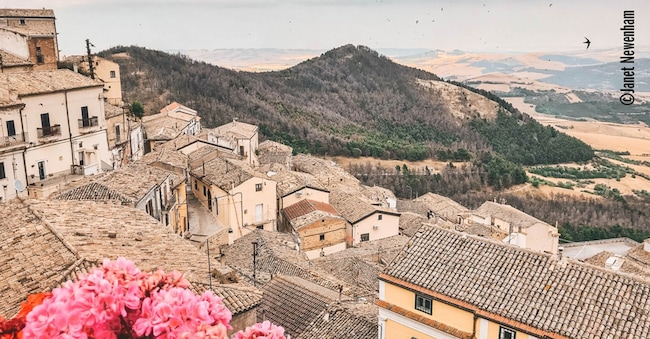
And amidst the narrow alleyways and whitewashed houses, Apulia's historic villages tell stories of a fascinating and indelible past, a genuine world where time expands in beauty. Perfect destinations to disconnect from the daily frenzy, with the pleasure of calm rhythms and sensorial discovery. Unique places where to restore body and soul, for a holiday of deep sleep, intense smells, stories and regenerating activities.
Slow time, here, holds together the cuisine of the masserie as the grammar of the Mediterranean diet, the festivals that light up the summer evenings, the markets and the re-enactments of the villages in the seasons in between. A geography that is travelled rather than consumed, and that for this very reason manages to keep high and low season lit within the same promise.
Puglia is still much more: you choose the layers you want to travel.

Plan your trip on viaggiareinpuglia.it

