The Miuccia Archive: forty years in the career of the first lady of Italian fashion
A collection of words versus a library of objects. Just as the permanent exhibition of the fashion house’s objects, spanning from 1913 to the present day, opens in Milan’s Galleria Vittorio Emanuele II, Miuccia Prada tells her story.
by the Editorial Team
 Aggiungi Il Sole 24 Ore
ai preferiti su Google
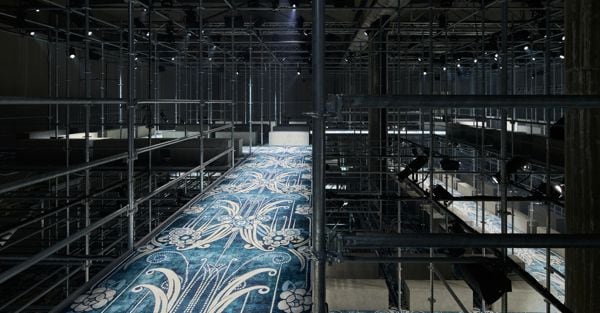
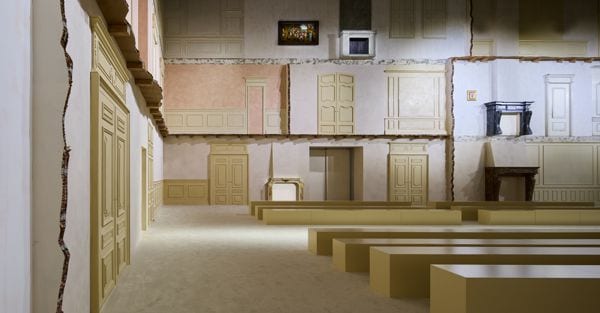
Eight floors, an underground passageway linking the two sides of the Octagon, a lift lined with pink velvet, and a route that leads from the boutiques – whose shop windows look out onto the nineteenth-century polychrome marble flooring – up to the patisserie and the permanent exhibition, then on to the studio, the flat with its large windows overlooking the allegorical lunette frescoes, and finally to the Observatory opening out onto the iron and glass dome. The Prada Galleria project, which has just opened in Milan, is a concept that gives physical form to a story, a repository of contents that are objects – suitcases, documents, handbags, clothes, designs, books – accumulated since 1913, the year the brand was founded. It is an enormous body of material, organised with a non-linear documentary approach. The past and the present are contemporary and coherent; everything revolves around an axis that is not chronological but circular, and the linchpin is Miuccia. To this archive of objects, Htsi has chosen to add an archive of words: reflections and perspectives which, over the course of many years, convey a sense of contemporaneity as a foreshadowing of her time – an extraordinary gift that has always distinguished the first lady of Italian fashion. A verbal collection, no less substantial than her creative output, despite the fact that the designer is more accustomed to expressing herself through her work than to articulating her thoughts. The selection criteria follow the same pattern as the Milanese epicentre: saturated with stimuli on the ground floor – the noble, varied abundance of the boutiques and the historical exhibition – and the organic void of the flat, where the rarity is only apparent. One need only linger for a few minutes in these rooms to sense their invisible force of attraction, the concentrated density of an identity so distinct and powerful that nothing escapes (as in a black hole, though here it is pink) across the event horizon.
We trace the evolution of this galaxy through an archive of words that are overflowing with fashion, yet incredibly devoid of clothes, shoes, bags and all the objects that make it up, because, after all, they are merely accessories to thought. This is explained by two definitions that Miuccia Prada has brought together: ‘In itself, fashion is a trivial matter: you get dressed in the morning and then get on with other things. But fashion is also a representation of one’s own worldview. Because, otherwise, I believe it is pointless.’ The construction of a vision of utility – albeit a concrete and commercial one (‘I make clothes for a company that has to sell clothes. So, if I didn’t want to make something that sells, I’d change jobs’) – begins like this.
‘I tried to be a bad girl, but I didn’t manage it as well as I’d have liked: not as well as the girls I really admired, nor as well as those who appear in my dreams’, 1994, to Ingrid Sischy on The New Yorker
‘If I have achieved anything in my career, it is to bring the real world into fashion and to make the ugly attractive. All the creative arts were open to the ugly, but fashion was not’, 1995, to Suzy Menkes in the International Herald Tribune
‘Prada is what I am, ultimately, and Miu Miu is what I would like to be’, 1997, to Tim Blanks for Style.com