
Arctic, Finland and Norway say yes to cooperation with Italia on critical raw materials, energy and defence
Overheating has contributed to easier access to raw materials such as rare earths and precious metals, gas and oil, as well as making the opening of new trade routes more and more concrete. Jarno Syrjälä, Undersecretary for Foreign Trade at the Ministry of Foreign Affairs of Finland, and Eivind Vad Petersson, Deputy Minister of Foreign Affairs of Norway, speak
by Andrea Carli
Key points
- Finnishman Syrjälä: 'More cooperation with Italia on critical minerals'
- Norwegian Petersson: 'New Italian strategy platform for further cooperation'
- "Now Norwegian gas covers almost 10% of Italy's gas needs"
- Participation of Italian military forces in the NATO exercise in northern Norway
- "The Arctic is a well-regulated region"
At a time when the Arctic is powerfully back at the centre of a geopolitical game involving heavyweights of the calibre of the US, Russia and China, Italia is trying to have its say. It does so in its capacity as observer state of the Arctic Council, a body that since its inception has aimed to promote dialogue between Moscow on the one hand and the other seven NATO member states (the United States, Canada, Norway, Sweden, Finland, Iceland and Denmark) on the other. And which has been at a standstill since March 2022, i.e. since Russia invaded Ukraine, due to the high tensions within it.
It is now a question of how the Nordic countries assess Italia's involvement in the Great Northern game, and which areas could be characterised by greater cooperation. Overheating has contributed to easier access to raw materials such as rare earths and precious metals, gas and oil, as well as making the hypothesis of the opening of new maritime trade routes increasingly concrete.
Finnishman Syrjälä: 'More cooperation with Italia on critical minerals'
An indication of these aspects came on Monday, 2 March, when the seventh edition of Arctic Connections, the international conference this year dedicated to the security of strategic domains, took place in Rome at the Circolo degli Esteri. The initiative was promoted by the Italian Society for International Organisation, the Royal Norwegian Embassy in Italia and the High North Centre for business and governance. "Rome is once again confirmed as the crossroads of dialogue between North and South, between the Mediterranean and the Arctic, reaffirming its traditional vocation for cooperation and bridge-building through modern forms of interdisciplinary diplomacy in today's complex times of profound geopolitical transformations. It thus becomes a real priority for the 'Italia system' to look at the Arctic in a different way," stressed Sioi President Ambassador Riccardo Sessa. For their part, Finland and Norway welcome Italy's growing activism and prominence.
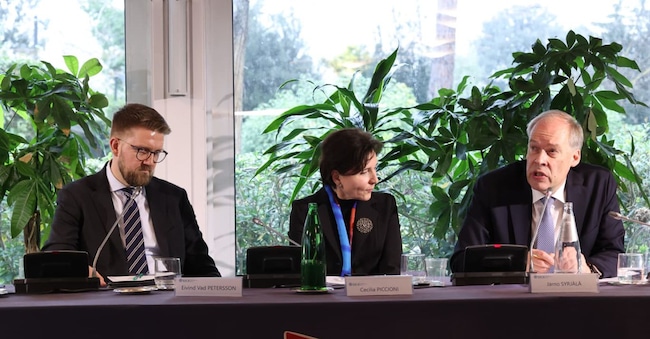
Jarno Syrjälä, Undersecretary for Foreign Trade at the Ministry of Foreign Affairs of Finland, participated in a panel, moderated by Ambassador Cecilia Piccioni, Director General for Political Affairs and Security and Deputy Secretary General of the Ministry of Foreign Affairs. Also speaking on the panel was the Deputy Minister for Foreign Affairs of Norway, Eivind Vad Petersson. 'I am quite sure that there will be cooperation in the area of critical materials,' Syrjälä confided. 'In Finland we have discovered that we are quite rich in them, in minerals of different types and also in rare earths. Just today, later today, we will have a round table, separate from the conference programme, between Finnish and Italian companies where we will raise this very topic, i.e. whether we can have cooperation, whether there will be more dialogue between our players. So from this first round table I foresee that there will be next steps: meetings, tables and so on'.
Scientific research is the prime mover of Italian action in the Arctic and has as its main point of reference the Base 'Dirigibile Italia' in the Svalbard Islands (Norway), active since 1997. "I think there is already an important cooperation between the different universities," Syrjälä said. But we are always eager to look for new ways in this area, especially with regard to high-tech applications in various economic fields. I am thinking, for example, of energy solutions and all these kinds of areas. In addition to the support of the universities, there are Italian companies that have invested in Finland and there are Finnish companies that have invested in Italia, so we can say that there is already a fair amount of exchange between our operators'.


