Midterm elections

Argentina, the 'miracle' Milei at the vote test

Legislative elections for the renewal of the House and Senate

by Roberto Da Rin

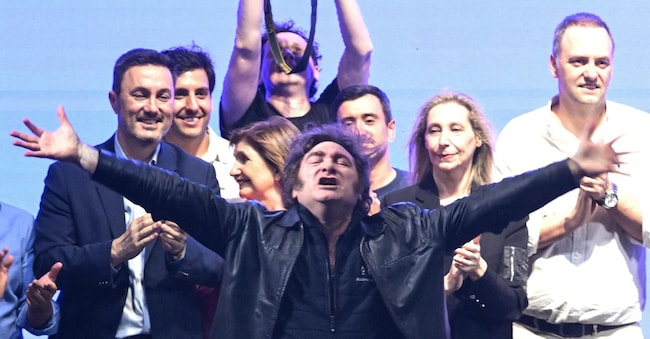
epa12477345 Argentine President Javier Milei (C) reacts during the closing campaign rally of La Libertad Avanza party in Rosario, Argentina, 23 October 2025. Milei closed La Libertad Avanza

4' min read

Translated by AI
Versione italiana

Key points

  • Corruption scandals and the economic crisis
  • The merits of reducing inflation are 'eroded' by welfare cuts
  • Trump's hugs and threats

4' min read

Translated by AI
Versione italiana

Nobody can predict whether the 'machine', pardòn, the chainsaw of Javier Milei, president of Argentina, is irreparably broken or repairable. And therefore able to proceed with the 'deforestation'. A metaphor with which El Leon (that's his nickname), has promised drastic cuts to the welfare state and public spending in Argentina.

On Sunday 26 October, midterm elections will be held, Argentines are called upon to renew half of the House (127 seats, with a 4-year term) and a third of the Senate (24 seats, with a 6-year term), for a new-faced Congress starting on 10 December.

Loading...

An electoral appointment in which the anarcho-capitalist is supported and endured by Donald Trump, who a few weeks ago granted him a $20 billion 'handout', accompanied by lavish praise, which seemed to indicate an indissoluble link between the White House and the Casa Rosada. Too bad that a few days later, punctual as an eclipse, came The Donald's swerve: 'If Milei loses, we'll be out, he'll have to fend for himself'.

In this case, it will not be easy to cross the ford of a political and social crisis that distances the memory of some positive macro-financial results achieved by Milei. First of all, a reduction in inflation, close to 300% in 2023, to 117% in 2024, (Indec data, the Argentine Istat (n.d.r.)) with a forecast of 32% for 2025.

Milei's clear victory in the presidential elections two years ago - largely favoured by a poor performance by the Peronist government of Alberto Fernandez, in tandem with vice-president Cristina Fernandez de Kirchner - was based on declarations and revitalising intentions, but above all on the 'tabula rasa' of widespread collusion and corruption. An unacceptable governance method that, down there at the Fin del Mundo, would have contributed to the sinking of the world's granary-country, capable of producing food for 400 million people and unable to feed 45 million.

Argentina, Milei in piazza prima delle elezioni mid term: scontri tra sostenitori e oppositori

The scandals

Hence the battle against the caste, 'responsible for the desastre', thundered Milei. Too bad the new deal didn't last long and earlier this year several scandals followed one another. The first misstep, by Milei himself, was the promotion on social media of a cryptocurrency that collapsed after a short time. Then the mess of Karina Milei, sister and Chief of Cabinet, who slipped into an alleged corruption scheme in the National Agency for Disability. Finally, the withdrawal of José Luis Espert, Milei's leading candidate in the province of Buenos Aires, who withdrew from the electoral race after admitting to having received payment for consulting services from a businessman arrested for drug trafficking.

The social crisis, which the cuts in public spending have inexorably exacerbated, is the other factor that does not play in Milei's favour. Health, welfare, school, university, are the sectors that have suffered the most striking consequences of the ultra-liberal policy of the government, which moreover had announced 'tears and blood'.

The markets and the polls

Beyond Trump's often contradictory statements, a few days ago the US Treasury Secretary, Scott Bessent, relaunched his intention to support the Argentine peso in the face of the recent speculative attacks. Bessent published a new post in which he reiterated the need for 'a strong and stable Argentina, a good neighbour is explicitly in the strategic interest of the United States' and that he did not want 'another failed state in Latin America'. Market volatility does not seem to take this into account, even in the face of a doubling of the stakes: the confirmation of the $20 billion swap with the US Treasury and the announcement of another possible credit line for another $20 billion with the participation of private banks and investment funds, which would bring the total aid promised by the United States to $40 billion.

Argentine bonds had a positive performance between the end of 2023 and the end of 2024; the country risk had reached a low of 561 in January 2025. But then the crisis in the real economy and political scandals changed expectations and the Argentine country risk stood a few weeks ago at 1,456 points, the second highest in Latin America, below only Venezuela (16,354).

The polls, as always, are divided between those who predict a defeat and those who give credence to a "remontada" by Milei. AtlasIntel, for Bloomberg News, sees it this way: more than half of Argentines (53.7%) disapprove of Milei with 42.4% supporting him. However, AtlasIntel predicts that La Libertad Avanza, Milei's party, will win tomorrow's election despite the fact that its estimated lead over Fuerza Patria, the main Peronist opposition party, has halved since July.

Neither the financial markets, even if backed by billions of dollars from the US Treasury and the International Monetary Fund, nor the conservative bourgeoisie of Buenos Aires, represented by the newspaper La Nacion, seem to believe it too much. Jorge Luis Borges said that 'Peronists are neither good nor bad, they are incorrigible'. Milei is certainly not a Peronist. But one of the stories in the splendid book 'Las mil y una noches peronistas', ediciones Granica, explains that 'in Argentina even the anti-Peronists are Peronists'.

Copyright reserved ©
Loading...

Brand connect

Loading...

Newsletter

Notizie e approfondimenti sugli avvenimenti politici, economici e finanziari.

Iscriviti