
Argotec: production ramp-up with a massive 50 million funding round
First share issue (with Nuo as the investor) for the satellite manufacturer. Avino: “The market has changed; now we have to move quickly.”

“The market has changed radically; now we have to move fast. And so this was the right time to bring in new capital.” A first for David Avino, founder of Argotec, one of the jewels of the Italian Space Economy – a company established in 2008 that, until now, had always operated and invested using its own funds. The funding round that has just been finalised is substantial: a 50 million injection provided by Nuo, an investment holding company focused on the global growth of leading Italian firms.
And this is certainly the case with Argotec, which specialises in the development and manufacture of small satellites; the company was founded less than 20 years ago but already has a strong track record to its name. This includes the successful deep-space missions carried out with NASA, as well as major contracts secured from ESA. This journey has transformed the company founded by David Avino from an ambitious start-up into one of the major players on the European scene, with a workforce of 350 employees. This workforce is constantly expanding, as evidenced by the more than 40 vacancies currently available.
“And we’ll be opening more,” explains Avino, “bearing in mind that, on average, we take on around ten new staff members every week – people who strengthen both our Turin office and our offices in the United States. “Having closed last year with revenue of 57 million, we now expect to exceed 70 million, whilst by 2027 we will rise well above 100 million. But beyond revenue, what matters is the bottom line, which has been in profit for some time now.”
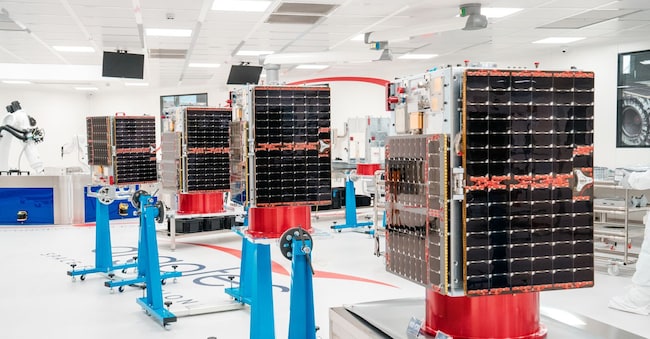
The new funding will be used to launch new services, strengthen the US headquarters and, above all, to increase the production capacity of the large-scale factory – covering 12,000 metres – on the outskirts of Turin, a facility which has enabled the industrialisation of the satellite manufacturing process.
“Today,” explains the entrepreneur, “at our Space Park – a facility in which we have invested over 30 million – we are able to produce one satellite a week, but to keep pace with market demand we want to go further, towards 80 satellites a year. And with these resources, we will move in that direction.”


