Arin the chatbot to help children with special educational needs is born
The project, promoted by the Fondazione Mondo Digitale ETS, in collaboration with IRCCS Fondazione Don Carlo Gnocchi, ITLogiX and Università degli Studi Roma Tre, is aimed at neuropsychiatrists, support teachers, parents, teachers
by Luca Tremolada
 Aggiungi Il Sole 24 Ore
ai preferiti su Google
4' min read
4' min read
It is called Pathway Companion and is the first platform based on artificial intelligence for children with special educational needs. The project, funded by Google.org, is promoted by the Fondazione Mondo Digitale ETS, in collaboration with the IRCCS Fondazione Don Carlo Gnocchi, ITLogiX and the Università degli Studi Roma Tre. It is aimed at neuropsychiatrists, support teachers, parents and teachers and is perfectly suited to the daily support of children between 8 and 14 years of age with reading comprehension difficulties, text comprehension and other special educational needs (BES).
How does it work?
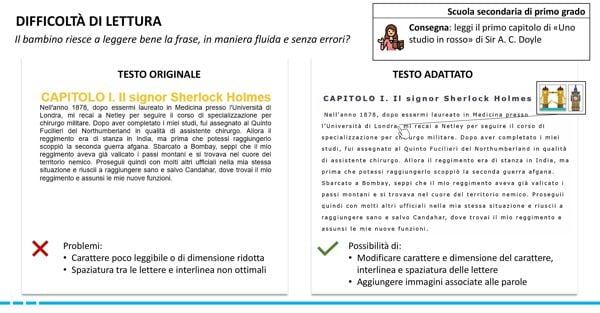
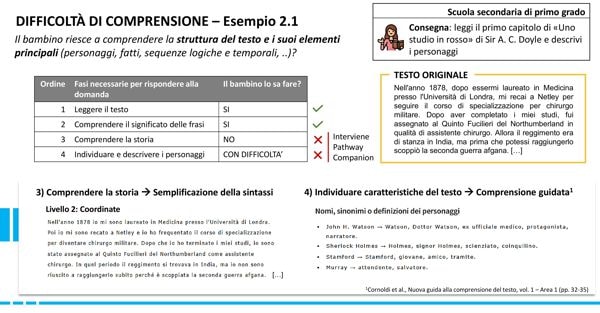
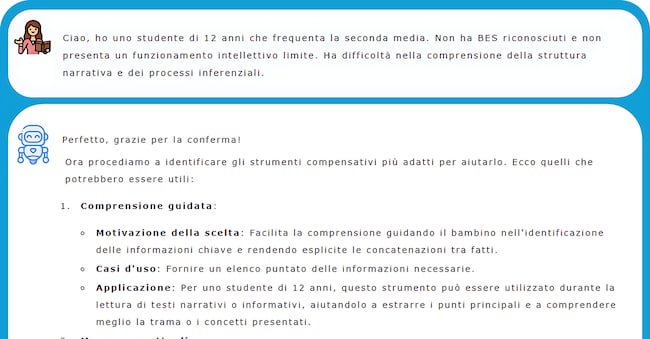
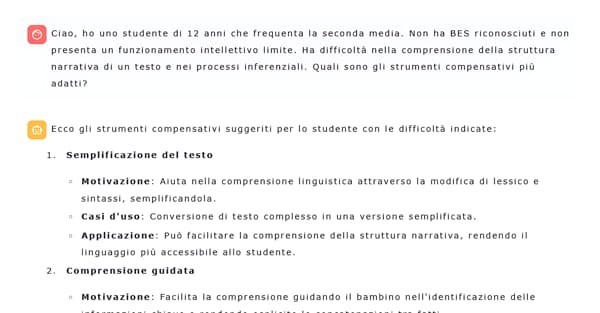
The platform, presented during closed-door demos with Il Sole 24 Ore, was designed together with a team of child neuropsychiatrists. The entry point to the platform is ARIN, the intelligent chatbot - based on ChatGPT - that assists users by exploiting an architecture based on three interconnected generative artificial intelligence engines. The teacher or specialist starts by creating a profile of each individual child with information such as age, class attended and specific difficulties. The pupil profile is entered into the platform, but no identifying data is provided to the artificial intelligence. Based on the training of the model, through conversational logic, ARIN proposes the most effective teaching strategies and compensatory tools to support the student. For example, depending on whether difficulties in narrative comprehension or inferential processes are declared, ARIN will propose a strategy to create customisable teaching content. The teaching material that each teacher can upload onto the platform is 'redesigned' and rewritten according to the specific needs of each individual child, taking into account his or her profile and the strategies identified, e.g. improving readability, comprehension and accessibility (e.g. syntactic simplification, use of images, speech synthesis). The system is able to produce mind maps and teaching sheets in support.
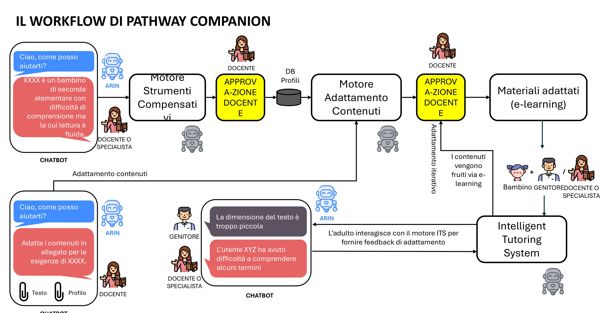
The 'game plan' is that of the human on the loop, which in this case is to be declined as teacher on the loop, in the sense that the teaching materials are those proposed by the teacher and the AI elaboration can be modified by the teacher at any stage, before being proposed to the student and then uploaded on the school's e-learning platforms.
'The teacher is not an obstacle to innovation,' comments Alfonso Molina, scientific director of the Fondazione Mondo Digitale ETS, 'but an integral part of the adaptive process. The system provides data, tracking, indicators of understanding: but it is the teacher, together with the family, who interprets these signals in the real context of the student. And then to ask for the help of an expert."
"In our model, the machine does not judge, but amplifies the ability of the teacher, and the caregiver, to understand and intervene. It is a balance between automatism and humanity, between algorithms and relationships. It is also a sign of responsibility, because with children and with BES you don't just experience technology, you build trust".