
Aristocratic Art at the Magnani Rocca Foundation
The exhibition, Symbolism in Italia. Origins and developments of a new aesthetic is curated by Francesco Parisi and Stefano Roffi

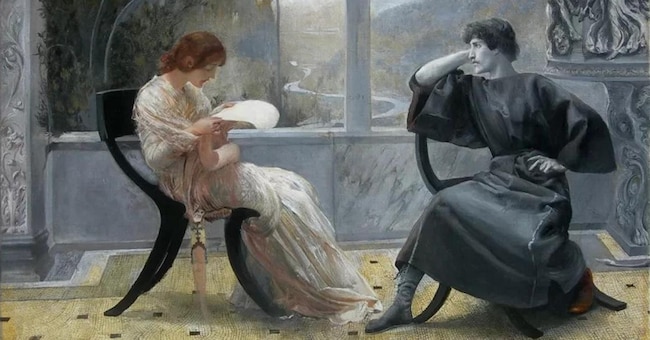
"O Vivïana May de Penuele/ icy virgo prerafaelita,/ o voi che compariste un dì, vestita/ di fino argento, a Dante Gabriele, / tenendo un liglio ne le ceree dita". So sang Gabriele D'Annunzio in Isaotta Guttadauro (1886), in the first quatrain of the magnificent Viviana. The book was the manifesto of that season, in the magnificent guise orchestrated by Vincenzo Cabianca, Giuseppe Cellini, Mario De Maria, the author of magnificent plates full of mysterious and terrible dames (such as the gloomy L'alunna, with a moon-tesque. who wanted to signal himself to the world as Marius Pictor, leaving testimony of himself in the form of architecture in the magnificent house of the Tre Oci in Venice. The female ideal of the Symbolist era in Italia was defined in just a few words, accurately drawing a cultural genealogy.
Symbolism in Italia
Feltrinelli Gramma has recently re-published an important study by Giancarlo Marmori on this season,Le vergini funeste, which greatly investigates European iconography, many years after the first edition appeared at Sugar in 1966. A remarkable exhibition at the Fondazione Magnani Rocca in Mamiano di Traversetolo (Parma) accurately analyses Symbolism in Italia. Origins and developments of a new aesthetic. The exhibition, curated by Francesco Parisi and Stefano Roffi, is accompanied by a catalogue published by Dario Cimorelli Editore (pp. 360, € 30). The paths taken lead first of all to the intersection of the arts that is the main feature of that season. D'Annunzio opens the dances, with the remarkable bust of Paul Troubezkoy, preserved at the Vittoriale. Images of dark magic (such as the beautifulThe Wizard by Edward Burne Jones), go hand in hand with the revival of the Renaissance, well demonstrated by Giulio Aristide Sartorio's Head of a Young Man, inspired by Antonello da Messina. Sartorio created the magnificent frontispiece of The Innocent (1892), while that of In the Dream (1893), is by Giovanni Segantini. In short, we are in the midst of what Vittorio Pica, the ideologue of this season, called Aristocratic Art, in a famous lecture given in Naples in 1892. The classical heritage proposes figures from mythology that come to life in the concreteness of bodies and colours. A red thread is dedicated to Sappho, popular in Europe after Alphonse Daudet's decadent reinterpretation (1884). Especially striking are the orgiastic moments, such as the splendidBaccante, a very provocative sculpture by Ettore Ximenes, and the resplendent A Babilonia (Semiramis) by Cesare Saccaggi from Tortona, chosen as the exhibition's symbolic image. The queen, dressed in white, wearing an elaborate headdress enjoys the evening breeze, with a leopard at her side. As Alcyone had categorically stated, the ancient myth was the bearer of an unbridled eros that transcended conventions and everyday manners. Arnold Böcklin paints Pan among children in a circle, Mario De Maria The Afternoon of a Faun, Eduardo Dalbono places fauns in a geographical dimension in his On the Road to Taranto. The magic of the god of the woods is central in some remarkable Böcklinesque works by Ettore Tito, such as Contadino con capre or Il ratto. In a canvas by Aroldo Bonzagni, very bright in form and colour range, Il toro sacro, a naked maiden with long hair is in the grip of an ecstasy as she caresses the animal's head. There is also no shortage of beautiful and often ominous female creatures, such as the repertoire of mermaids, ranging from the magnificent Green Abyss by Giulio Cesare Sartorio (at the Pinacoteca Ricci Oddi in Piacenza), The Octopus, also by Saccaggi, and Nymph by Cesare Laurenti or the numerous Medusae, including the disturbing one in plaster by Arnold Böcklin and Peter Bruckmann. Also in evidence are the sombre panels by Alberto Martini, who was at the court of the Marchesa Casati Stampa for a long time and painted many different costumes. Ladies of the waters abound, such as The Waves by Ettore Tito, The Daughters of the Rhine by Glauco Cambon. A repertoire of resplendent images of myth as an exit from the everyday, therefore, which affirmed industrial progress as the sole purpose of existence. The exhibition closes the story in 1915, because with the outbreak of the World War, although certain resonances remained alive (such as those in the works of Raoul Dal Molin Ferenzona, faithful all his life to his Symbolist imagery, an artist studied by Emanuele Bardazzi), the imagery of reference changed decisively and the clamorous and complex season of the modern era flared up.

