The book

How Aristotle's philosophy illuminates the role of the modern manager

The thought of the great Greek philosopher offers keys to guide companies and teams with wisdom, vision and responsibility in a contemporary working environment

by Massimo Donaddio

4' min read

Translated by AI
Versione italiana

4' min read

Translated by AI
Versione italiana

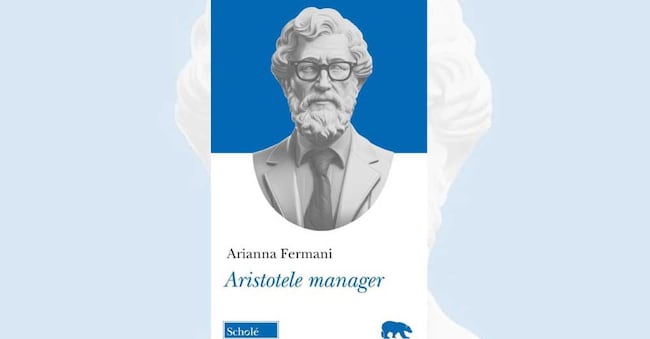
Certain authors not only never fade away, but, with time, continue to be useful in new ways and meanings, in contexts perhaps different from those that gave rise to their intellectual endeavours, so much so that their reflection and elaboration has been capital for the history of our culture and civilisation. One does not need to know Aristotle's life and works perfectly to know that the great Greek philosopher was one of the pillars of ancient thought, whose light reached far and wide, crossing the centuries and different contexts of Western history. Arianna Fermani's beautiful booklet, Aristotle manager (Scholé editions), projects the thought of the Stagirite (as the philosopher was called in school books) even into the company, grappling with HR departments and employees to be motivated to the best of their ability.

Obviously, Aristotle could know nothing about how a modern company is conceived, but as a thinker who observed and reflected deeply on all human knowledge, the key concepts of politics and economics, as well as those of ethics, to which he devoted no less than three major books, were by no means foreign to him.

Loading...

The author of the text, a lecturer in the history of ancient philosophy at the University of Macerata, takes us on a journey through the very rich Greek language - the language of Aristotle - in search of the profound meaning of words that, while supporting the Hellenic philosopher's arguments, also bring out meanings that are valid for us today.

It is a strand that is proving to be effective and productive, that of summoning the wisdom (or rather, the wisdom) of the ancient philosophers and having it confronted (indirectly) with the problems of today's man, in particular with the stresses coming from the world of work and business. The 'timeless' reflections of the great thinkers actually have something to say even in the age of post-modernity.

Going down to the concrete and using Aristotelian arguments, the manager, then, is the one who is capable of 'leading by the hand', of governing, disciplining, but also 'taking charge', giving order to the whole (company).

He is called upon to have vision, to look at the whole (like an architect) but also to look far ahead, establish the goal, identify the meaning of the work and give direction to his team. A task not too different from that of a philosopher, who would have thought?

The role of 'order-giver', which the author assigns to the manager, is a typical characteristic that derives from the Greek, and Aristotelian, way of reasoning in particular: to give order to the whole (in our case, to the company), so that it can function at its best, can be beautiful and good (in the sense of 'healthy').

From Aristotle, moreover, comes an indication of success, which all managers must strive for in some way: this is never given 'for free', but implies commitment, constant application, assiduity and discipline. Success based on commitment, however, will give a sense of achievement to oneself and to the community (the company) of which one is a part and for which one works. It will require the right technique, virtue and wisdom (a central and very significant term in Greek philosophical culture): the manager is like a skilful conductor who directs a precise score, is able to distribute and assign roles and tasks correctly, drawing a symphonic unity from all the various elements. His 'wisdom' will enable him to make the correct decisions and choices that will have an outcome in line with the objective he has set himself; his experience will enable him to combine vision with strategy, while knowing that 'fate' may also get in the way of his objectives in some way and that, therefore, all risks must be well calculated.

The author rightly points out that it is not so easy to reduce to the Greek way the multiplicity of situations - sometimes even contradictory - that are involved in the life and activities of a company. Here, too, however, the manager is the one who knows how to discern, distinguish and separate the various aspects in order to reach the best conclusion: he uses wisdom to hit the right targets and make the most appropriate decision, always, however, bearing in mind the context and the good of the community (the company), also represented by the individuals who are part of it (colleagues, employees and collaborators, we would say today).

A manager will be fortunate, therefore, to the extent that he is successful, not the other way around: for Aristotle, in fact, fortunate "is he who has achieved the ultimate goal of his existence, he who, by acting rightly and wisely, has built the foundation of his own happiness and success", writes the author. But, even more so, the manager will have to 'make sense' of his team's work, because it is not so much the fatigue that makes one unhappy, as the lack of meaning of what one does, the lack of direction and purpose, a clouded and obscured vision of the future.

To sum up, then: the manager-philosopher is the one who is capable of looking at the whole (of a problem, of the company) but does not forget the parts of which it is made up, is capable of directing them by taking charge, towards a goal. He inspires trust, he is reliable and credible and inspires his employees to believe in themselves. He loves his work, considers it a source of liberation and fulfilment, but does not let himself be carried away by the thirst for wealth, because he knows that wealth is not the ultimate goal of life, if it is to be good. He knows that the good and beautiful things in life cannot be bought, and he gives economy the - high - value it deserves, even though he knows that it is only an (important) part of life, but not the whole of life.

Arianna Fermani

Aristotle manager

Morcelliana Scholé, 144 pages, 15 euro

Copyright reserved ©
Loading...

Brand connect

Loading...

Newsletter

Notizie e approfondimenti sugli avvenimenti politici, economici e finanziari.

Iscriviti