
Aronofsky rewrites the rules of crime
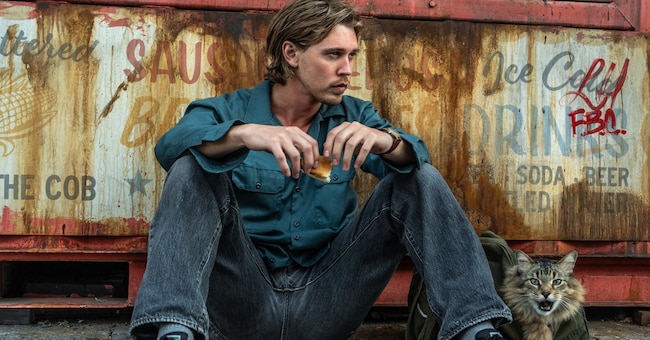
'An Uncomfortable Circumstance - Caught Stealing' stars a former baseball phenom turned bartender (Austin Butler)

3' min read
3' min read
Anyone who frequented Rivington Street or Avenue D in the 1990s is familiar with the stark colours, the diners, the car parks, the burning buildings of "the world's largest retail drug market", a deadly quadrangle of upside-down, rotting letters, to which Darren Aronofsky chooses to return, twenty-five years after filming π - Theorem of Delirium among the fabrications of Bushwick, Brooklyn, with much of the same crew. "New York in the 1990s was a kind of peak of humanity," he tells us candidly. "The Soviet Union had collapsed, 9/11 hadn't happened yet, the biggest threat was Y2K and our president was at the centre of controversy because he may have been having an extramarital affair. We didn't know it yet but, those years captured the last moment of innocence of a great power'.
Whatever happened, then, to American optimism? This is asked by An Inconvenient Circumstance - Caught Stealing, Aronofsky's adaptation (for Sony Pictures) of Charlie Huston's '98 novel about a former baseball phenom turned bartender (Austin Butler) with a cat left to him by his punk-rock neighbour (Matt Smith). Before long, Hank Thompson finds himself with a handful of gangsters on his tail: a merry ethnographic brigade of criminal gangs, mobsters and Orthodox Jewish hitmen (played by Liev Schreiber and Vincent D'Onofrio), interspersed with Shabbat dinners, Yiddish lessons and an elegiac, far-flung East Village. 1998 was not just a year but a worldview, a configuration of possibilities and threats, photographed, drawn and cut out for the eyes by cinematographer Matthew Libatique, set designer Mark Friedberg and editor Andrew Weisblum.
For Austin Butler (Elvis), the role is the fulfilment of an unlikely artistic prophecy. At the age of twelve, cast in a student film as a dog who turns into a boy, he had met a self-styled director whose filmmaker of the heart was Darren Aronofsky. "Requiem for a Dream thus became my initiation rite into cinema," he says, smiling. "Ever since I was a kid, I had this woodworm in my head: sooner or later I'm going to work with Darren, sooner or later I'm going to work with Darren...". Butler's physicality required careful calibration, between action hero and a limp Buster Keaton. "I trained with trainer Julia Crockett; I never realised how much of a comedian or tightrope walker you can become, when you're running from angry goons or getting hopelessly drunk. Not surprisingly, I love clown work. I would like to learn the job of a clown and work in a circus, sooner or later'.
After her directorial debut with Blink Twice, Zoë Kravitz brings her perspective on art as moral excavation. "In Darren's film I have a small part, I'm Hank's girlfriend, but as an actress and director I'm always more drawn to the exploration of power. I think art cannot exist without empathy and risk,' Kravitz reflects.
Set designer Mark Friedberg, whom the director characterises as a 'philosopher designer', is on his third project with Aronofsky after Noah and The Whale. He has collaborated with graffiti experts and publicists to recreate the dizzying urban New York of '98, even more outlawed and out-of-whack when the notes of British post-punk band Idles ignite, a temporal collision described by frontman Joe Talbot as "a lucid dream". The Idles not only contributed four original tracks, but recorded the entire soundtrack composed by Rob Simonsen.

