Major investigation

Arrests over online child pornography; 34,000 images and 22,000 videos discovered. The prosecutor: a horrific criminal phenomenon

Six precautionary measures, one suspect taken into custody and 10 people arrested in the act for possession of a large quantity of material

 Mimmo Frassineti / AGF

6' min read

Translated by AI
Versione italiana

6' min read

Translated by AI
Versione italiana

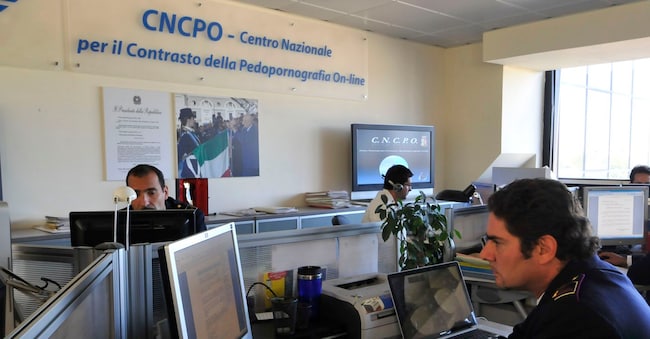
A complex investigation launched in 2024 as part of the State Police’s ‘Fly Trap’ operation, coordinated by the District Anti-Mafia Directorate of the Public Prosecutor’s Office at the Court of Rome and led by the National Centre for the Fight against online child pornography of the Postal and Cyber Security Police Service, has led to the execution of six precautionary measures, the detention of one suspect and the arrest of ten people caught in the act of committing a crime for the possession of a substantial quantity of child sexual abuse material, following 23 searches of premises, personal belongings and computer systems ordered by the Public Prosecutor’s Office against the suspects, both as administrators and as ordinary members, of the criminal organisation dedicated to the possession, trade, dissemination and promotion of large quantities of child sexual abuse material that is the subject of this investigation.

The investigations were launched by the Postal Police in 2024 following information shared, as part of international cooperation, by the US agency Homeland Security Investigations (HSI) regarding the presence on Telegram of a private group called ‘New Saga’, dedicated to the distribution of child sexual abuse material. The investigative work carried out, together with an analysis of the cryptocurrency transactions used to access the group, led to the identification of one of the administrators, a 24-year-old man from Campania, who was subsequently subjected to a personal, premises and digital search in May 2024, and to launch a complex operation carried out undercover.

Loading...

Prosecutor Lo Voi: a horrific criminal phenomenon

 “A trade unworthy of minors”. This was stated by Rome’s Chief Public Prosecutor, Francesco Lo Voi, during a press conference at the offices in Piazzale Clodio to outline the results of the investigation that led to the arrest of 17 people accused of being part of an organisation dedicated to the online distribution of child pornography.

“It was a particularly important investigation, and not just because of the figures involved. What we uncovered was an organisation with a structure comparable to that of a multinational company, with key figures acting as directors,” explained the head of the Rome-based investigation team, stating that “the decisive factor was the ability of an officer who managed to infiltrate this organisation and gain its trust to the point of becoming a director” of the group himself, added Lo Voi.

“A horrific criminal phenomenon has come to light,” he continued, “in which ‘the organisation had over a thousand users worldwide, including more than 20 in Italia, who paid with cryptocurrencies to gain access to the content’ – between 3 and 9 dollars a month.” The “disturbing fact is the revelation concerning the very young age of the organisation’s members and their ability to generate money for this appalling criminal phenomenon”, Lo Voi pointed out.

Investigative work

To be more specific, gthanks to the investigative work, which continued uninterrupted from 2024 to 2025 with the collaboration of the US agency HSI and in coordination with the competent public prosecutor’s office, specialist staff from the C.N.C.P.O managed, over time, to build a relationship of trust with the administrators, eventually gaining the status of ‘co-administrator’ within the various child pornography groups – often created in different versions, after they were shut down, with imaginative names to ensure their anonymity and recognisability only to participants (New Saga-La Zanzara 2, with versions 3 and 4 – renew).

To avert the risk of surveillance by law enforcement agencies, the administrators used ‘exclusive private channels’ for the exchange of information and organisational matters; one of these was named ‘La Sala dei Re’ (The Hall of Kings), to emphasise the context of power within which the administrators of the Telegram groups believed they were operating. The investigations have documented in detail the existence of a complex organisation comprising various administrators tasked with managing and promoting the various groups created for the distribution of child sexual abuse material, as well as setting up related services to ensure anonymity and encrypt the content, including cloud storage and virtual servers, content moderation, and the creation of bots – automated programmes capable of managing the large number of users – to ensure the continuity of the community even in the event of groups being shut down or accounts being lost.

How the network worked

The investigation revealed the existence of a private, structured and organised online community, governed by strict rules, comprising over 1,009 participants, accessible via a dedicated link posted to attract more users, whose membership was granted upon payment of small sums of money in cryptocurrency (referred to as ‘donations’) or the sharing of new child pornography material.

Members received direct and constant support from the organisers, including the sharing of IT resources necessary to ensure anonymity and safeguard the illicit material being circulated – including in encrypted form – to prevent its loss. The methods employed by the administrators had led to an increase in the volume of child sexual abuse material available in the databases. During the undercover operation alone, investigators seized approximately 282.9 gigabytes of illegal material, comprising over 22,000 videos and 34,000 images.

The investigations, carried out using advanced and innovative de-anonymisation techniques, made it possible to identify the individuals involved and gather circumstantial evidence to support the Rome Public Prosecutor’s Office’s request for six pre-trial detention orders, which were issued by the Rome Investigating Magistrate, one of which was replaced with house arrest due to the suspect’s state of health. These orders were executed on 15 September against three Italian directors, resident in the province of Naples, Barletta and Verona, and a Swiss national, as organisers/promoters; and against two individuals, resident in the provinces of Messina and Genoa, as accomplices, for having shared and stored a substantial quantity of child sexual abuse material in a digital archive.

Loading...

The 22 Italian users, 10 of whom were also actively sharing material, were subject to searches of their premises, personal belongings and computer systems. The operations, carried out on the same day, culminated in the arrest of 10 individuals caught in the act of committing an offence, as they were found in possession of a substantial quantity of child sexual abuse material, videos and images of children, some of very young age; the illegal material had been skilfully concealed, was difficult to access, and protected in folders—some of which were encrypted—to prevent its discovery; the exact quantity is still being quantified. Among those arrested in the act were six individuals resident in the provinces of Turin, Milan and Padua, and one each from the provinces of Fermo, Cagliari, Palermo and Treviso; few of them had specific criminal records, whilst others were perpetrators who appeared above suspicion.

The enforcement of these measures involved over 100 specialist officers from the Postal and Cyber Security Police, drawn from the Operational Centres and the respective Operational Sections in Ancona, Bari, Bologna, Cagliari, Catania, Florence, Milan, Naples, Palermo, Rome, Turin, Trento and Venice, with the collaboration of staff from the relevant regional forensic police units, as well as the presence, in an observational capacity, of HSI officers at locations deemed to be of particular operational interest.

The seized material

A substantial amount of IT equipment was seized, comprising around 200 devices (smartphones, tablets, PCs, hard drives), along with illicit child pornography material confiscated from international markets and trading platforms. The judicial cooperation initiated to carry out the detention order and the search of the premises, personal effects and electronic devices, conducted by the Cantonal Police against the Swiss national, with the participation of two officers from the CNCPO and in collaboration with staff from the International Police Cooperation Service, has enabled the acquisition of further investigative evidence leading to the identification of another administrator, whose profile had already come to light due to his active involvement – as also noted in the evidential documentation underpinning the detention order.

On the night of 16 September, the suspect, a 26-year-old man with no previous criminal record, who was located in the Province of Cremona following a search carried out by officers from the Lombardy Cybercrime Police, was taken into custody on suspicion of a criminal offence pursuant to an order issued very swiftly by the judicial authorities in Rome. During the course of the investigation, 996 accounts linked to foreign countries were also identified; the findings of this investigation were shared by the C.N.C.P.Either to the competent authorities, via international cooperation channels, with operational and intelligence support from Europol and the collaboration of Interpol, to initiate procedures for identifying victims and ensuring their safety in accordance with cooperation protocols. Several countries have engaged in international cooperation with the C.N.C.P.O. to exchange information, leading to the arrest of individuals identified on the ‘New Saga’ group, which is no longer active.

Copyright reserved ©
Loading...

Brand connect

Loading...

Newsletter

Notizie e approfondimenti sugli avvenimenti politici, economici e finanziari.

Iscriviti