Food trends

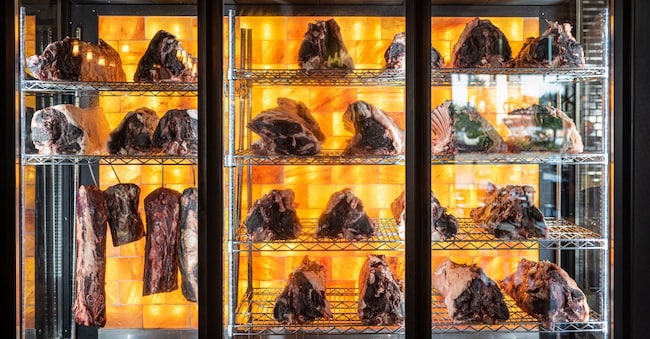
Premium meat arrives: aged like wine, matured steaks exceed 180 euros per kilo

Growing trend in 'dry aged' meats with dedicated sommeliers. Super-ripened meats get a positive opinion from Efsa

by Giorgio dell'Orefice

3' min read

Translated by AI
Versione italiana

3' min read

Translated by AI
Versione italiana

The key word is not a beautiful one, premiumisation, plus as a term borrowed from English many will turn their noses up at it, but this is what is happening in the wake of what has already been done for a long time by wine, in the meat sector with the creation of the dry aged steak segment. Exactly as in wine, it is also a question of creating a premium segment by playing on the time factor and thus on ageing to achieve greater profitability. It is in this way that the method of extreme ageing dry aged transforms steak into a sensory experience, in effect into a luxury good that can fetch more than 180 euros per kilo. Basically, it is a dry-aged process for periods of more than 15-20 days and can be up to three months or even a year.

Meat Sommelier

A trend that is going hand in hand with the appearance of meat sommeliers in restaurants or the showcases dedicated to premium ribs in restaurants and even supermarkets.

Loading...

The numbers

The beef sector in Italy, according to ISTAT, has a turnover of EUR 12.8 billion in production and EUR 28.5 billion in consumption and could make a further quantum leap with the take-off of a premium segment.

The Authority's go-ahead for extreme ripening

On the other hand, 'super-rolling' has also received the green light from Efsa, the European Food Safety Authority based in Parma, which has clarified that the consumption of dry-aged meat 'is as safe as that of fresh meat, provided it takes place under controlled conditions of temperature, humidity and ventilation, in electronically controlled millimetre cells'.

Costs and races

According to some estimates, this market segment can reach a share of up to 15-20% of the total turnover, guaranteeing operators a price plus of up to 45% compared to the average. As far as breeds are concerned, the dry aged meat segment is testing the 60-day Black Angus that has a quotation between 55 and 75 euro/kg, the Chianina Igp or the 90-day Spanish Rubia Gallega that can reach 115 euro/kg, up to the Elite selections of 120 days between 130 and 180 euro/kg.

"Supertuscan" also in meat

Amongst the experiments to be reported is the case of long-aged Fiorentine T-bone steaks that could thus define a 'Supertuscan' category also in meat and not only in wine. Perhaps to be tasted in combination for the more affluent.

Fresh meat or cold cuts?

In the meantime, the debate is raging between the production and catering sectors as to whether this new zootechnical product, due to its seasoning, should still be categorised in the fresh meat or cured meat segment. "Technically," explains the director of Assica (the association of cured meat industrialists) Davide Calderone, "the legislation (EU Regulation 853/2002) differentiates between meat preparations and meat products. The first are kebabs, hamburgers, sausages. The latter are cold cuts, which by regulation 'must lose the characteristics of fresh meat . Steaks dry aged, once the superficial, oxidised part has been removed, are in fact meat and not meat products'.

Demand for quality meat is growing

"The growing attention to 'dry aged' meat reflects an increasingly conscious demand for high quality beef," explains Assocarni director François Tomei, "and restores value to a product that for years was treated as a mere commodity. We look favourably on this trend, which contributes to the qualification of the entire beef supply chain'.

This is not marketing but the recovery of a tradition

This is not a fashion or marketing operation, but the recovery of a technical and cultural concept that has always been part of the meat tradition: maturation.

'For a long time,' added Tomei, 'the market has favoured a product perceived as 'very fresh', often to the detriment of a natural and fundamental process such as maturation, which is indispensable for developing tenderness, taste and aromatic complexity. In the Italian context, characterised by a production deficit of around 37% in beef, as Assocarni we are strongly committed to the relaunch of national breeding and production. And even a premium niche such as this can contribute to enhancing the value of quality Italian meat, which has the potential to compete, in taste and tenderness, with the most noble European breeds. Finally,' concluded Tomei, 'in a framework of overall stable consumption, the added value expressed by 'dry aged' meat can reflect positively on the entire supply chain, encouraging producers and favouring a more adequate economic recognition of quality'.

Copyright reserved ©
Loading...

Brand connect

Loading...

Newsletter

Notizie e approfondimenti sugli avvenimenti politici, economici e finanziari.

Iscriviti